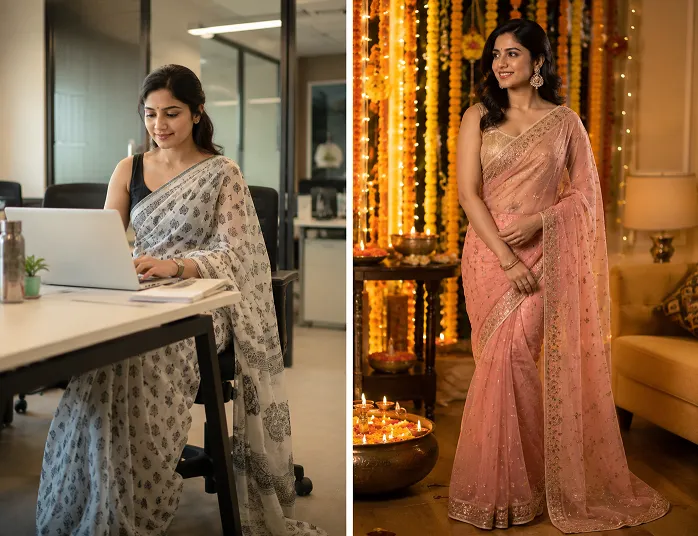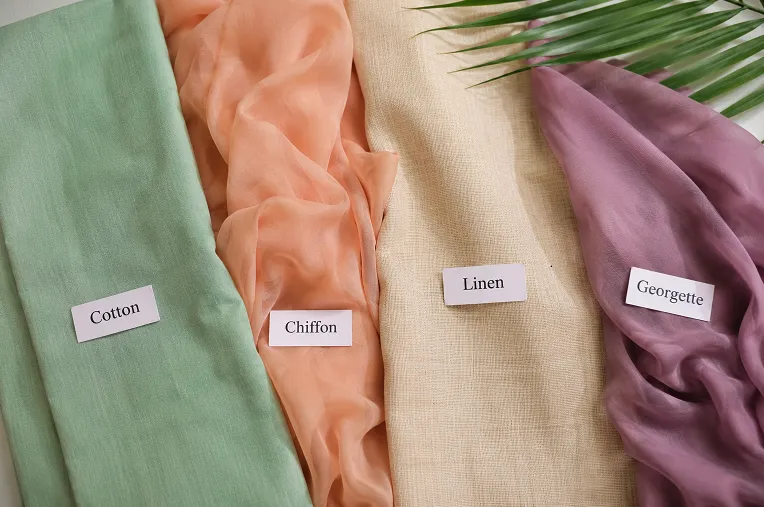
A saree seller in Surat’s textile market once told me something that stuck with me. Two sarees can hang side by side looking almost identical, yet one costs three times more than the other. The price makes no sense until you understand what actually happened on the loom before either one reached the shop.
Most articles describe weaving in the same vague, poetic way, warp and weft, the patient weaver, the rhythmic shuttle, without explaining why any of it holds the fabric together or why it changes what you pay.
This piece breaks down how a saree is woven in real mechanical terms, the kind that actually helps you when you’re standing in front of two sarees trying to decide which one is worth the money.
Table of Contents
From Yarn to Loom: What Happens Before the Weaving Even Starts
Before a single thread crosses another, the saree weaving process starts with degumming, dyeing, and winding the yarn. Silk yarn especially needs this because raw silk carries a natural gum called sericin, and it has to be washed out with soap and soda before the yarn will take dye evenly.
Run raw silk between your fingers before this treatment and it feels almost sticky and rough. After degumming, the same yarn turns smooth, cool, and slightly glossy, which is the texture you actually recognise as silk.
The weaver then separates yarn into two roles. Warp threads run the length of the fabric and get wound tightly onto a beam under tension. Weft threads run across the width, carried by a shuttle.
This is the over-under crossing most people picture when they think of weaving. Surat’s own textile market runs on this exact same warp-weft logic, whether it is a power loom churning out yardage in a factory or a small handloom unit tucked in a lane behind the market, weaving one saree over several days.

Why Interlacing Actually Holds a Saree Together
Here’s the part almost nobody explains properly. Interlacing is not just decorative crossing. Every time a warp thread goes over a weft thread and then under the next one, it creates friction in two directions at once.
One thread pulls against its neighbour from both sides. Multiply that by thousands of crossings across a saree’s length and width, and you get a structure that resists coming apart, because no single thread can move without dragging the threads around it.
That’s the whole trick, and it’s the real mechanical answer to how a saree is woven strongly enough to survive years of daily wear.
This is also why a tightly woven fabric survives years of ironing, folding, and being pulled out of a cupboard in a hurry, while a loosely woven one starts showing gaps at the same stress points within a single season.
Everyone assumes a heavier saree is automatically a stronger one. Actually, weight has very little to do with it. A dense, tightly interlaced lightweight georgette can outlast a loosely woven heavier fabric by years.
That’s something more women should know before they equate weight with quality, the way they do when reading through this guide to types of sarees in India.
How a Saree Is Woven, Step by Step
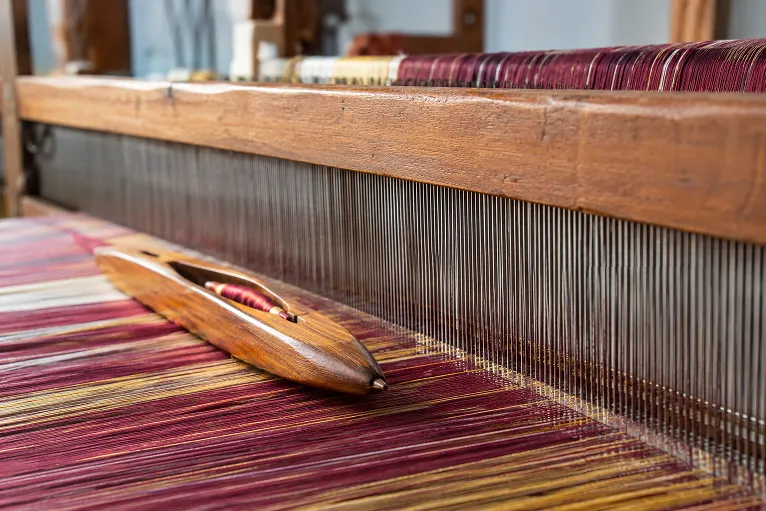
Once the warp is set on the loom and threaded through the heald and the reed, the saree production process becomes a repeating cycle of three motions, done thousands of times over.
- Shedding: the loom lifts alternating groups of warp threads to open a gap, called a shed, for the weft to pass through.
- Picking: the weft thread, wound on a small spool inside the shuttle, is thrown or pulled across that open gap from one side to the other.
- Beating: the reed swings forward and presses the newly placed weft thread firmly against the fabric already woven, closing any gap between rows.
- Rolling forward: once enough cloth has built up, it rolls onto the front beam while fresh warp releases from the back, ready for the next cycle.
On a traditional pit loom, the weaver’s feet control the shedding through pedals while both hands manage the shuttle and the beating comb at the same time.
Watch an experienced weaver for more than a few minutes and the rhythm looks almost musical, the clack of the shuttle followed by the steady thud of the reed, over and over.
Before the yarn even reaches this stage, it usually goes through a dyeing process, and whether that colour comes from a natural source or a chemical one changes both how it behaves on the loom and how it ages, something covered in more depth in this piece on natural dye versus chemical dye.
Why a Jacquard Weave Can Carry a Motif a Plain Weave Never Will
A plain or pit loom lifts the entire warp sheet together in one or two large groups. That works fine for a solid colour or a simple stripe.
But it physically cannot create an intricate floral motif or a detailed border, because every thread in a group has to move the same way at the same time.
A jacquard mechanism changes that completely. It controls each warp thread individually through its own cord, guided by a punched card or, on modern looms, a digital pattern file. One thread lifts while its neighbour stays exactly where it is.
An engineering reference from ScienceDirect explains that a jacquard mechanism allows far greater patterning freedom than a simple shaft-controlled loom, because each warp end is guided by its own hook instead of a shared shaft.
That single mechanical difference is the entire reason complex motifs exist on fabric at all, and it changes how a saree is woven from a simple striped cotton to an intricate silk brocade.
This is exactly why a woven-in motif on a Banarasi or any jacquard saree feels raised and structural under your fingers, not flat like a print.
It also survives decades folded away in a trunk without cracking or peeling the way a printed design eventually does, because the pattern lives inside the yarn structure, not on top of it.
Most people assume a heavily embellished saree is automatically hand-embroidered work. Often it isn’t. It’s the loom doing something a needle never touched, and that distinction matters more than most shop tags admit.
Why Some Sarees Take a Day and Others Take a Month
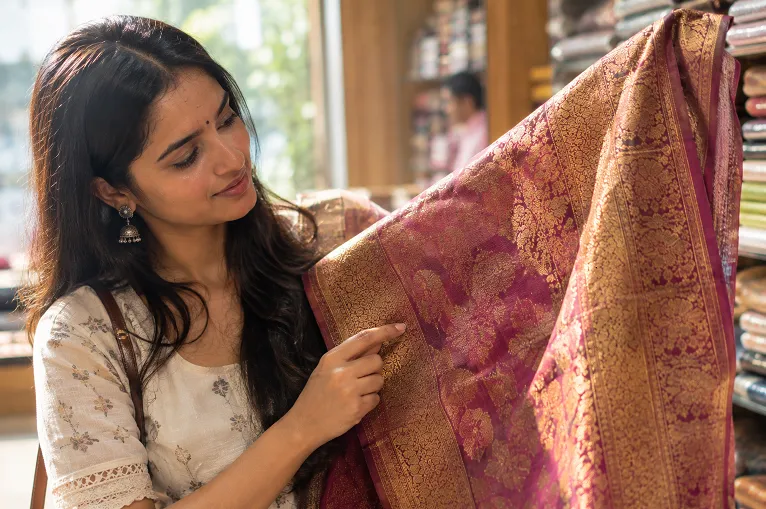
Thread density, meaning how many warp and weft threads are packed into every inch of fabric, is one of the biggest things separating an 800 rupee saree from an 8,000 rupee one. More threads per inch means more crossings, more friction, more durability, and also far more time on the loom.
Handloom saree making moves at its own pace. A finely detailed piece, especially one with zari work or a dense jacquard motif, can take a skilled weaver an entire day to produce just a few inches of fabric.
A full six yard saree with heavy border work can realistically take three to four weeks of one weaver’s time, sometimes longer for elaborate pallus.
Put a number on it and the range gets even clearer. Simple cotton weaving can wrap up in a few days on the right loom.
An intricate Paithani or a heavily worked Banarasi piece can add up to well over a hundred hours of hands-on skilled labour, spread across three to twelve months from start to finish.
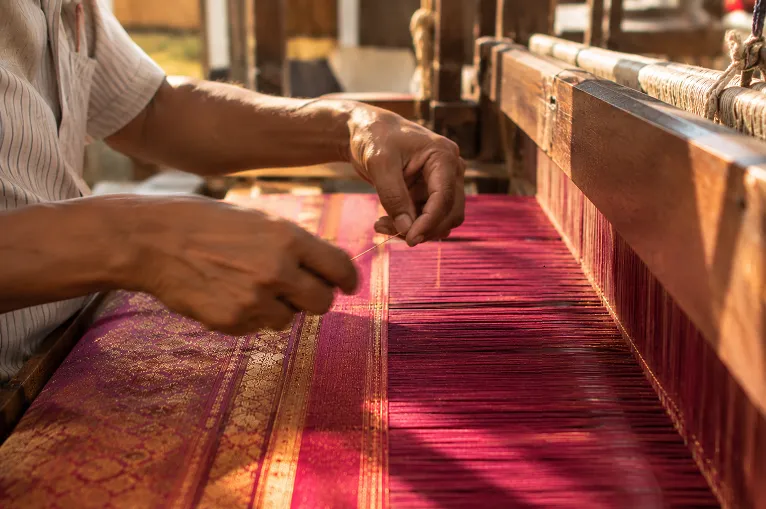
Most women look at a handloom saree’s price tag and assume they’re being overcharged. That’s usually the wrong read. You’re paying for weeks of one person’s actual labour, not a random markup someone invented.
Banarasi silk in particular is heavier than most women expect. If you’re wearing it through a full day wedding function, the weight resting on your shoulder from the pallu will start to show by evening. That’s simply the trade-off for that density and durability.
Anyone deciding between a heavier handloom silk and a lighter option for a long event should read up on saree versus lehenga for a wedding before locking in a choice.
What Actually Matters Before You Buy a Handwoven Saree
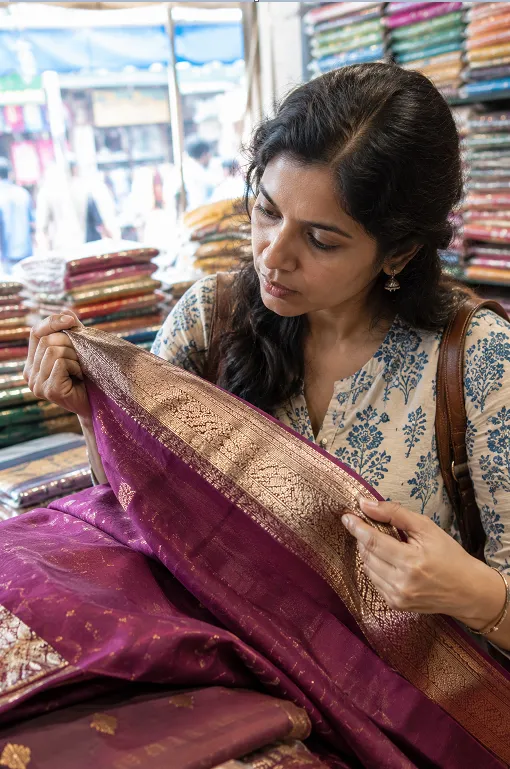
Before you pay a premium for “handloom,” run your fingers along the reverse side of the border. Genuine handwoven work carries small, human irregularities, a slightly uneven float here, a faint variation in tension there, unlike the machine-perfect uniformity of power loom or printed fabric.
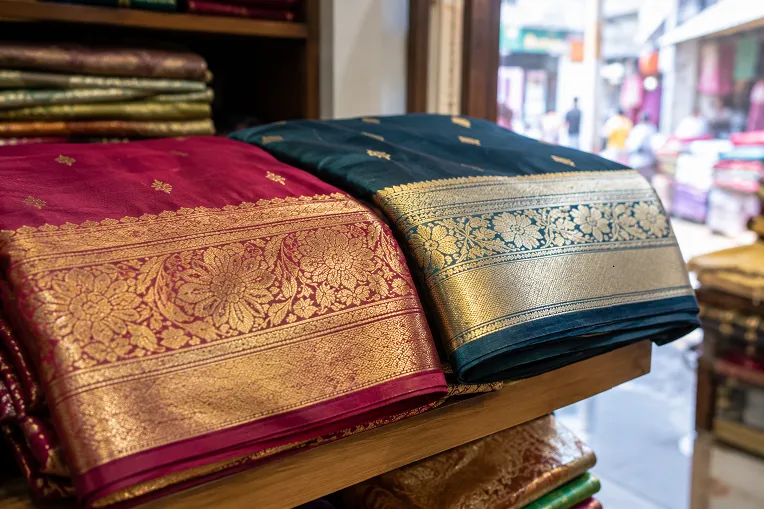
Zari is another place where price quietly gets decided. Real zari uses actual silver or gold-wrapped thread, and it carries a softer, slightly uneven metallic sheen once you look closely.
Imitation zari uses metallic polyester or a plastic-coated thread instead. It looks similar under shop lighting, but it reflects light in a flatter, far more uniform way, and it usually feels stiffer between your fingers.
The Government of India runs its own handloom mark scheme for exactly this reason, to certify that a labelled product was genuinely made by hand. Ask how long a piece took to weave, not just what it’s called.
Knowing how a saree is woven, and how many hours actually went into it, is the fastest way to judge whether the price in front of you makes sense.
This is the kind of detail Surat textile manufacturing units deal with daily.
At Ethora, we manufacture sarees, salwar kameez, kurtas and lehenga choli directly at our own unit in Surat, and everything outside that range comes straight from Surat’s local textile market, so the answers we give come from people who actually sit with these fabrics every day.
The Real Takeaway
The next time you’re weighing two similar-looking sarees, check the back of the border with your fingers before you even glance at the price tag. That one habit tells you more about what you’re actually paying for than any label on the shelf.
There’s a lot more to explore on the Ethora blog if you want to go deeper into specific saree types, fabrics, and how to store or style them once you own them.
Our own store is launching soon, and everything on it will come directly from Surat’s manufacturing floor, the same one behind everything explained here.
Frequently Asked Questions (FAQs)
How long does it actually take to weave a saree?
It depends entirely on the weave. A simple cotton saree on a power loom can be done in under an hour, while a dense handloom silk saree with heavy border work usually takes two to four weeks.
Some double ikat weaves like Patola take months, because the yarn itself has to be dyed into the pattern before the weaving even starts.
What’s the real difference between a handloom and a power loom saree?
A handloom saree is woven manually, one weft thread at a time, with the weaver’s own hands and feet controlling the process. A power loom performs the same interlacing mechanically at far higher speed.
Handloom pieces usually carry small natural irregularities that power loom fabric doesn’t, and that’s part of what you’re paying for, not a flaw.
Can I tell if a saree is genuinely handwoven just by looking at it?
Mostly yes, if you know where to look. Check the reverse side of the border for slight unevenness, and feel for a woven motif with your fingers, since a genuinely woven design has texture while a printed one stays flat.
Machine-perfect symmetry across all six yards usually signals power loom production, not handloom.
Where can I buy good quality handwoven sarees online without overpaying?
Look for sellers who can actually tell you the fabric’s thread density and where it was made, not just a fabric name.
Ethora manufactures sarees, salwar kameez, kurtas and lehenga choli directly at its own Surat unit, and sources everything else straight from Surat’s textile manufacturers, so you get factory level pricing and real fabric knowledge instead of a reseller markup.
Now that you know what separates a fast power loom saree from a piece a weaver spent weeks on, you’re in a much better position to shop with your eyes open, not just your budget. Ethora manufactures sarees, salwar kameez, kurtas and lehenga choli directly at our own unit in Surat, and everything outside that range comes straight from Surat’s local textile manufacturers themselves. Our store is launching soon, bringing that same factory-level fabric knowledge straight to you.