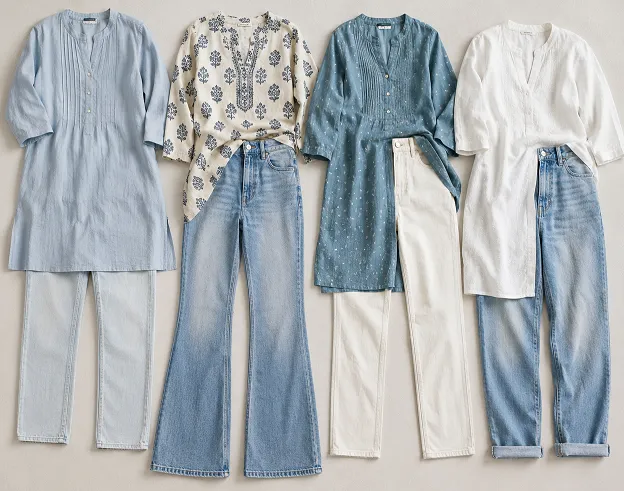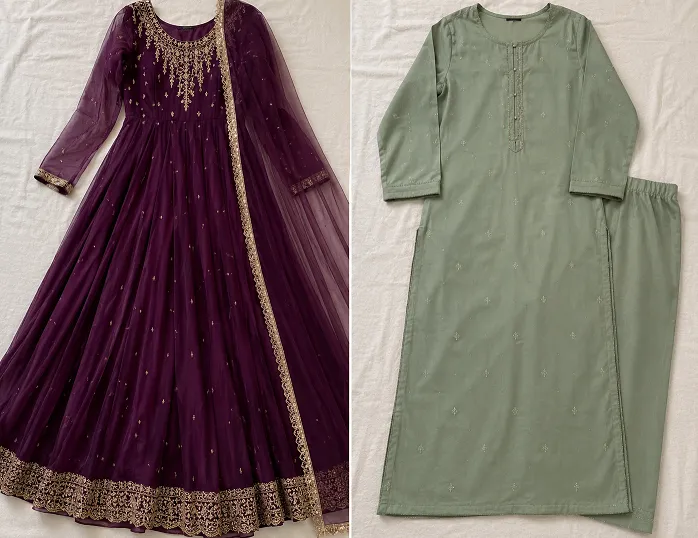
You try on a kurti that looked perfectly shaped on the hanger, and in the trial room mirror it falls the exact same width at your shoulders, waist and hips. No curve. No waist. Just fabric hanging straight down.
That is the real frustration behind searching for a kurti for rectangle body shape. You already know your body type. You are not looking for a definition, you are looking for a kurti that actually creates a waist where the fabric currently refuses to.
This piece skips the basics you have probably already read elsewhere. It goes straight into four cuts that genuinely work, exactly where the empire seam should sit, which fabric actually holds a flare, and why your choice of palazzo or jeans can quietly undo everything your kurti just did.
Table of Contents
What Actually Works: Kurti Styles for a Straight Body Type
Before getting into the details nobody explains properly, here is the short version. If your bust, waist and hips are close to the same width, four cuts do the most work.
- Empire waist kurtis, where the seam sits right under the bust and the rest of the fabric flows loose, so the eye reads a waist even though the fabric never touches your actual waistline.
- Peplum kurtis, where a flared panel sits at hip level and adds width exactly where a rectangle body usually has none.
- Belted straight-cut kurtis, the simplest fix, since a belt alone can carve out a waist on almost any plain straight kurti.
- Angrakha or wrap-style kurtis, where the asymmetric overlapping front adds a diagonal line across an otherwise straight frame.
These four kurti styles for a straight body type cover almost every occasion, from a regular workday to a full wedding function.
We have already broken down the actual waist-illusion logic behind belts, panels and bust volume in our salwar kameez for rectangle body shape guide, so we will not repeat it here.
If you are not fully sure your body falls into the rectangle category, Ethora’s free body type calculator gives you a clear answer in under two minutes based on your actual measurements.
Empire Waist Kurti for Rectangle Body Shape: Where the Seam Should Actually Sit
Empire waist is the most repeated recommendation for this body type, and also the most poorly explained. Almost nobody tells you exactly where the seam should sit.

Too high, near your armpit, and the kurti reads as maternity wear instead of a waist illusion. That placement pushes fabric outward before your body has even started narrowing, so there is nothing left for the eye to define.
The correct spot sits right where your bra band sits, at the base of your bust, not above it. This is close to where historical empire silhouettes were originally cut, and that precision is exactly what separates an empire waist kurti for rectangle body shape that actually works from one that just adds bulk near your chest.
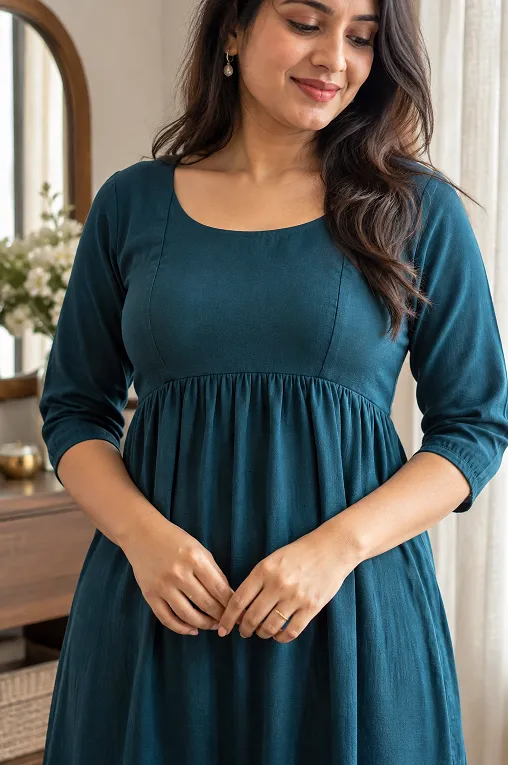
At that placement, the seam creates one clean, narrow line before the fabric flows out. Placed even an inch higher, that same seam adds bulk instead of removing it.
Here is the part most guides skip. Try the kurti sitting, not just standing. A seam that looks fine standing can ride up and bunch near your bust the moment you sit for a car ride or a college lecture.
Peplum Kurtis: Why the Fabric Decides If They Work
This is the part left out of almost every kurti guide, and honestly, it matters more than the cut itself.
A peplum kurti only does its job if the flare actually holds away from your body. A very soft, thin fabric in the same cut can be too limp to hold that shape, so it just falls flat against you instead of flaring out.
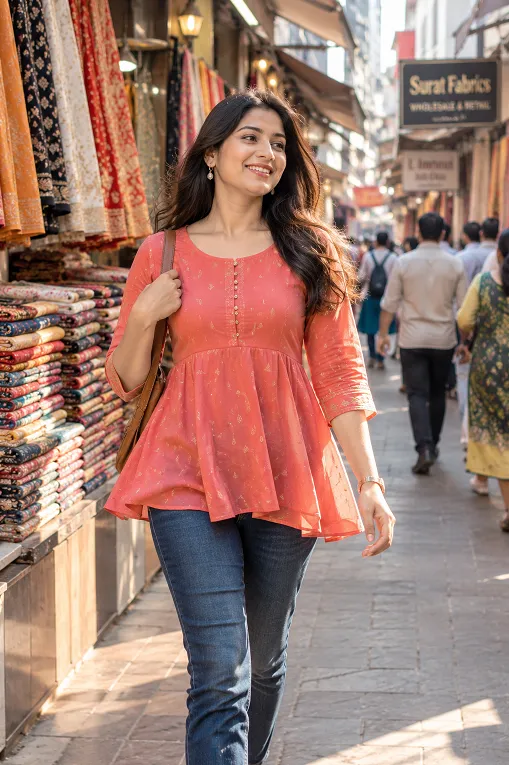
I have seen this happen with a peplum design that looked structured on the mannequin and turned into something completely different on a real body walking through a market.
Georgette has more body than chiffon, so a peplum panel in georgette holds its shape while you walk, while the same panel cut in chiffon collapses against your hip within a few steps. Georgette’s tightly twisted weave is exactly why it behaves this way, giving it just enough structure to hold a flare that soft fabrics cannot.
The same logic decides whether an empire waist or an angrakha kurti actually works too. The fabric, not the cut, is what shows up on your body.
Most women pick a peplum kurti by how it looks on the hanger or the mannequin. That is the wrong test. Hold the fabric, let it fall, and watch what it actually does before you decide anything.
Now pair that fabric decision with what goes underneath, because this is where most styling advice quietly contradicts itself. Every article says pair a rectangle body with a voluminous palazzo to create curves. Nobody mentions that this can backfire depending on what you already have on top.
If your kurti is already a peplum or a flared empire cut, it is already doing the work of adding volume and creating a waist. Add a voluminous palazzo underneath, and you now have volume stacked on volume, which cancels out the very waist your kurti just created.
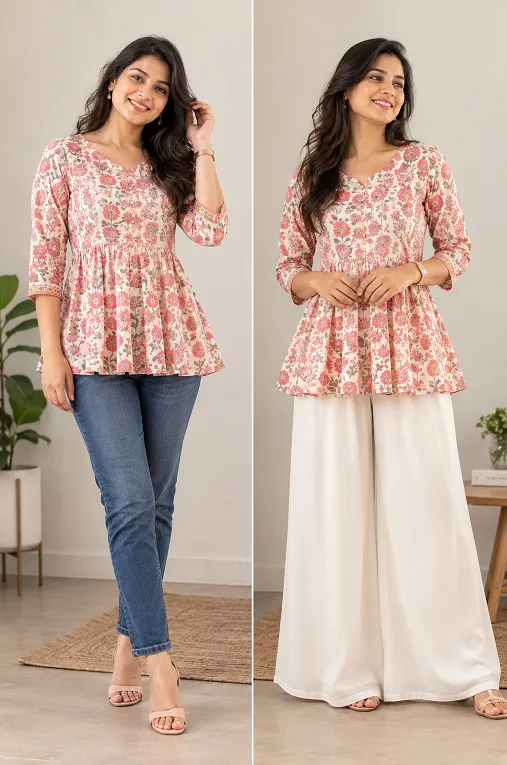
Pair that same flared kurti with straight fit jeans instead of a wide palazzo, and the contrast between the flared top and the straight bottom is exactly what makes the waist visible. It gives the eye one clear place to land.
You will see this play out at a Navratri night or a college fest, where flared kurtis paired with straight jeans look sharper than the same kurti paired with a wide palazzo, especially once you are dancing and the fabric is actually moving under the lights.
Here is an opinion I will state plainly. For most women searching for the best kurti cut for a rectangle figure, a peplum kurti with slim straight pants creates a more visible waist than the same kurti with a flowy palazzo ever will. Volume only works when nothing else is already adding volume.
Belted Straight-Cut Kurti: The Simplest Waist Trick
If you own even one plain straight kurti, you already own the easiest fix on this list. A slim belt cinched at your natural waist does what an entire cut sometimes cannot.
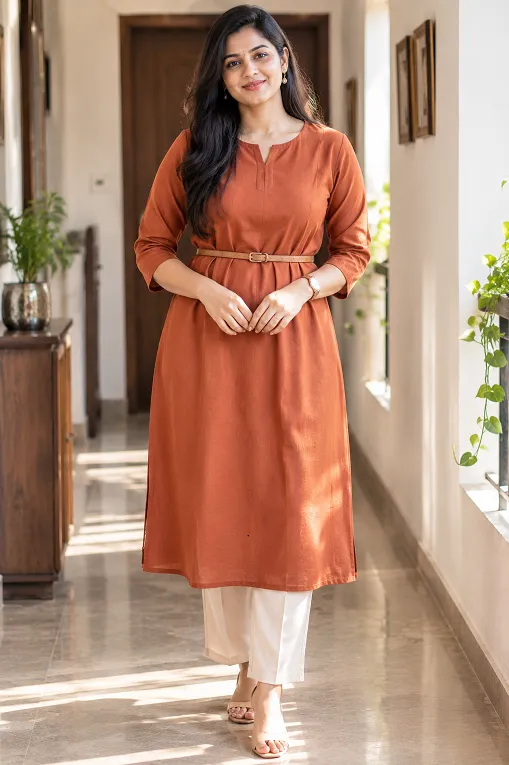
This works best with fabric that has some fall to it above and below the belt, not something stiff enough to stand away in a box shape at the hem. A soft cotton or a lightly structured georgette lets the belt actually cinch instead of just sitting on top of straight fabric.
If you are unsure how fitted the rest of the kurti should feel around your body before you add a belt, our guide on how loose a kurti should actually be breaks the fit test down in more detail. This is one of the smaller decisions that quietly makes or breaks a rectangle body type kurti design.
Keep the belt at your actual natural waist, not lower on your hips. Worn too low, it stops reading as a waist definer and starts looking like an accessory with no real job to do.
Angrakha and Wrap-Style Kurtis: Adding an Angle Where There Is None
A rectangle body shape has one thing in excess, straight lines. An angrakha kurti, with its asymmetric overlapping front tied at the side, is one of the few cuts built specifically to interrupt that straight line.
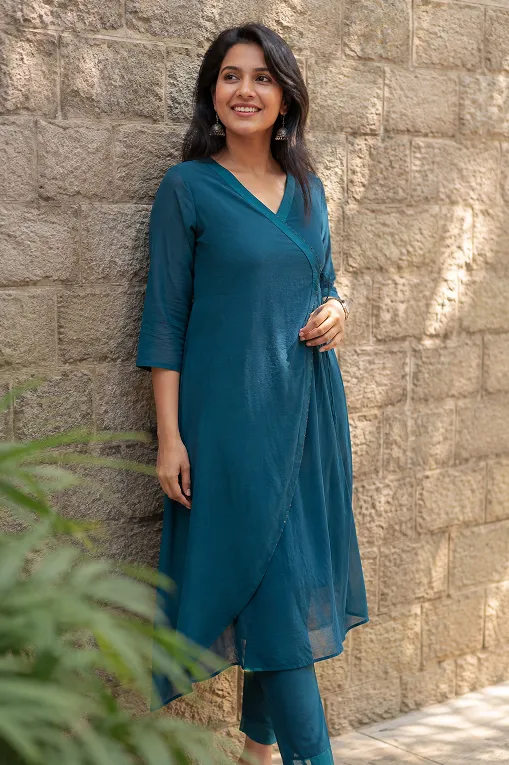
The diagonal wrap crossing your torso does something a symmetrical cut cannot. It gives the eye a slanted line to follow instead of a flat vertical one, which is what actually reads as shape from a distance.
This cut works particularly well for a shaadi season function or a Diwali evening, where the layered, overlapping fabric also photographs beautifully under warm indoor lighting, catching light differently at every fold as you move.
A soft fabric works fine here, unlike peplum or empire cuts, because the angrakha’s shape comes from the overlap and the tie, not from the fabric holding a flare on its own.
What to Check Before You Buy a Peplum or Empire Kurti
Before you buy a peplum or empire style, do the fabric test at the store, not at home. Pinch a section of the flared panel and hold it out from your body for a few seconds.
If it drops straight back down, the fabric is too soft to hold the shape the cut is supposed to create. If it stays out and settles into a soft curve, it will actually work on you.
Structured cotton, georgette and crepe usually pass this test. Very thin chiffon and soft viscose rarely do, no matter how good the cut looks on a hanger.
We manufacture our own kurtis directly at our unit in Surat and source everything else from Surat’s local textile market, so this fabric-first check comes from people who actually handle these weaves every single day, not just style them.
Conclusion
The cut of your kurti matters, but the fabric decides whether that cut actually shows up on your body. This is the real work behind choosing a kurti for rectangle body shape that lasts beyond one photo: pick from these four fits, check the fabric before you check the flare, and place the empire seam by feel, not by guesswork.
There is more styling detail like this across the Ethora blog if you want to go deeper into fit and fabric.
Our store is launching soon, with kurtis made at our own Surat unit alongside pieces sourced directly from Surat’s textile manufacturers.
Frequently Asked Questions (FAQs)
Does empire waist work for every rectangle body shape?
It works for most, but not if you are very petite. On a shorter frame, a seam sitting right under the bust can shorten your torso instead of lengthening it, so keep the flare below it fairly minimal.
Can I wear a fitted kurti if I have a rectangle body shape?
Yes, but only with added definition somewhere, like a belt, a peplum panel or a wrap style. A completely fitted straight kurti with no waist detail just outlines the straight lines you are trying to soften, which is exactly what kurti for straight body shape women should avoid.
What fabric holds a peplum flare the best?
Georgette and crepe hold a peplum flare better than chiffon or soft viscose because the tighter twist in their yarn gives the fabric enough body to stay away from your hips instead of clinging to them.
Where can I buy good quality kurtis online without guessing on fabric?
Check the fabric name and ask if it is structured or soft before you buy, since photos rarely show that difference. Ethora manufactures kurtis directly at its own Surat unit and sources other pieces from Surat’s local textile manufacturers, so you get factory-level fabric knowledge and quality without middleman pricing once the store is live.
Getting the seam, the fabric and the bottomwear to actually work together for your rectangle body shape takes more than a styling checklist, it takes clothes made by people who understand how fabric behaves on real bodies. Ethora manufactures its kurtis and other ethnic wear directly at its own unit in Surat, and for everything outside that range, we source directly from Surat’s local textile manufacturers, so you get genuine fabric quality without layers of middlemen. Our store is launching soon, drop your email below and be the first to know.