
You try on a kurti that looked perfect on the model in the catalogue photo, and somehow on you it adds width exactly where you didn’t want it. Your shoulders and waist look fine. It’s the hip and thigh area that the kurti seems to celebrate a little too enthusiastically. This isn’t your fault, and it isn’t the kurti’s fault either.
Finding the right kurti for pear shaped body needs is less about following one silhouette rule and more about understanding how cut, fabric and length work together on your specific frame. This piece covers the things that actually change how a kurti sits on hips and thighs, not just the A-line and Anarkali list you’ve read on ten other blogs.
Table of Contents
What a Pear Shape Actually Needs From a Kurti
A pear shaped body carries more width at the hip and thigh than at the shoulder and bust. That’s it. It’s not a flaw, it’s just where your body naturally stores weight, and most Indian women fall somewhere close to this shape, especially after their twenties. If you’re not fully sure this is your shape, our free ethnic wear body type calculator can confirm it in under a minute using just your measurements. The goal with a kurti isn’t to hide the hips. It’s to create enough visual balance between the top and bottom half so the eye doesn’t stop and stay at the widest point.
Most women choose a kurti length or cut based on what looks good on the hanger. That’s the wrong way to do it. A kurti has to be judged on your body, moving, under real light, not on a mannequin in a shop.
Kurti for Pear Shaped Body: The Cuts That Genuinely Work
Some silhouettes do the balancing job better than others.
- A-line kurtis flare out gradually from the waist, which softens the hip line instead of hugging it.
- Anarkali kurtis flare even more dramatically from the bust, which shifts visual volume upward and away from the hips entirely. If you’re torn between this and a fitted silhouette, our breakdown of Anarkali vs straight salwar kameez goes deeper into how the two actually differ on the body.
- Straight cut kurtis in a structured fabric work if they’re cut generously through the hip, since a tight straight cut is the one style that consistently works against a pear shape.
- Angrakha style kurtis with the front overlap add detail near the chest and shoulder, drawing the eye up before it travels down.
- Avoid kurtis that are fitted at the waist and then cling straight down through the hip. This is the single most common mismatch we see.
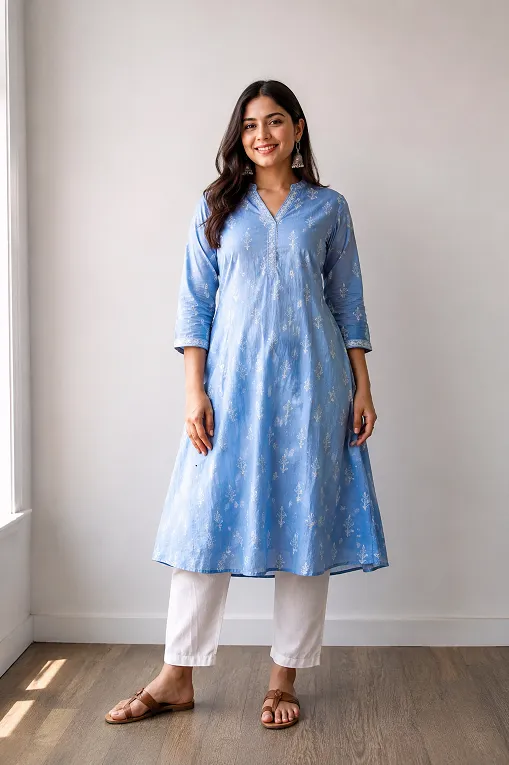
The Anarkali works on a slightly different principle than the A-line. Instead of flaring gradually from the waist, it flares from right under the bust, so almost the entire lower half of the kurti is doing the balancing work rather than just the hip area downward. On a pear shape, this usually reads even softer than an A-line because there’s no fitted waist section drawing a line at the widest part of the body first.
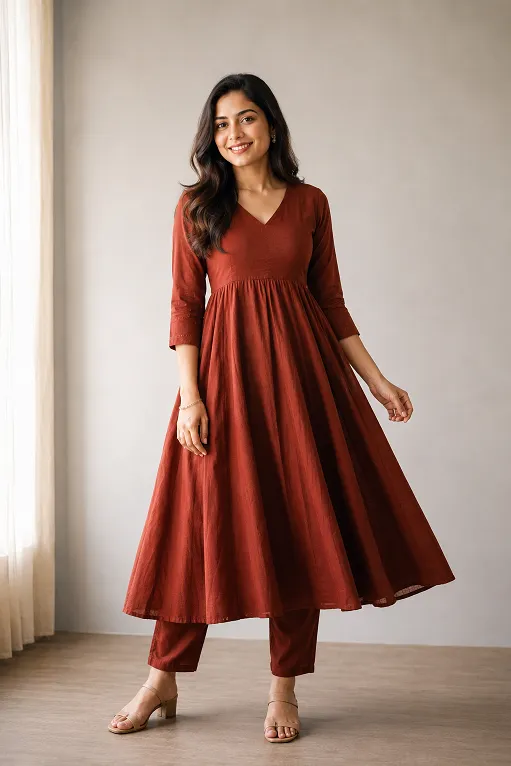
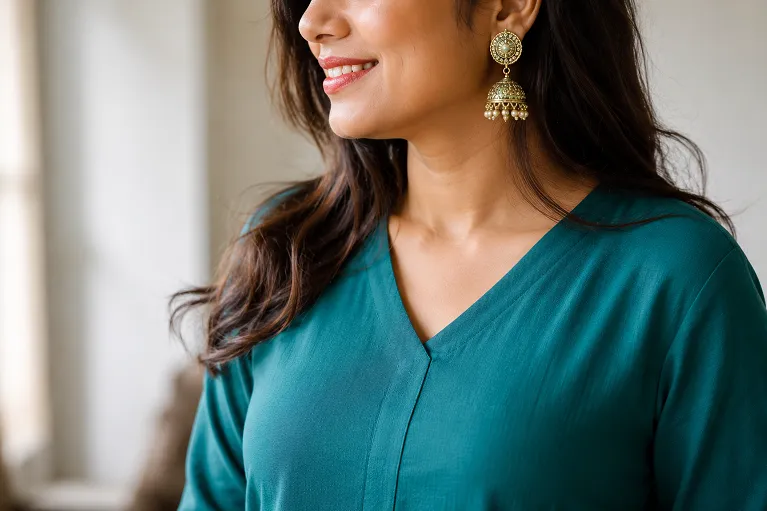
It’s not only the cut below the waist that matters here. The neckline plays a smaller but real role too, since a V-neck or boat neck gives the eye a natural stopping point higher up before it travels down to the hip. It’s a small detail, but on days when you’re already wearing a balancing cut, a good neckline just adds a little more upward pull without you doing anything else differently.
Why the Same Cut Behaves Completely Differently in Different Fabric
This is the part almost nobody talks about when choosing a kurti for pear shaped body, and it changes everything about how the cuts above actually perform.
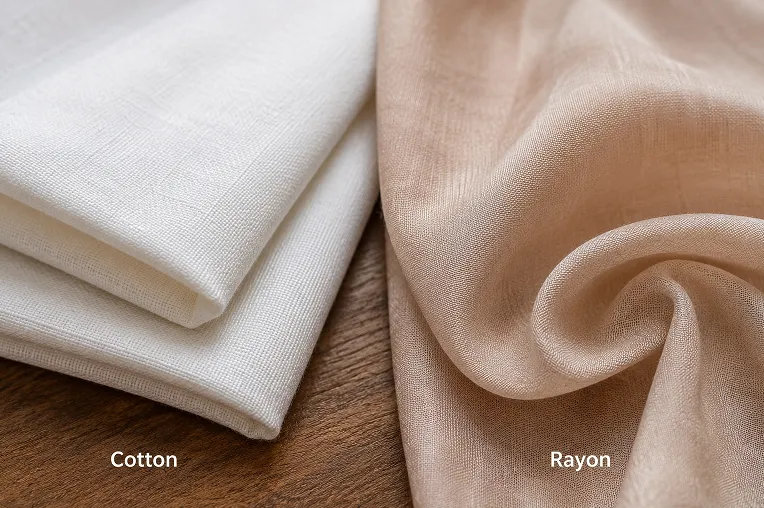
An A-line or flared kurti in a crisp cotton or a structured fabric like cambric holds its shape away from the body. The flare stays a flare. It creates that gentle triangle silhouette that visually lifts weight off the hip.
Now take the exact same cut in a soft rayon or a fluid georgette, and the fabric behaves completely differently. It doesn’t hold the flare outward. It drapes and settles closer to the body, especially around the hip and thigh, which quietly undoes the balancing effect the cut was designed to create in the first place.
We see this constantly at the mill. Two kurtis, same pattern, same measurements on paper, and they photograph and fit like entirely different garments once the fabric changes. Georgette has more body than chiffon, so it holds a flare slightly better when you’re walking, but even georgette softens with wear and humidity over a few hours.
If you’re buying an A-line or flared kurti specifically to balance a pear shape, the fabric decision matters just as much as the cut decision. A stiffer cotton or cotton-silk blend will do more for you than a soft rayon in the identical silhouette.
Getting the Kurti Length Right for Your Actual Height
Every article says avoid short kurtis. That’s true, but it’s incomplete, and treating it as one universal rule is where a lot of women get it wrong.
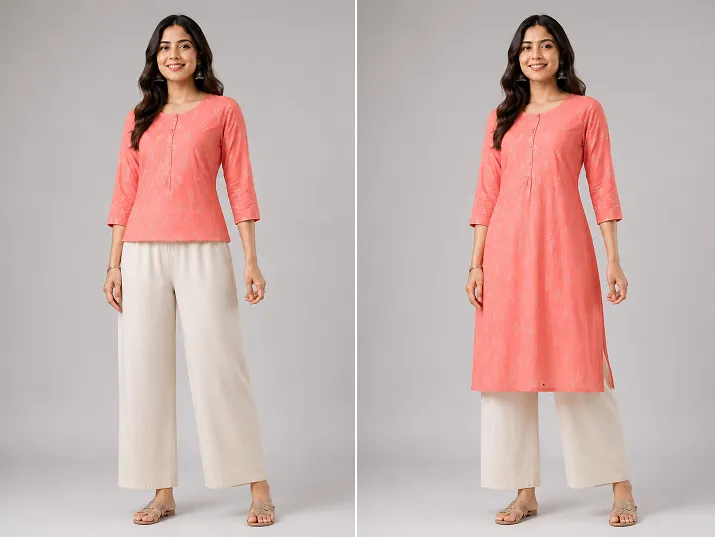
A short kurti for a pear shaped body can actually work, but only under two specific conditions. First, the kurti must end above the widest point of the hip, typically at the upper hip or waist rather than sitting right across the fullest part. Second, it needs to be paired with a slim straight bottom rather than a flared or palazzo style. A short A-line or angrakha kurti ending at the upper hip with a slim churidar or straight pant keeps the silhouette clean. The mistake is not wearing short
kurtis. The mistake is wearing a short kurti that ends exactly at the widest hip point and letting it sit there without a balancing bottom underneath.
The real question is where the kurti ends relative to your widest hip point, and that changes with your height. On a petite frame, a kurti that ends four to five inches below the hip usually skims past the widest point cleanly and continues the line down. On a taller frame, that same four to five inch drop can end up hitting mid-thigh instead, which is often a slightly awkward stopping point that draws the eye right back to the hip and thigh area instead of moving past it.
So instead of memorising a length in inches, stand in front of a mirror and check where the kurti ends relative to your own hip line, not relative to a length that worked for a friend or an influencer. If it ends anywhere between your widest hip point and your mid-thigh, that’s usually the zone to avoid. Below mid-thigh, closer to the knee, tends to work far more consistently across most heights.
The Bottomwear Mistake That Cancels Out a Good Kurti
Every article you’ve read tells you to pair a dark bottom with a lighter kurti, and colour contrast does help. But colour is only half the story, and honestly, it’s the smaller half.
Here’s what nobody mentions: if you pair an A-line or flared kurti with an already voluminous palazzo or a wide leg bottom, you’re stacking volume right back at the hip and thigh, in the exact place the kurti was trying to move attention away from.
The kurti flares out, the palazzo flares out below it, and the two together create more width in that zone, not less, regardless of what colour either one is.
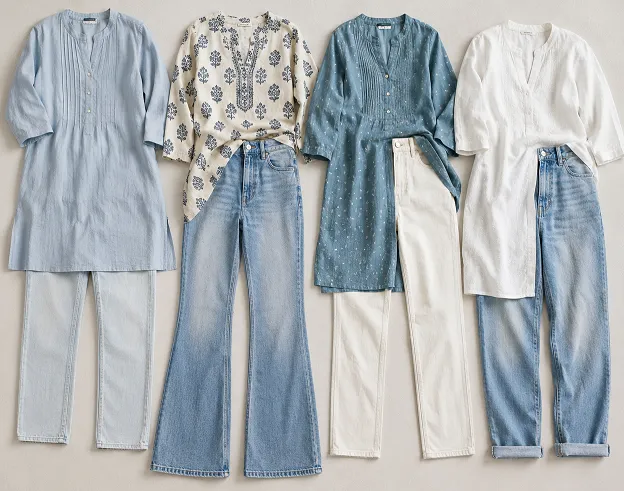
A straight pant, a slim churidar, or a slightly tapered bottom does far more work with an A-line or flared kurti than a wide leg palazzo does, even in the “correct” dark colour. If you love palazzos, save them for straight cut or fitted kurtas instead, where there’s no competing flare above them. Prefer a more western look on regular days? Pairing a straight or A-line kurti with slim or straight-leg jeans works on the same logic, and we’ve covered the fit details for that combination separately in how to wear a kurti with jeans.
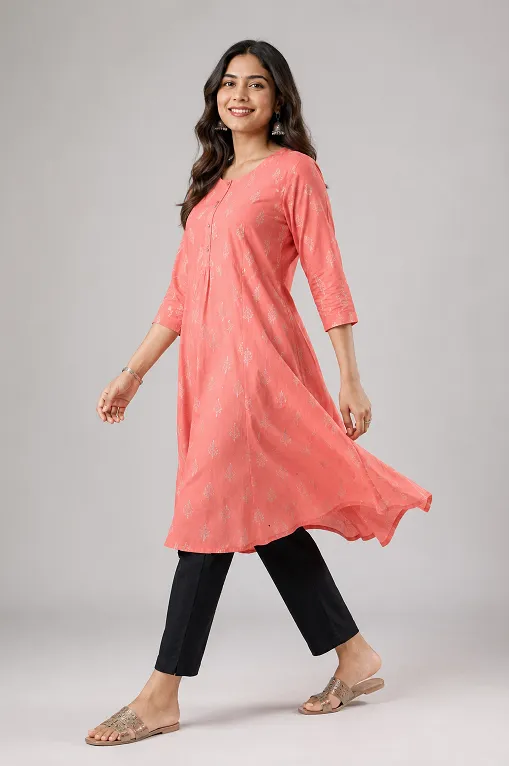
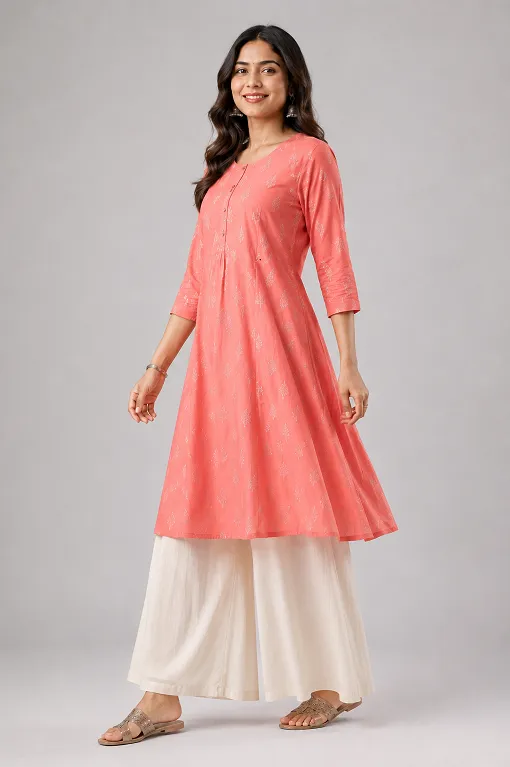
This is also where a lot of festival dressing goes wrong. During Navratri, women often reach for a flowy kurti with an equally flowy palazzo because it feels comfortable for dancing, and comfort matters, but if balancing your silhouette matters too, a slim bottom under a flared top gives you both movement and shape. (Related: our Navratri outfit ideas for garba night covers this in more detail for festive dressing specifically.)
What Actually Matters Before You Purchase
Before you buy a kurti for pear shaped body, check how the fabric holds its own flare, not just how the flare looks on a hanger or in a product photo. Pinch the fabric near the hem and let it go. If it springs back into shape, it’s structured enough to hold an A-line or flared cut away from the body through the day.
If it falls flat and clings immediately, it’s soft, which isn’t necessarily bad, but it won’t do the balancing job the cut is designed for. We manufacture our kurtis directly at our Surat unit, and for fabrics outside our own production, we source straight from Surat’s local textile market, so this fabric-behaviour check comes from actually handling these materials every day, not from styling theory borrowed off the internet.
One Thing Worth Saying Plainly
Everyone tells you to stick to darker colours and busy prints to camouflage your hips, but a well fitted bright kurti in the right cut usually does more for how you carry yourself than a dull, muted one ever will. Confidence changes posture, and posture changes how any outfit looks on you. Don’t let the “slimming colour” advice talk you out of a colour you actually love. If you want to go further with pairing colours the right way for ethnic wear, our guide on colour combinations for ethnic wear is worth a look.
Bringing It Together
Choosing the right kurti for pear shaped body isn’t about following a single silhouette rule. It’s the cut, the fabric behind that cut, the length relative to your own height, and the bottomwear underneath it, all working together instead of against each other. Get any one of these wrong and the rest can’t fully compensate.
Get them right together and the outfit does the balancing without you having to think about it every time you get dressed. There’s more styling guidance like this waiting for you on the Ethora blog if you want to keep exploring. Our store is launching soon, and every product on it will come directly from our own manufacturing unit or Surat’s textile market, with no middleman in between.
FAQ
Which kurti length is best for a pear shaped body?
There’s no single universal length. Check where the kurti ends relative to your widest hip point rather than an inch measurement. Anything ending right at or slightly above the hip tends to draw attention there, while lengths that clear mid-thigh usually flow past the hip cleanly for most heights.
Should I avoid tight kurtis completely if I have a pear shape?
Not entirely. A kurti fitted at the shoulder, bust and waist can work well if it flares out from the waist down instead of staying tight through the hip. The problem isn’t fit at the top, it’s a straight, clingy cut continuing all the way down over the hip and thigh.
Can I wear a straight cut kurti with a pear shaped body?
Yes, but choose one cut generously through the hip and made in a fabric with some structure, like cotton or a cotton-silk blend. A straight cut in a soft, clingy fabric is usually the least flattering combination for this body shape.
What should I check before buying a kurti online for my body type?
Look closely at the fabric description, not just the photo. A soft rayon or georgette will drape closer to the body than a structured cotton in the exact same cut, which changes how the silhouette actually performs on you. At Ethora, we manufacture kurtis at our own Surat unit and source anything outside that range directly from Surat’s textile market, which means the fabric information you get is based on how these materials actually behave, not just how they photograph.
Does the colour of the bottomwear matter more than the cut for pear shape?
Colour contrast helps, but the cut of the bottomwear matters just as much, if not more. Pairing a flared or A-line kurti with an already wide leg or palazzo bottom adds volume back at the hip regardless of colour. A slim or straight bottom usually balances a flared kurti better than a “correctly coloured” wide leg one.
Can I wear a short kurti if I have a pear shaped body?
Yes, but the ending point matters more than the length itself. A short kurti that ends above your widest hip point, at the upper hip or waist, works well with a slim straight bottom like a churidar or tapered pant. The combination you want to avoid is a short kurti ending right at the fullest part of the hip, since that draws a horizontal line exactly where attention is already likely to go. Short A-line and angrakha kurtis work better than short straight cuts for this reason.
Finding a kurti that actually balances your frame comes down to details most stores never mention, like how a fabric holds its own flare. We manufacture our kurtis directly at our own unit in Surat, and everything outside that range we source directly from Surat’s local textile manufacturers, so what you get is backed by real fabric knowledge, not guesswork. Our store is launching soon, and we’d love for you to be among the first to shop it.
Pingback: Kurti For Inverted Triangle Shaped Body: 5 Confident Fixes | Ethora
Pingback: Lehenga For Pear Shaped Body: 7 Confident Styling Fixes | Ethora