
You zip up the lehenga skirt, turn sideways in the mirror, and the blouse suddenly looks smaller than it did on the hanger. That gap between how an outfit looks on the rack and how it sits on your actual body is the real reason most shape guides fall flat.
Finding the right lehenga for pear shaped body types is not about hiding your hips. It is about knowing exactly where to place volume, weight and detail so the whole outfit reads as one balanced silhouette instead of two competing halves.
If you have not confirmed your shape yet, Ethora’s ethnic wear body type calculator sorts you into one of five categories in under two minutes and gives you matching saree, suit and lehenga suggestions in one go.
Table of Contents
What Actually Makes a Pear Shape, and Why Lehengas Work Well For It
A pear shape means your hips are noticeably wider than your bust and shoulders, usually with a defined waist in between. If the calculator gave you this result, you are in good company. It is one of the most common shapes among Indian women, not an outlier.
Getting the lehenga cut for pear shaped body proportions right starts with the blouse, not the skirt. A lehenga is already built to work in your favour more than most Indian outfits, simply because it separates the top and bottom into two pieces you can style on their own terms.
Unlike a kurti, which falls in one straight line, a lehenga lets you treat the blouse as its own decision. If you are curious how this plays out in shorter, everyday fits, the guide on kurti for pear shaped body covers cuts that work outside a full lehenga.
The mistake most women make is picking blouse and skirt as a matched set without checking whether each piece is actually doing its job. A blouse cut for an hourglass frame does not flatter a pear shape just because it came stitched to the right skirt.

The Blouse and Neckline Principle That Ties Everything Together
Every guide you read will tell you to choose a wide neckline, statement earrings and structured hair for a pear shape. Almost none of them explain why these three things work together.
The real reason is simple. A wide neckline, bold earrings and voluminous hair all create width at the top of your body. That width becomes a visual anchor point that balances the width your hips already carry.
Once you understand this one principle, you stop needing a checklist for every accessory decision. You can apply the same logic to a dupatta pin, a choker, or even how you tie your hair for a specific function.
A boat neck or wide square neck blouse pulls the eye horizontally across your shoulder line. Add jhumkas or chandbalis that sit slightly away from the face, and the same width repeats at the ears. This is the same principle behind styling a saree for pear shaped body, just scaled up because a lehenga blouse covers more surface area than a saree blouse usually does.
Sleeves get skipped in most advice, but they matter. A cap sleeve or short puff sleeve adds a small amount of shoulder width without looking bulky. A full, heavy long sleeve can end up narrowing the shoulder line instead of widening it.
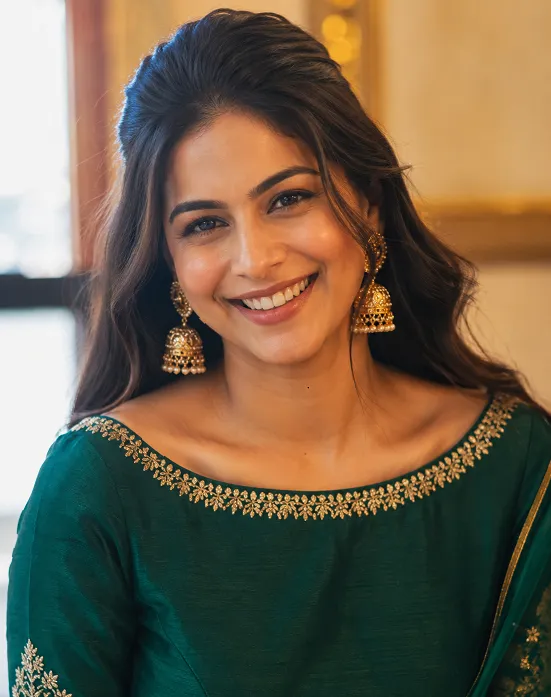
If you want the same effect in a more structural way, a cape layered over the blouse does this even more literally. The cape’s own shoulder seam extends the width line further out than fabric or embroidery alone can, without adding anything at the hip.
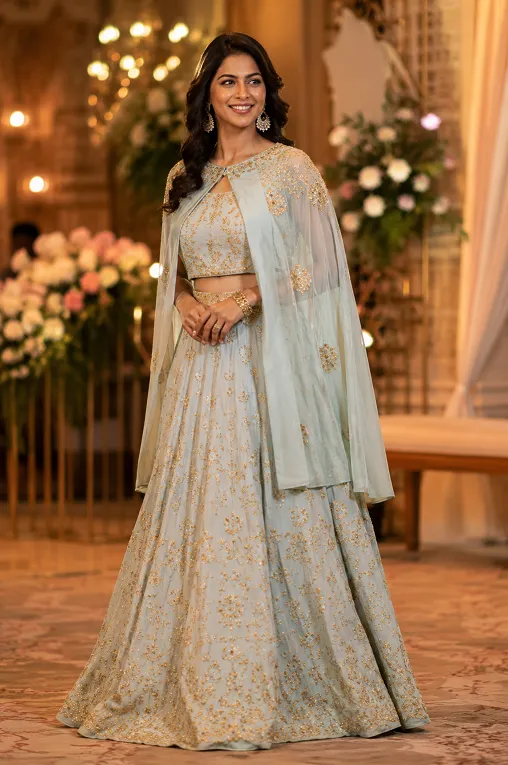
How Much Volume at the Top Is Actually Enough
Here is where most styling advice stops short. Add volume up top gets treated like a fixed rule, and that is exactly where things go wrong for a lot of women.
If your hip to shoulder difference is moderate, heavy embellishment across the entire blouse can tip the balance too far. The waist starts to look unnaturally pinched, and the outfit reads as top heavy instead of balanced.
A better way to calibrate this is to look at your own hip to shoulder ratio instead of copying a blouse straight off a mannequin. Wider hips can carry a fuller neckline and a heavier earring. A smaller difference calls for detailing concentrated at the neckline and sleeve edge rather than spread across the whole blouse.
A good pear shape lehenga design calibrates volume to your actual proportions, not to a generic rule copied from every other article on this topic.
Actually, I would push back on the standard advice here. A heavily embellished blouse layered over an already flared, heavily worked skirt can cancel out both effects instead of doubling them. Pick one half of the outfit to carry most of the detail, and let the other stay comparatively simple.
Why an A-Line Lehenga Might Pull at the Hip Seam When You Sit
This matters more when you are choosing a lehenga for pear shaped body types than for almost any other shape, because you are already working with more volume through the hip and thigh.
A softer fabric like georgette or chiffon falls cleanly between the legs when you sit down. Georgette is a member of the crepe family, woven with tightly twisted yarn that gives it just enough body to hold a pleat while still moving with you instead of fighting you.
A stiffer silk or brocade A-line skirt behaves differently. It holds its shape beautifully while you are standing, which is exactly why it photographs so well for the pre-function pictures.
But through a long event, sitting for the meal or the pheras, that same structure can visibly gap or pull right at the hip seam. Georgette will not photograph quite as crisply from a distance, but it earns that back the moment you are seated for three hours straight at a sangeet.
I have seen this happen at enough Surat weddings to say it with confidence. The stiffer the fabric, the more it needs your actual hip and thigh measurement, not just your waist size, to sit correctly through hours of moving between standing and sitting.
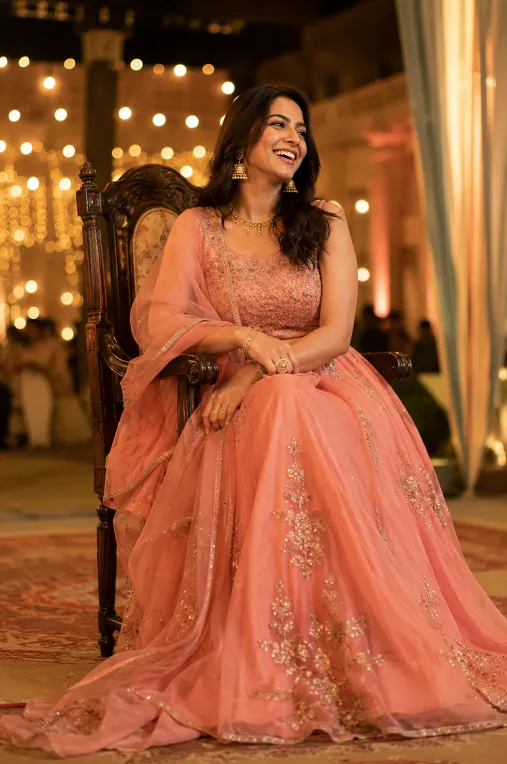
Dupatta and Accessories That Complete the Look
The dupatta is where a lot of women either overdo it or forget it entirely, and both mistakes undo the balance you just built with the blouse.
Drape it over one shoulder and let it fall diagonally across the back instead of straight down both shoulders. A diagonal drape adds width at the shoulder line without adding bulk near the hip, which keeps the top-heavy balance working in your favour.
For Navratri or Diwali functions where you are dancing for hours, a lighter net or organza dupatta holds its pleats better than a heavy silk one. It will not slide off your shoulder every ten minutes on the garba floor either.
Everyone says avoid bright colours near the hip to look slimmer, but honestly, a pear shape wearing a confident, well-placed colour block at the waist does more for how put together she looks than another beige lehenga ever will.
These pear body shape lehenga tips work together as a system, not as isolated rules you apply one at a time.
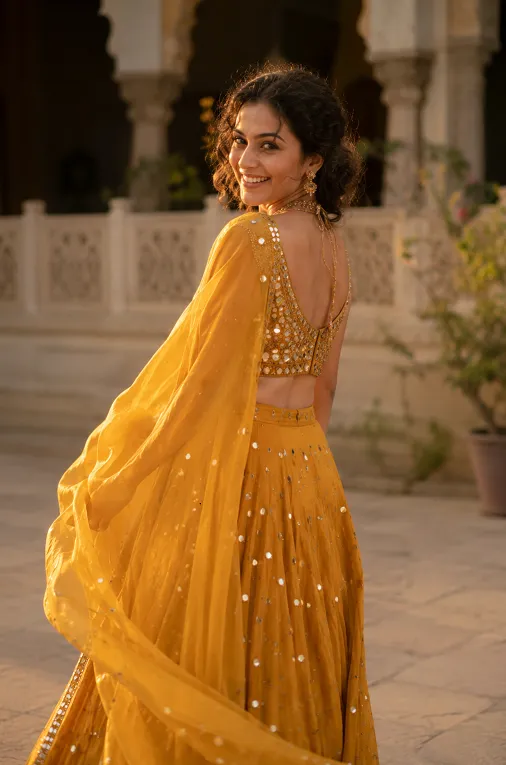
What to Check Before You Buy a Lehenga for Pear Shaped Body
Before you buy, touch the fabric of the skirt and imagine sitting in it for four hours straight, not just standing in front of the trial room mirror for two minutes.
If you are set on a heavily embroidered silk or brocade A-line, ask whether the blouse can be made in a softer fabric, since the two pieces do not need to match in weight even when they match in colour.
Check the seam allowance at the hip too. A slightly generous seam here is what prevents that visible pull when you sit down at a function for hours.
If you are still deciding between the best lehenga for pear body type and a saree for the same event, remember the skirt length matters just as much as the fit. The guide on lehenga length for height covers how hemlines should change based on how tall you are.
Ethora manufactures its lehenga choli range directly at its own unit in Surat and sources everything else from Surat’s local textile market, so this advice comes from people who handle these exact fabrics every day.
Conclusion
The one idea to carry with you is proportion, not correction. A pear shaped body does not need fixing. It needs a lehenga that understands where to add width, where to let fabric fall freely, and where to leave things alone.
Get the blouse, the fabric weight and the dupatta drape working together, and the rest of the outfit follows on its own.
If you enjoyed this, there is more styling detail waiting for you across the Ethora blog. Our store is launching soon, with everything sourced or made right here in Surat.
FAQ
What is the best lehenga cut for a pear shaped body?
An A-line lehenga in a softer fabric like georgette or chiffon works best because it skims the hips instead of clinging to them. Pair it with a blouse that has a wide neckline and some structure through the shoulder, since that combination does most of the real balancing work.
Should a pear shaped body avoid mermaid or fishtail lehengas?
Not entirely, but a fishtail cut needs to be fitted through the hip and thigh very precisely, or it will emphasise exactly the area you are trying to balance. If you love the silhouette, ask for the flare panel to start just below your widest hip point rather than right at the waist, since that single change alters how the flare reads on your proportions.
How do I know if a lehenga blouse fabric is good quality before buying it online?
Good blouse fabric should hold its embroidery without puckering and should not turn sheer under normal indoor lighting when you stretch it slightly. Ethora manufactures its blouse pieces at its own Surat unit and sources everything else directly from Surat’s textile market, which means genuine fabric knowledge and factory-level quality without the usual middleman markup.
Can a pear shaped body wear a heavily embellished lehenga skirt?
Yes, but balance the embellishment with a blouse that carries some detail of its own rather than leaving it completely plain. A fully plain blouse against a heavily worked skirt pulls the eye straight down to the hips, working against the balance you just built.
Choosing the right cut for your proportions is really about paying attention to how a garment actually behaves on your body, not just how it looks on a hanger. Ethora makes its lehenga choli range at its own manufacturing unit in Surat, and sources everything else directly from Surat’s local textile market. Our store is launching soon, so you will soon be able to shop pieces built on exactly this kind of fabric knowledge.
Pingback: Lehenga For Curvy Body Type: 6 Honest Styling Fixes | Ethora