You have stood in front of the mirror in a straight-cut kurti and felt your shoulders look wider than they actually are. You have also bought a kurti that looked flowy on the hanger and somehow made your upper body look boxier once it was on. That is not bad luck. That is a fit problem, and it has a specific fix.
Most advice on kurti for inverted triangle shaped body stops at “wear flared kurtis” and moves on, which is not wrong, just incomplete. This guide goes further into where the flare should actually begin, why raglan sleeves work the way they do, and one dupatta habit that quietly undoes all of it.
If you have not already checked which of the five shapes you fall into, Ethora’s free body type calculator takes under two minutes and gives you saree, suit and lehenga recommendations together, not just one garment.
Table of Contents
What Inverted Triangle Actually Means
Bust noticeably wider than the hip, shoulders that carry visual weight, and a waist that may or may not be sharply defined. That is the inverted triangle body shape, plain and simple.
If your bust and hip are close in width with a narrower waist between them, you are looking at hourglass instead, and the styling advice below will not apply the same way. Worth knowing before you follow anyone’s fit tips, including ours.
And if your hips are the wider point instead of your bust, the advice flips almost entirely. Ethora’s guide on kurti for pear shaped body covers cuts that work in the opposite direction from everything below.
Once you know this is your shape, styling a kurti for inverted triangle shaped body comes down to a handful of construction choices, starting with where the flare actually begins.
Fix 1: Where the Flare Needs to Start on a Kurti for Inverted Triangle Shaped Body
Every kurti guide tells you to buy a flared or peplum kurti. Almost none of them tell you where the flare should begin, and that detail changes everything.
A kurti that flares from the bust or underarm adds fabric volume exactly where your frame is already widest. Instead of balancing your silhouette, it makes your upper body read bigger, not smaller.
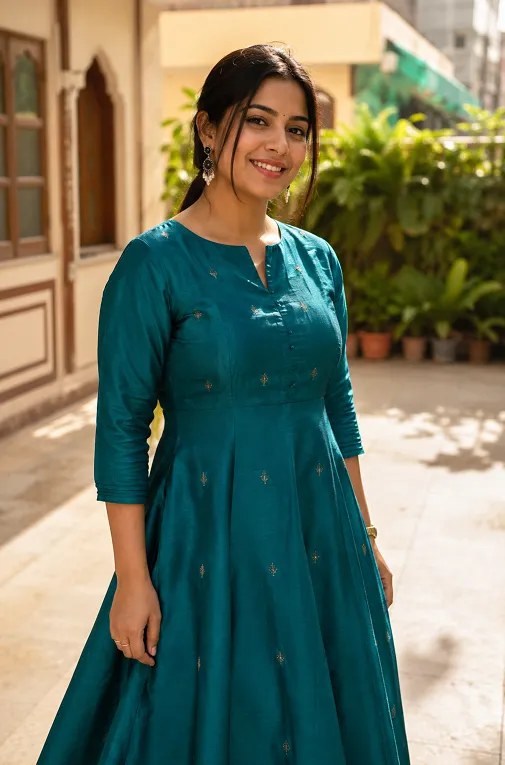
The flare has to begin at or just below the natural waist. That is the only point on the body where added volume reads as hip curve instead of shoulder bulk. Anarkali-style kurtis and A-line kurtis that hold their fitted line through the bodice and release only from the waist down do this correctly.
Most women choose a kurti by how it looks flat on a hanger, and the hanger cannot show you where the seam sits on an actual body. That is the real mistake here, and it is an easy one to make when you are shopping online.
Fix 2: Why Raglan Sleeves Actually Flatter This Shape
You will see raglan sleeves recommended everywhere for broad shoulders, but rarely explained. Here is the actual construction reason.
A set-in sleeve is stitched at the shoulder point, creating a hard horizontal seam exactly at the widest part of your frame. Your eye reads that seam line first, and it reads it as width.
A raglan sleeve is cut differently. The seam runs diagonally from the underarm up to the neckline instead of sitting on the shoulder itself, so there is no hard horizontal line at the shoulder point at all. The diagonal cut softens the shoulder edge instead of framing it.
This is also why dolman and batwing sleeves are recommended for inverted triangle body type kurti shopping. They share the same idea of moving the seam away from the shoulder point, just with more ease built in.

Fix 3: Why Dupatta Drape Direction Matters Here
This is the part almost nobody tells you, and it undoes the work of a good kurti if you get it wrong.
A dupatta draped evenly across both shoulders, hanging straight down the front on both sides, adds a horizontal line of fabric exactly where your frame is already wide. It works against everything the flare and the raglan cut are doing for you.
A single diagonal drape, pinned at one shoulder and falling across the body, does not repeat that horizontal line. It draws the eye down and across instead of straight out to both shoulder points.
If you want the full range of options, Ethora’s guide to dupatta draping styles covers seven ways to drape one, several of which work specifically for a broader shoulder line.
Everyone tells inverted triangle body types to avoid embellishment on top, but honestly, a single diagonal line of embroidery running down one side of the kurti front draws the eye downward and works in your favour. It is the horizontal embellishment across the chest that causes problems, not embellishment itself.
Fix 4: Necklines, Colour and Length That Hold the Balance
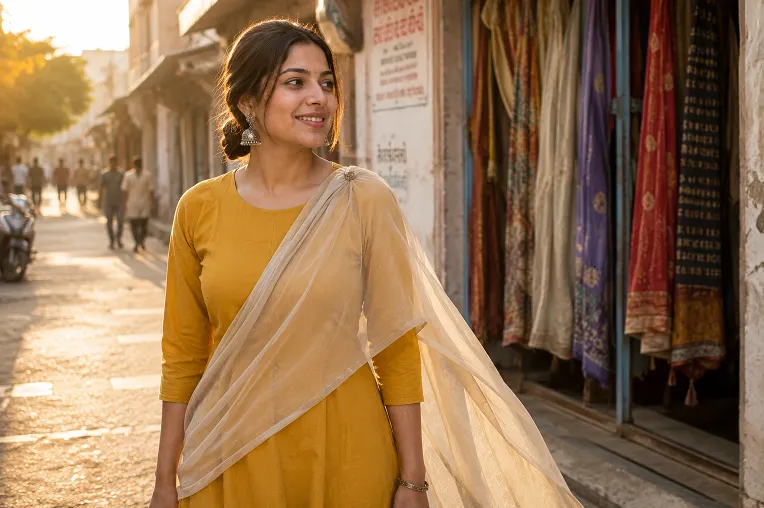
Deep V-necks and sweetheart necklines break up the horizontal line of the shoulders the same way a raglan seam does, just at the collar instead of the sleeve. Boat necks and high round necks do the opposite, so save those for a rectangle or pear body shape instead.
Colour placement matters more than most people admit. A darker or more muted shade on top with a brighter or printed bottom pulls visual weight downward without you having to think about the cut at all.
On fabric, here is something a hanger will never tell you either. Georgette has more body than chiffon, which means it holds a peplum or A-line flare cleanly as you walk instead of collapsing flat against the hips the way a thinner chiffon can. If the flare is doing the work of the hip illusion, the fabric holding that shape actually matters.
For length, anything that ends mid-thigh with a flare gives the eye more room to register the hip curve than a short kurti that cuts off before the flare has fully opened out.
The same waist-down flare logic applies to full salwar kameez for inverted triangle shape dressing too, not just kurtis. The neckline and sleeve rules above carry over directly, the only thing that changes is that you are now balancing the shoulder line against a longer stretch of fabric instead of a shorter one.
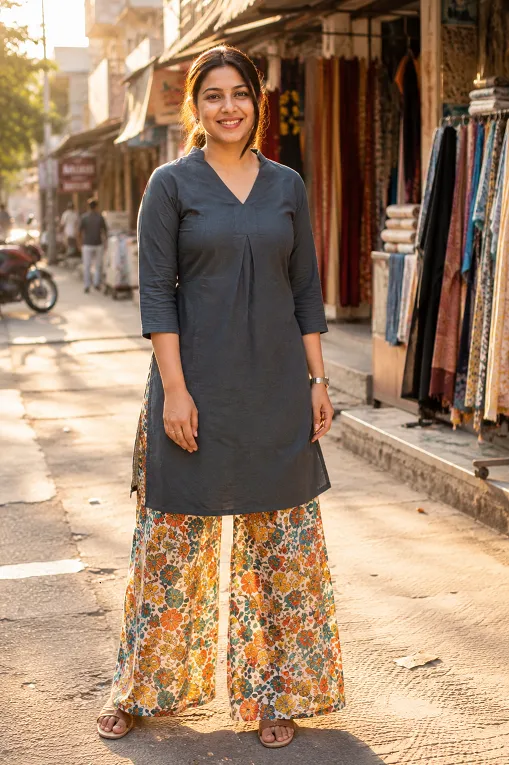
Fix 5: Dressing This Shape Through Real Indian Seasons and Occasions
A Banarasi silk kurti with heavy zari work looks stunning in photos, but the weight sits on the shoulder line all day, and by evening at a Diwali gathering or a long wedding function, that weight starts to show on your posture. Choose it for a few hours, not a full day event, if your shoulders are already the focal point.
In Mumbai humidity or a Surat summer, a flared cotton or modal kurti in a mid-weight fabric holds its shape through the day without clinging the way a thinner synthetic can by 4 pm. Modal in particular looks close to rayon on the shelf but behaves noticeably better once humidity sets in.
The same fabric logic holds for most inverted triangle shape ethnic wear you pick for Navratri or a college fest, not just an everyday kurti. A stiffer fabric keeps the flare’s shape through hours of dancing or standing around, while a limp one collapses flat within the first hour.
For office wear, this waist-down cut still works under a blazer or jacket. A straight-cut kurti under structured outerwear stacks two boxy lines on top of each other, while a gently flared one breaks that up.
If you are comparing this against how the same broad-shoulder logic plays out in sarees, the saree for body type guide walks through pleats and blouse necklines for hourglass, pear, apple and rectangle shapes side by side.
What Actually Matters Before You Buy
Before you add a kurti to your cart, check exactly where the seam that starts the flare sits, not just whether the product description says “flared” or “A-line.” A flare starting from the underarm or bust is doing the opposite of what you want, even if it is technically flared fabric.
Run your finger along the side seam in the product photos if the site has close-up shots. If the fitted portion clearly stops at the waistline and the fabric releases below that, you are looking at the right cut for a broad shoulder body type kurti in general, not just this specific silhouette.
This is something we check constantly at Ethora. We manufacture kurtas, salwar kameez, sarees and lehenga choli directly at our own unit in Surat, backed by Pahal Silk Mills, and everything else we carry is sourced directly from Surat’s local textile market.
So the fit advice on choosing a kurti for inverted triangle shaped body comes from people who actually cut and stitch these seams, not just style around them.
The Takeaway
The difference between a kurti that flatters an inverted triangle shape and one that fights it usually comes down to one seam line, where the flare actually starts. Get that right and the raglan sleeve, the diagonal dupatta and the colour placement all fall into place around it.
There is more styling detail like this across the Ethora blog if you want to keep exploring what actually works for your shape. Our store is launching soon, and everything on it will come directly from our own manufacturing unit and Surat’s textile market, the same source this advice comes from.
FAQ
Which kurti cuts should an inverted triangle body avoid?
Boxy straight-cut kurtis with set-in sleeves and boat necklines add horizontal width exactly where this shape already carries it. High necklines with embellishment across the chest have the same effect and are best kept minimal.
Can an inverted triangle body wear a fitted kurti?
Yes, as long as the fit is through the bodice only and the hem releases into some movement below the hip. A kurti fitted all the way to the hem with no release anywhere reads as one straight column and does not help balance the shoulders.
Does dupatta fabric weight change how the drape looks?
Yes. A heavier fabric like Banarasi silk holds a diagonal drape’s shape all day, while a lighter chiffon dupatta needs re-pinning more often since it slips off a single shoulder more easily by evening.
Where can I buy a well-fitted kurti online without guessing the cut?
Check the product photos for a visible side seam showing exactly where the flare starts, and read the fabric composition, not just the fabric name. Ethora manufactures kurtas directly at its Surat unit and sources everything else from Surat’s local textile manufacturers, so what you see in the listing matches actual factory-level construction rather than a stock photo styled to look better than the product.
What is the difference between an A-line kurti and an Anarkali for this body shape?
Both work if the flare begins at the waist. An Anarkali generally has a fuller, longer flare that suits festive wear, while an A-line kurti keeps the flare narrower and works better for daily or office wear under this same shape logic.
Once you know where your flare should start, shopping for a kurti stops being a guessing game. Everything on this list, from the waist-down cut to the raglan seam, is built into what we manufacture directly at our own unit in Surat, backed by Pahal Silk Mills. For pieces outside our own production, we source directly from Surat’s local textile manufacturers, so you get factory-level quality without a middleman marking it up. Our store is launching soon, and you will be able to shop all of this the moment it opens.