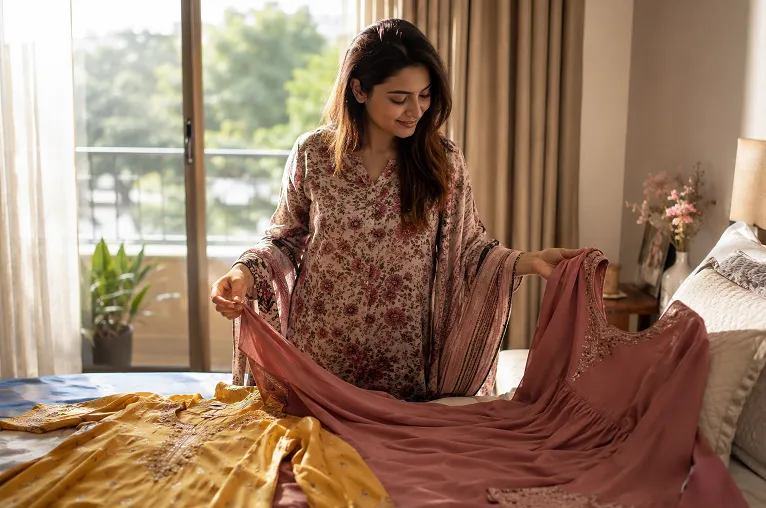
You’ve laid out both outfits on the bed the night before a family function. One salwar kameez, one palazzo suit, both freshly ironed, both perfectly nice. And you still don’t know which one to wear.
That indecision is not really about which looks better. It is about which one will hold up once you’re actually wearing it, sitting through a three hour function, walking on uneven ground, getting in and out of an auto rickshaw with a dupatta in one hand.
The palazzo suit vs salwar kameez debate gets treated like a style question online, but it is really a fit and fabric question. This article covers the three things that actually decide it, plus where each one genuinely works better.
Table of Contents
Palazzo and Salwar Kameez Are Not Really Two Separate Things
Here’s something most articles skip over. A palazzo suit is not a rival category to salwar kameez. It is a bottom style within it, sitting alongside churidar and Patiala as one of the ways a salwar kameez can be cut.
So technically, every palazzo suit you own is a salwar kameez. But in everyday shopping and styling, “salwar kameez” has come to mean the traditional tapered bottom, while “palazzo” means the wide, flowing one. That’s the working difference, and it’s the one that actually affects your day.
If you want the full breakdown of how the term overlaps with regional names, our guide on what a Punjabi suit is called and how it relates to salwar kameez covers that in more detail.
Why a Palazzo Suit Actually Feels More Comfortable, Not Just Different
Everyone says palazzo pants are more comfortable than a traditional salwar. Almost nobody explains why, so it ends up sounding like a vague opinion rather than a fact about how the garment is built.
A traditional salwar, however loose it is through the hip and thigh, tapers in at the ankle. That taper creates one fixed point of constriction. In heavier fabric, that pinch shows up every time you sit cross-legged, climb stairs, or fold your leg under you at a function.
A palazzo has no equivalent point. The leg stays the same width from hip to hem, so there is nowhere for the fabric to bunch or grip. That is the actual construction reason behind the comfort claim, not just a general “flowy is comfy” idea.
This matters more in Indian conditions than people admit. Through a Surat or Ahmedabad summer, ankle-level fabric that clings even slightly against sweat starts to feel unbearable by the third hour of a wedding function.
Palazzo Suit vs Salwar Kameez: How Each One Actually Behaves When You Sit
This is the part almost no article covers, and it is the one that decides whether your outfit still looks put together after two hours at a function table.
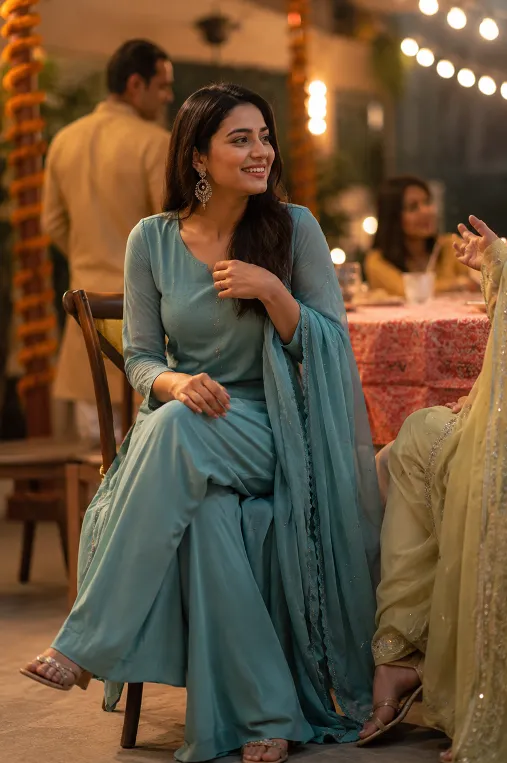
A wide-leg palazzo in a stiffer fabric, like a heavier cotton or a thick matka silk, does not fall neatly when you sit. It pools around your ankles and can look bulky, almost like extra fabric got left over.
The same silhouette in a soft, flowing fabric behaves completely differently. Georgette or a lightweight rayon palazzo drapes down and settles naturally against your legs the moment you sit, instead of stacking up in folds.
A traditional salwar doesn’t face this problem the same way, because it’s already gathered in at the waist. There’s simply less loose fabric hanging free that needs somewhere to go when you sit down.
So the honest palazzo vs salwar kameez answer on sitting comfort is not a flat yes or no. It depends entirely on the weight of the fabric your palazzo is cut from, which is something almost no salesperson tells you before you buy.
Here’s a small detail from actually handling these fabrics. Georgette has more body than chiffon, so a georgette palazzo holds its fall and its pleat while you’re walking, where a chiffon one will move more but show less structure.
Neither is wrong, they just behave differently. Knowing that changes what you should pick for a long, seated event versus one where you’re mostly standing and moving.
Can a Palazzo Suit Actually Make a Petite Frame Look Shorter?
This is the one nobody wants to say out loud, but it’s true, so here it is. A wide flare starting too high on the body, or too wide relative to your height, can visually shorten a shorter frame instead of elongating it.
It sounds backwards, since palazzo suits are usually marketed as universally flattering. But a tapered salwar doesn’t carry this same risk at all, because it never adds that much horizontal volume at any single point on the leg.
If you’re on the shorter side, the fix isn’t avoiding palazzo suits altogether. It’s choosing a flare that starts lower, at or below the hip, and keeping the hemline close to the floor rather than pooling at the ankle.
This general proportion principle holds true even outside Indian ethnic wear. A petite-focused styling breakdown from PureWow makes a similar point about wide-leg silhouettes on shorter frames, with a high rise and a longer hem length doing most of the work.
If your height is a recurring styling concern rather than a one-outfit decision, our detailed guide on dressing for a shorter height across ethnic wear goes through this in more depth.
Which One Actually Suits Which Occasion
Neither outfit wins outright here. It genuinely depends on what your day looks like.
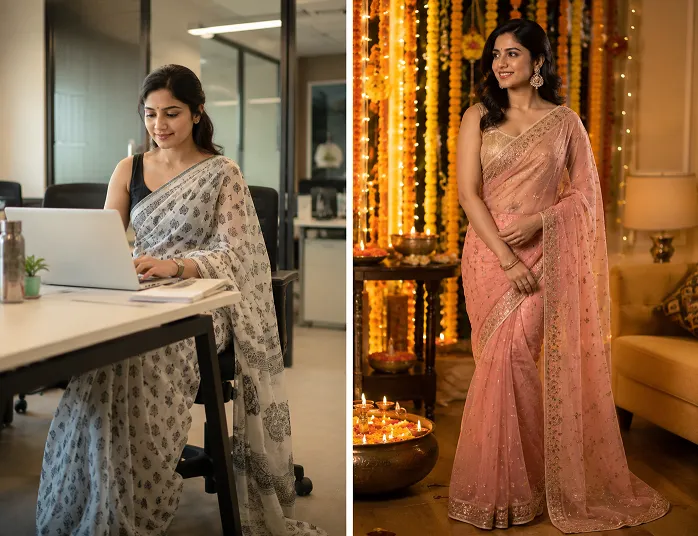
A salwar kameez, especially in cotton or a light silk blend, still holds up best for long office days. It moves with you without adding volume around your legs when you’re at a desk or walking between meetings, which is why our guide on salwar kameez for office wear stays a useful reference if that’s your main use case.
A palazzo suit earns its place at festive events where you’re mostly standing, greeting people, and want the drama of movement in the fabric. Navratri and Diwali gatherings are a good example, and if you’re planning outfits for garba nights specifically, our Navratri outfit ideas guide covers what actually holds up through hours of dancing.
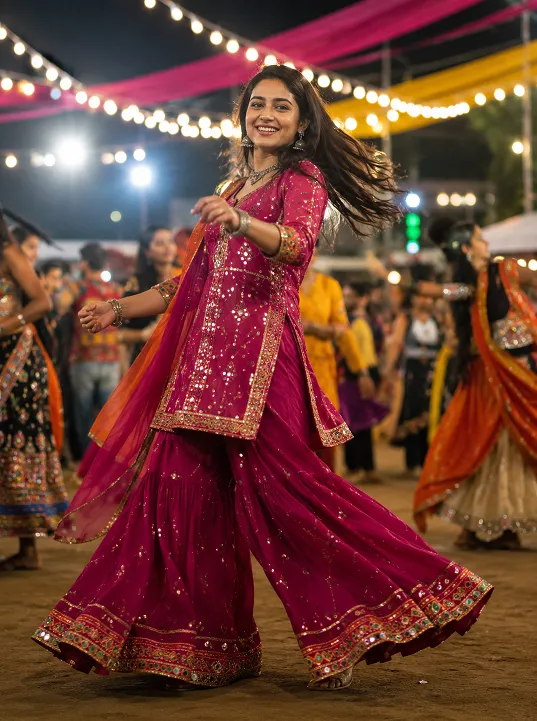
Here’s an unpopular opinion worth saying plainly. Everyone treats salwar kameez as the automatically “safer” and more work-appropriate choice, but a well-cut palazzo suit in a structured fabric reads just as polished, sometimes more, without any of the ankle bunching a stiff salwar can develop by evening.
And one honest mistake worth naming. Most women pick their palazzo length based on how it looks folded on a hanger in the store. That’s the wrong way to check it, because a hanger tells you nothing about how the flare sits once it’s moving on your actual legs.
What Actually Matters Before You Buy Either One
Fabric weight is the single most important thing to check before you buy a palazzo suit, more than colour or print. It’s the difference between a palazzo that drapes beautifully when you sit and one that pools awkwardly by the second hour of an event.
Hold the fabric up and let it hang loose in the shop. If it falls straight down with barely any resistance, it will drape well seated. If it stands away from your hand with any stiffness, expect some pooling.
Organisations like the Man-Made Textiles Research Association in Surat, working under India’s Ministry of Textiles, exist specifically because fabric behaviour under weight and movement isn’t guesswork, it’s something the industry actually studies.
We say this because we manufacture salwar kameez, sarees, kurtas and lehenga choli directly at our own unit in Surat, and for everything outside that range, we source it straight from Surat’s local textile market. Fabric weight is the first thing we check too.
Palazzo Suit vs Salwar Kameez: The Honest Takeaway
There isn’t a single winner here, and any article that tells you there is one is skipping the fabric conversation. A palazzo suit gives you a genuine comfort advantage in construction, but only earns it back visually if the fabric weight and your height are both accounted for.
Pick your salwar kameez style the way you’d pick anything that has to survive a full Indian day, by how it moves, not just how it photographs.
If this kind of practical, fabric-first breakdown is useful, our blog has more comparisons like this one worth exploring. Our store is launching soon, with pieces manufactured at our own Surat unit and sourced directly from Surat’s textile market, so you’re getting the fabric knowledge along with the outfit.
FAQ
Is a palazzo suit more comfortable than a salwar kameez?
For most body types, yes, mainly because a palazzo has no tapered ankle to create a pinch point the way a traditional salwar does. But comfort also depends on fabric weight, since a stiff, heavy palazzo can feel bulkier around the legs than a well-cut salwar in lightweight cotton.
What is the actual difference between palazzo and salwar kameez?
A palazzo suit is technically a type of salwar kameez, using a wide, straight-leg bottom instead of the traditional tapered salwar. The real practical differences show up in how each behaves when you sit, walk, or wear it in heat and humidity.
Can I wear a palazzo suit if I am petite?
Yes, but the flare should start lower on the body rather than high near the waist, and the hem should sit close to the floor instead of pooling. A flare that’s too wide relative to your height can visually shorten your frame instead of lengthening it.
How do I know if a fabric is good quality before buying ethnic wear online?
Check the weight and how the fabric falls when held loosely, since a good drape means less pooling and a more finished look once stitched. At Ethora, we manufacture salwar kameez, sarees, kurtas and lehenga choli directly at our own Surat unit, and source everything else straight from Surat’s textile manufacturers, so you’re getting factory-level fabric knowledge without paying middleman pricing.
Is palazzo suit or salwar kameez better for daily wear?
A traditional salwar in cotton or a light blend usually works better for daily wear and office days, since there’s less loose fabric to manage while sitting at a desk. A palazzo suit is better saved for festive days and events where you’re mostly standing or walking.
Once you’ve picked between a palazzo suit and a salwar kameez, the next decision is usually which fabric to trust for the occasion, and that’s exactly where we can help. Ethora manufactures salwar kameez, sarees, kurtas and lehenga choli directly at our own unit in Surat, and for everything outside that, we source straight from Surat’s local textile market, India’s largest textile hub. Our store is launching soon, so sign up here and be the first to shop straight from the source.