Your mother’s twenty year old Kanjivaram still catches the light the same way it did on her wedding day, and the salesman in front of you is holding up a saree half the price, insisting its zari is just as good. You have heard the words real vs fake zari thrown around so often that they barely mean anything anymore.
The truth is, you are not wrong to feel unsure. Zari can look almost identical whether it is silver and gold or copper and polyester, and most shops will not correct you unless you ask the right question. This guide covers what genuinely works at home, what does not, and the one step worth taking before you spend real money.
Table of Contents
What Real Zari Actually Is (And Why Surat Makes Most of It)
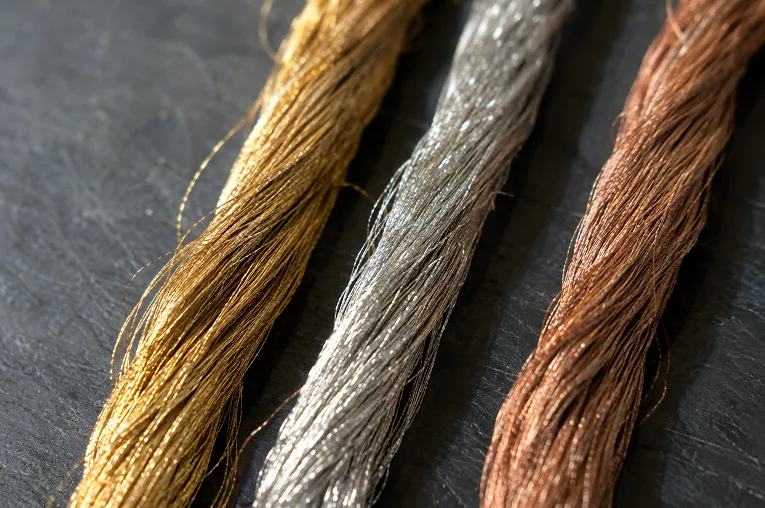
Real zari starts as pure silver, drawn into a wire so fine it looks like thread. That wire is coated with a thin layer of gold, then flattened and wound tightly around a base of silk or cotton yarn. Locally, this finished thread is called kasab.
Surat produces most of India’s zari, and the craft carries an official Geographical Indication registration from the Government of India under the name Surat Zari Craft. That status exists specifically because Surat’s silver electroplating process and generations of artisan skill are hard to replicate elsewhere at the same standard.
Hold a length of real zari and it feels cool and a little heavier than you would expect for something so thin. The shine is warm and slightly muted, never the blinding, mirror bright flash you get from cheaper thread under a shop’s tube lights.
Real vs Fake Zari Isn’t Actually a Two-Way Split
Here is where most articles get lazy. They present real vs fake zari as a strict binary, gold and silver on one side, cheap plastic on the other. In practice, there are at least three or four grades sitting between those two extremes, and most of them are being sold honestly.
Tested zari, also called half-fine zari, uses a copper base coated first in silver and then in a thin layer of gold. It looks close to real zari and costs a fraction of the price, because the precious metal is only a coating, not the core.
Imitation zari skips the precious metal coating almost entirely, usually a copper wire or a metallic polyester yarn dyed to match gold or silver tones. It will not tarnish the way real zari does, which actually makes it a sensible pick for something you plan to wear often, like festive kurtas through Navratri season.
Here is an opinion I will state plainly. If you are buying a saree you will wear twice in ten years, paying the premium for pure zari purely for resale value is usually not worth it. Save that spend for a piece you genuinely intend to pass down.
How to Check Zari Quality at Home: 5 Tests, Explained Honestly
If you want to get comfortable identifying fake zari work without leaving the shop, these five checks are the ones textile families in Surat actually rely on. None of them need special equipment, and settling real vs fake zari this way takes about a minute.
- Colour and shine check. Real zari has a duller, warmer gold or silver tone, while imitation zari is often engineered to shine brighter under artificial light specifically to catch your eye. If a piece looks blinding under a tube light, that brightness is doing the selling, not the metal.
- Weight check. Pick up the fabric where the zari work is heaviest, usually the border or pallu. Real zari carries noticeable weight for its size because silver is a dense metal, while polyester based imitation zari feels almost weightless in comparison.
- Rub and scratch check. Rub a section firmly against plain white cloth first. Genuine gold coated zari leaves no colour behind, while a copper based imitation often leaves a faint reddish or coppery smudge. Then press a thumbnail into the thread and drag it slightly. Real zari stays intact, at most showing a trace of the silver layer under the gold. Fake zari flakes or peels to expose a dull plastic or oddly coloured base underneath.
- Burn check, done carefully. Snip a tiny loose thread end only, never from the saree body itself, and hold it briefly to a flame. Real zari chars and leaves a fine ash, while plastic based zari melts, curls, and gives off a distinct chemical smell.
- Price-sense check. Compare the asking price against the going rate for that grade of zari in your city. A saree marketed as pure zari at a price closer to imitation rates is not a bargain, it is a warning sign.
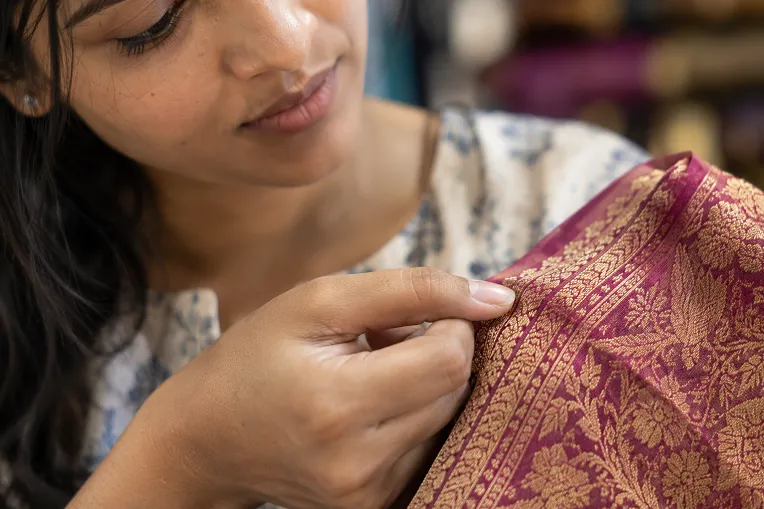
Most women assume brighter automatically means better quality. That assumption is exactly backwards, and sellers who use cheaper zari know it.
Here is the part nobody selling you a saree wants to say clearly. These five checks narrow down what you are likely holding, they do not conclusively prove precious metal content. A copper alloy can be tuned to survive a rub or scratch check, and a flame test on one thread tells you nothing about the rest of a six meter saree.
For an everyday kurta or a saree under a few thousand rupees, that uncertainty barely matters. For a piece running into tens of thousands, treating a thirty second home test as final proof is where people get burned, sometimes literally.
When a Home Test Isn’t Enough: What a Jeweller Can Actually Tell You
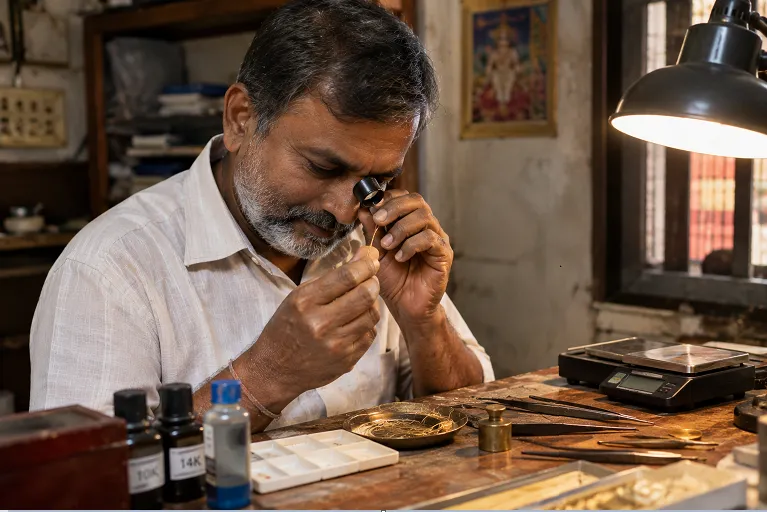
Most articles end their advice here with something vague like “get it verified by an expert.” That is not particularly useful on its own. A certified goldsmith or jeweller with an acid testing kit or an XRF machine can test zari’s precious metal content directly, the same way they verify jewellery purity, because it is fundamentally the same material.
This is not a stretch. Researchers have developed computerised XRF testing protocols specifically for zari thread, aimed at giving handloom silk sarees the same purity verification jewellery already gets. In parts of South India, some sellers even provide a government zari test certificate alongside pure zari sarees.
A jeweller visit usually takes fifteen minutes and often costs less than the price gap between a real and a tested zari saree. For anything above a few thousand rupees, that is a cheap way to stop guessing.
Reading the Saree Itself, Not Just the Zari
Banarasi silk is heavier than you expect, and if you are wearing it through a full wedding day, the weight from a real zari pallu starts pulling on your shoulder by evening. That weight is not a flaw. It is usually a sign of how much metal actually went into the weave.
Real zari does not stay gold forever. Silver oxidises, so over years it settles into a soft grey patina rather than staying mirror bright, and that muted look is actually prized on older Kanjivarams and Banarasis.
Imitation zari behaves differently. It tends to develop patchy black or greenish spots within a couple of years, especially through Surat’s humid stretches from June to September, because the copper underneath is reacting, not the surface finish ageing gracefully.
If you want to understand why zari behaves so differently depending on how it sits in the fabric, how a saree is actually woven breaks down the weaving mechanics behind it, including why borders carry heavier zari than the body of the saree.
How you store the saree afterward matters just as much as what you bought. Real zari tarnishes faster with humidity and direct sunlight, and getting how to store silk sarees right will slow that down by years.
Sarees with the heaviest zari work, Banarasi and Kanjivaram especially, tend to show up most during Diwali and wedding season, when the pallu is doing most of the visual work in a room. If you are still deciding what to build your wardrobe around before committing to a heavily worked piece, types of sarees in India is a reasonable place to start.

What Actually Matters Before You Buy
If you are close to buying a high value piece, do not stop at home tests. Ask the seller which grade of zari it uses, pure, tested, or imitation, and get it written on your bill. Above a few thousand rupees, a certified goldsmith or jeweller can run an acid test or XRF check the same way they verify jewellery.
These zari authentication tips work best combined, not alone. Ethora manufactures directly at its own unit in Surat, and sources everything else from Surat’s local textile market, so this advice comes from people who handle a genuine zari saree every working day.
Conclusion
Real vs fake zari was never really a yes or no question. The better question is which grade you are actually paying for, and whether the price matches it honestly. Home tests get you most of the way there. A jeweller and an XRF check get you the rest.
There is more practical, fabric-first writing like this across the Ethora blog, and it is worth a browse if this guide helped.
Our own store is launching soon, with everything made or sourced directly from Surat’s textile hub.
Frequently Asked Questions (FAQs)
How can I check zari quality without burning the thread?
Weight and colour tell you a lot before you ever need a flame. Real zari feels heavier for its size and has a duller, warmer shine, while imitation zari feels light and looks unusually bright under shop lighting.
On Kanjivaram borders specifically, the zari should feel noticeably heavier than the body of the saree, since that is where most of the metal sits. If the border feels suspiciously light for a piece sold as pure zari, that is worth questioning before anything else.
Does real zari turn black over time?
Yes, and that is actually a sign it is real. Silver oxidises with air exposure, so a genuine piece slowly settles into a soft grey patina rather than staying shiny forever. Imitation zari behaves differently, developing patchy black or green spots because the copper base underneath is corroding, not ageing gracefully.
Is tested zari the same as fake zari?
No, and treating them as the same thing is unfair to honest sellers. Tested zari uses a copper base coated in silver and gold, so it carries far less precious metal than pure zari but is openly sold as a mid-range option.
Fake or plastic zari, by contrast, usually has no precious metal at all and imitates the look purely through colour and finish.
Where can I buy a genuine zari saree without overpaying?
Start with a seller who tells you the zari grade upfront and puts it on the bill, rather than one who only says “it’s good quality” when asked.
Ethora manufactures its sarees, salwar kameez, kurtas and lehenga choli directly at its own Surat unit, and sources everything else straight from Surat’s local textile manufacturers. That gives you factory-level fabric knowledge and pricing without a chain of middlemen marking things up along the way.