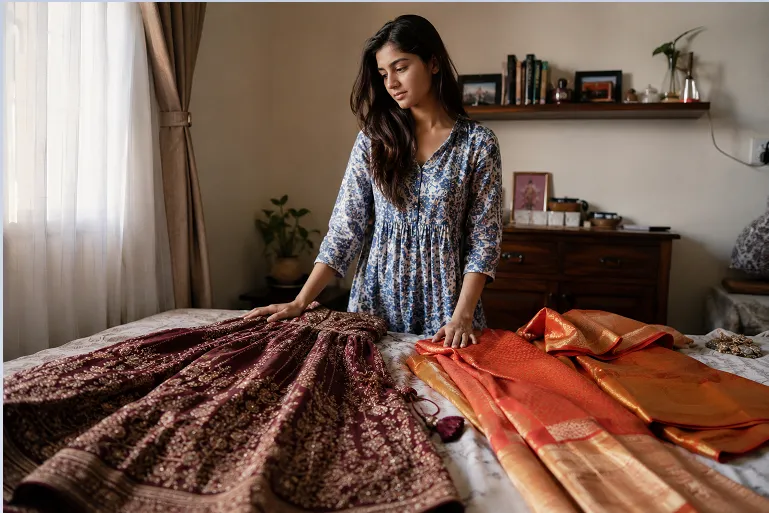
The DJ drops the first Punjabi beat, your cousins pull you towards the floor, and suddenly every step feels like dragging a curtain behind you. The waist is digging in. The hem is under your heel.
Most of us have stood at the edge of the floor holding our skirt like a shopping bag. It does not have to go that way. Learning how to dance in a heavy lehenga is mostly about fit, footwork and a few small fixes nobody mentions at the trial.
This guide covers seven of them, from waist to hem to dupatta. Think of it as a lehenga movement guide written by people who cut, stitch and carry these fabrics every day.
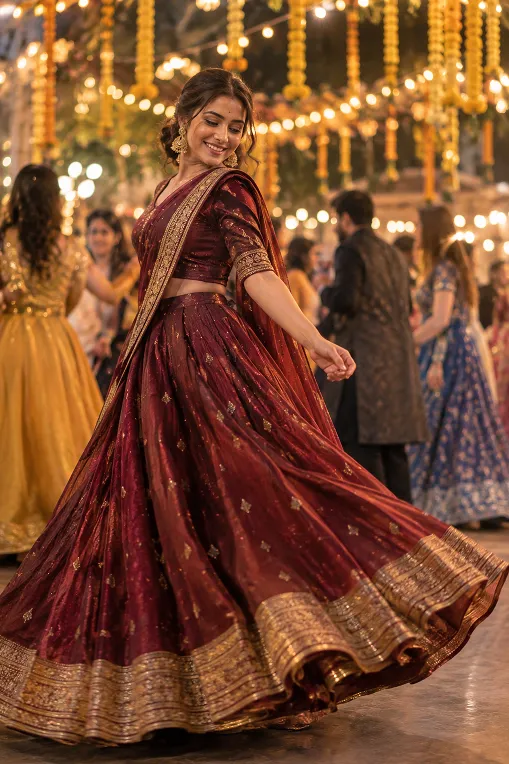
Table of Contents
Why a Heavy Lehenga Fights You in the First Place
The weight is not the real problem. Where the weight sits is.
A festive or bridal lehenga carries most of its load in two places, the waistband and the hem. Dense embroidery, three layers of can-can (the stiff net underskirt that gives the flare) and a wide border all pull downwards while your hips are trying to move.
The All India Artisans and Craftworkers Association describes genuine zardozi as dense and raised, with a heavy feel that comes from its metal coils. You feel every gram of that around your hips. You hear it too, because dabka and sequin work chinks softly against itself with every turn.
Fabric decides how that load behaves. Raw silk holds its shape and swings like a bell, while georgette has enough body to fall in clean folds and keep its ripple at the hem. A stiff net skirt over can-can hardly moves with you at all, and it scratches the thighs through thin lining by the third hour.
Add Surat’s October humidity or a packed Mumbai wedding hall, and a nylon can-can turns clammy against the skin in under an hour.
Around the cutting tables in Surat, you learn to judge a lehenga by how it hangs from a hook, not how it looks on a mannequin. You also learn that a skirt hanging evenly from the waist behaves very differently from one that drags from the hem, and only the first survives a full night of dancing.
How to Dance in a Heavy Lehenga Starts With the Fit
Nobody talks about this part because it is not glamorous. But if the waist and hem are wrong, no amount of dance practice will save you.
Everyone says to pick a lighter lehenga if you plan to dance. I disagree. A heavy lehenga that is cut and hemmed properly moves better than a light one that clings and tangles. Weight is manageable. A badly fitted waist is not.
1. Fix the Waist First
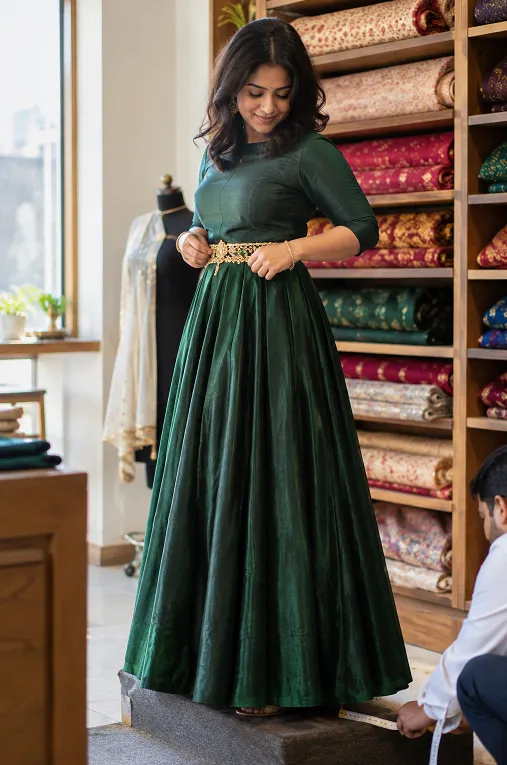
A drawstring alone is not enough for a heavy skirt. It slips as you move, and you end up tightening it until it bites. Ask for a stitched inner waistband with hooks, so the skirt sits on your natural waist and the weight spreads across your hips.
Then add a kamarbandh, the decorative waist belt, over the join. It looks like styling, but it also holds the skirt snug against you so the weight stops tugging your blouse downwards.
Sit down in it before you decide it fits. If you can only stand comfortably, the waist is too tight.
2. Fit the Hem in the Shoes You Will Wear
Here is the mistake I see most often. Women do the final trial in flat chappals or bare feet, then arrive on the day in three inch block heels. The hem ends up an inch too long or too short, and by then the tailor has gone home.
The hem should clear the floor by about an inch in the exact footwear you will dance in. Any lower and your heel catches on every backward step. Any higher and the whole outfit looks borrowed.
If you are unsure how much length suits you, this guide to lehenga length for your height explains the measurements.
Walking and Dancing Without Tripping Over Your Skirt
With the fit sorted, the next problem is movement. Here is how to dance in a heavy lehenga and still get across the venue in one piece.
3. Shorten Your Stride
Walking in a lehenga is where most tripping happens, and it is rarely on the dance floor. It is the stairs to the stage, the step into the hall, or the last step down from an auto rickshaw.
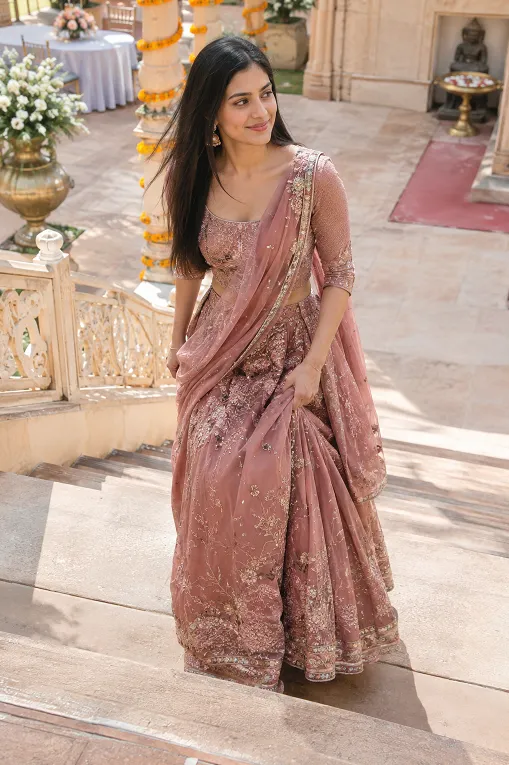
Take steps about two thirds of your normal length. Look ahead, not down, and gather the skirt at your hips just enough to clear the step, about two or three inches. Lifting higher throws off your balance and shows off your shoes for no reason.
Getting into a car works on the same idea. Gather the skirt at your sides, sit first, then swing your legs in. Dragging the skirt in behind you crushes the can-can and creases the border.
4. Gather From the Sides, Not the Front
Pinching the front hem is the natural instinct, and it is the wrong one. It lifts the skirt unevenly, exposes your feet and leaves the back trailing for someone to step on.
Instead, hold a small fold at each hip with your fingers, or keep one side loosely gathered at hip height. The weight then rides on your arm instead of dragging at your waist, and the skirt lifts evenly all the way round.

5. Start Turns Slowly and Stop Them on Purpose
A heavy skirt has momentum. Once it is swinging, it wants to keep swinging, which is exactly why the hem wraps around your legs the moment you freeze. Start a twirl slowly, let the skirt catch up, then step out of the turn instead of stopping dead.
There is a particular sound a well cut raw silk lehenga makes as it opens out, low and full, nothing like the flutter of georgette. Once you feel that rhythm, you stop fighting the weight and start using it.
For bhangra or Garba beats, keep your steps small and your knees soft. Small steps, big flare.
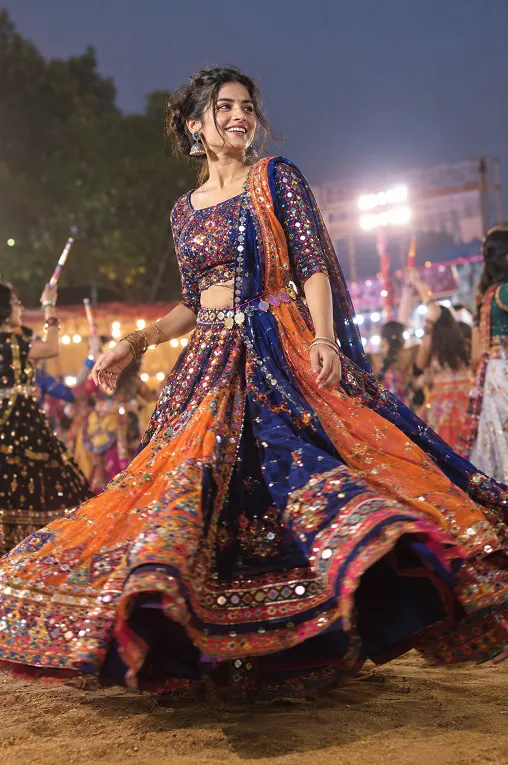
Every guide on how to dance in a heavy lehenga tells you to rehearse, and every guide is right. Twenty minutes at home in the actual lehenga, a week before, teaches you more than any video.
If you are still choosing an outfit for the night, these sangeet outfit ideas built around dancing are worth a look first. And since Garba nights usually favour a wider, lighter flare, it helps to know how a chaniya choli differs from a lehenga before you buy.
Small Lehenga Comfort Tips That Save the Night
6. Sort Out the Layers Underneath
What sits under the lehenga matters as much as the lehenga itself. Layers of net can-can hold heat and scratch the thighs. A soft cotton underskirt, or a thin cotton lining between you and the net, makes a big difference by the third hour.
Add soft cotton shorts underneath to stop thigh chafing in humid weather. It is unglamorous. It is also why some women dance until midnight and others give up at ten.

7. Pin the Dupatta and Pack a Small Kit
Most heavy lehenga styling tips stop at jewellery and hair. The pins and the potli are what actually keep you on the floor.
A dupatta that is only draped will be on the ground in two songs. Pin it in three places, at the shoulder, mid back and waist, from the inside so the pins do not snag the embroidery. A Banarasi or brocade dupatta is heavier than it looks, and by evening the shoulder pin starts to tell you so.
Keep a small potli with four or five safety pins, a hair clip and a pair of soft juttis or flats. Around 11 pm, swapping heels for flats does more for your stamina than any plate of snacks.

What to Check Before You Buy a Lehenga for Dancing
Turn the skirt inside out before you pay. Rough thread ends and hard stone backs will scratch and snag once you start moving, so look for a soft lining behind the embroidery. Ask how many layers of can-can it carries and whether they can be reduced.
Hold the skirt at the waist for thirty seconds. If your wrist tires, your hips will too. Cheap versions skip the inner finishing, use stiff nylon net and hang everything from a single drawstring.
We manufacture lehenga choli at our own Surat unit and source everything else from Surat’s local textile market, so this advice comes from people who handle these fabrics every day.
Conclusion
Do the full trial once. The actual lehenga, the actual shoes, and twenty minutes of dancing to your favourite songs, a week before the event. Any trouble with the waist, hem or dupatta shows up in the first five minutes, while there is still time to fix it.
A lehenga you have already danced in at home is one you can forget about on the night.
If this helped, there are more honest fabric and styling guides waiting on the Ethora blog.
Our store is launching soon, with products coming directly from Surat’s manufacturing source.
Frequently Asked Questions (FAQs)
How to dance in a heavy lehenga without holding the skirt all night?
Gather a small fold at each hip and let the weight rest on your forearms, then move mostly from the hips. For a hands-free option, ask your tailor to stitch two soft loops inside the hem at the side seams. Slip a finger through each loop and the hem lifts evenly, leaving your palms free for the steps.
Which lehenga fabric is easiest to dance in?
Georgette and soft net move most freely, and organza gives a light, airy flare. Velvet is best saved for a Delhi winter wedding, because it holds heat and its pile drags on the floor. Check the lining too, since satin lining turns slippery and sticky in humidity while cotton lining lets the skirt swing cleanly.
How do I use the washroom in a heavy lehenga?
Take a friend along the first time and gather the skirt from both sides at once, bunching it over your forearms instead of lifting the back. Cotton shorts underneath mean you are never wrestling extra layers. One practice run at home saves a lot of panic at the venue.
What should I check when buying a lehenga online for dancing?
Ask for the hem length in centimetres, not just floor length, along with the can-can layer count and whether the lining is cotton. Look for hooks at the waist, not a lone drawstring. Ethora manufactures at its own Surat unit and sources other products directly from Surat manufacturers, giving you real fabric knowledge and factory-level quality without middleman pricing.
A lehenga that moves with you on the dance floor starts with how and where it is made. Ethora manufactures at its own unit in Surat, and everything else is sourced directly from Surat’s local textile manufacturers. Our store is launching soon.