You have tried every saree draping trick from every fashion page, and the pleats still end up sitting oddly around your hips by the time you reach the venue. That gap between what the photo promised and what actually happened in the mirror is real, and it rarely has anything to do with which saree you picked.
For a complete guide covering all four body types including apple, hourglass and rectangle, our saree for body type guide covers every shape with fabric and border advice, including a short section on saree for pear shaped body styling. This article goes deeper into just that one shape.
Pleat width, the exact drape style you choose, and where your blouse ends all change how a pear shape reads in a saree, and almost nobody explains why. Once you see the mechanics, you stop guessing.
Table of Contents
Why Pleat Width Changes Everything for a Saree for Pear Shaped Body
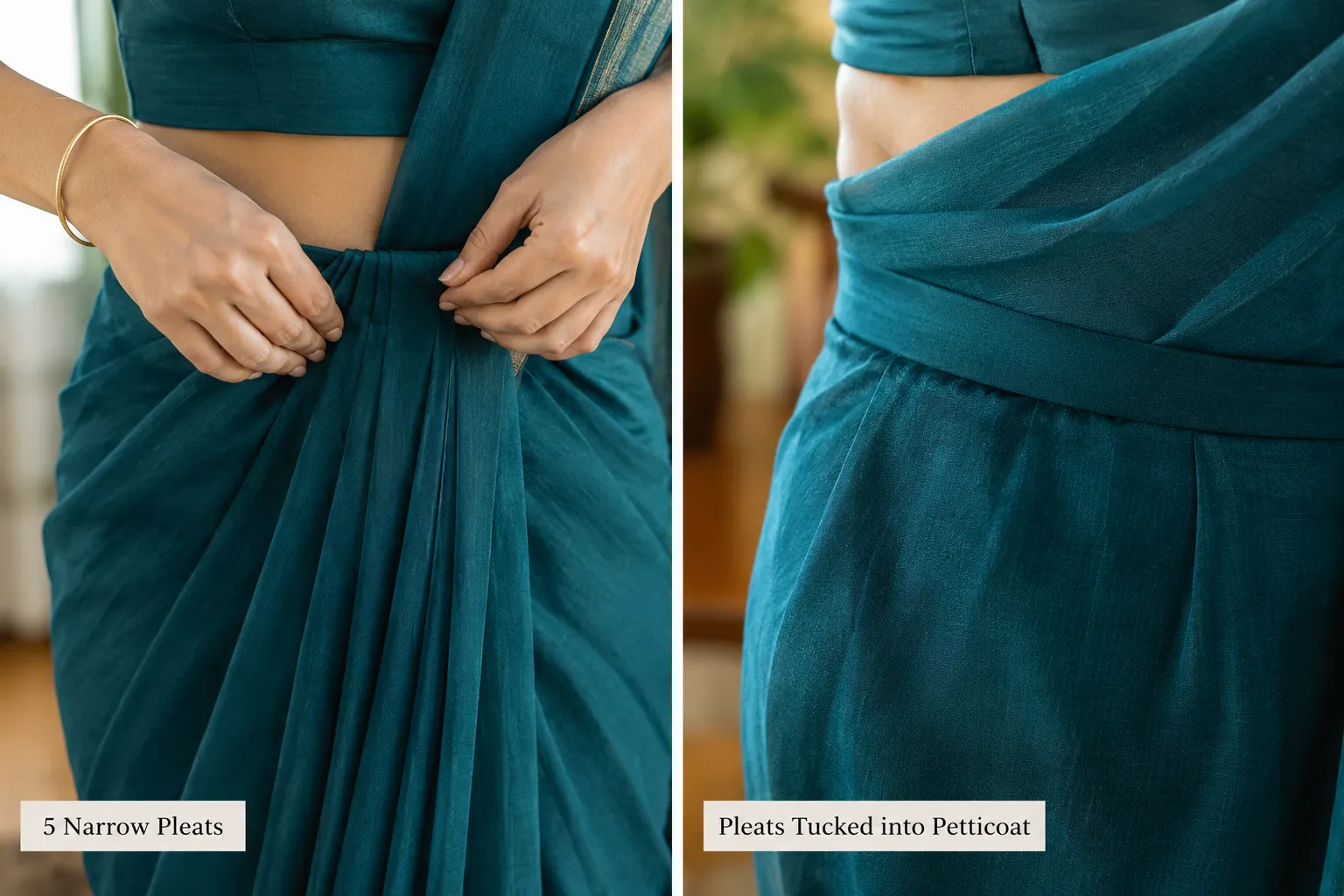
Here is something most styling articles never mention. The width and number of your front pleats matter on their own, completely separate from the fabric or border you chose.
Narrow pleats that fall straight down from the waist keep the hip line sleek. Wide or fanned pleats, the kind that flare out at the top before falling, add visible bulk at exactly the point a pear shape does not need it.
This has nothing to do with whether your saree is plain or heavily worked. A saree with five narrow, evenly pressed pleats will always look neater on wide hips than the same saree pleated into eight loose, fanning folds.
Fabric body plays into this too. Georgette has more structure than chiffon, so narrow pleats made in georgette hold their shape when you are moving through a crowded function, while the same pleat count in soft chiffon can start drifting wider within an hour of wear.
Your petticoat fit changes this as well. A loose petticoat forces you to compensate with extra pleats to get a snug tuck, which is exactly the fanning effect you are trying to avoid.
Getting the fit right at the waist first, before you even start pleating, is worth the extra two minutes. Our saree petticoat guide walks through the fit adjustments that actually hold pleats in place through a full day.
Most women blame the saree’s print or border when the pleats bulge at the waist. Honestly, the actual problem is almost always pleat count and width, not the saree itself.
Which Saree Drape Actually Balances a Pear Shape
This is where most saree styling advice stops short. Everyone says “choose a balancing drape” for a saree for pear shaped body without ever naming which one actually does that.
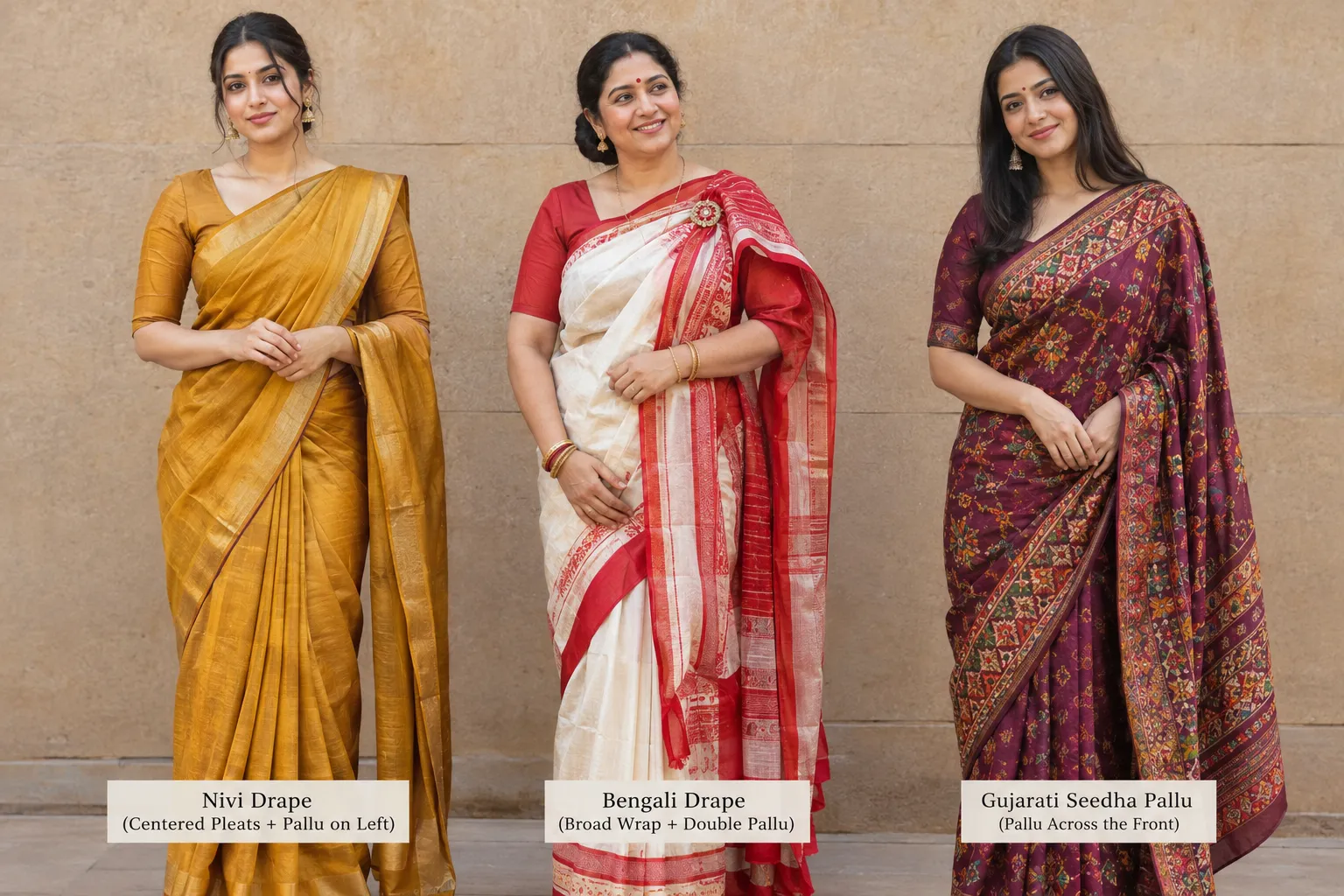
Nivi drape. The most common style across India, with pleats centred and tucked at the waist. For a pear shape, Nivi keeps the pleats compact rather than spread across the hip, which adds structure without extra emphasis on the widest part of the body.
Bengali drape. This style wraps more broadly across the upper body and shoulders before the pallu falls. That extra width up top creates a proportional illusion against wider hips below, so the eye reads the whole silhouette as more balanced rather than bottom heavy.
Gujarati drape. Also called the seedha pallu, this style brings the pallu across the front of the body instead of the back. Because the most decorated part of the saree sits facing forward near the shoulder, it draws attention upward and outward rather than letting the gaze settle at hip level.
Regional drapes have carried these exact proportional effects for generations, long before anyone called it “body balancing.” A Google Arts and Culture story on India’s regional sari drapes, built with the CSMVS museum in Mumbai, notes that Bengali draping traditionally emphasises the border while Gujarati draping puts the pallu front and centre.
That is precisely the visual logic that works in a pear shape’s favour.
Everyone tells pear-shaped women to avoid the Gujarati drape because more fabric sits near the front. That advice misses the point. If the pallu falls diagonally toward the shoulder rather than pooling low near the hip, it pulls the eye up, not down. The angle of that fabric matters more than which drape you picked.
Which of these actually suits you also depends on fabric weight, since a stiff silk will not fall the same way as a soft georgette in any of these three drapes.
If you are unsure where you land, Ethora’s free body type calculator gives you a result in under two minutes based on your actual measurements, which makes choosing between these drapes far less of a guessing game.
Blouse Length Decides More Than Structure or Volume
Structured shoulders and a bit of sleeve volume get talked about often for pear shapes. What barely gets mentioned is that blouse length is its own separate decision, and getting it wrong undoes everything else you just got right.
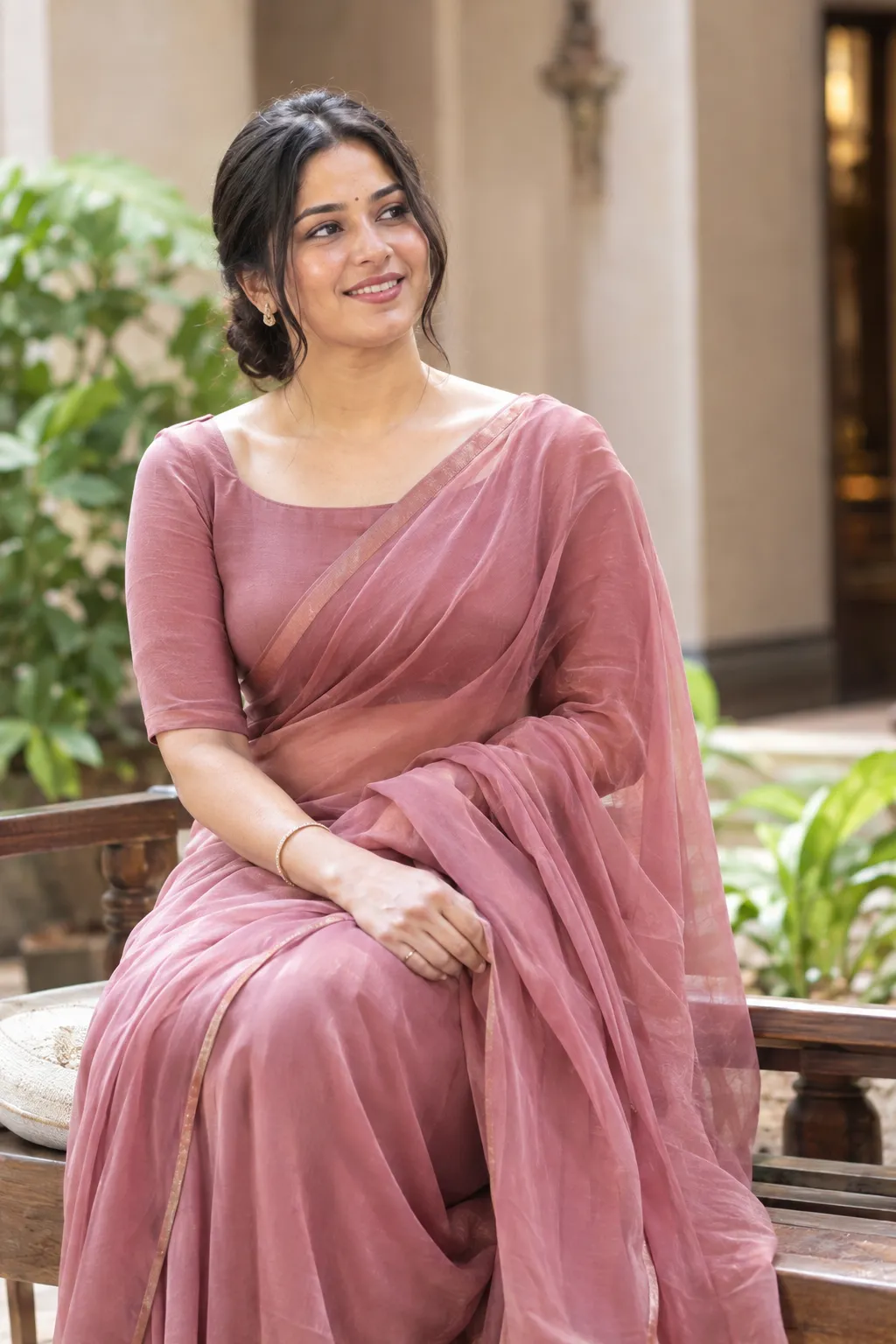
Shorter or waist length blouses are the better choice for a pear shape. They end exactly where the body already narrows, so there is nothing extra to smooth over.
Longer, corset style blouses that extend past the waist are actually built for apple and rectangle shapes, where the goal is smoothing a fuller midsection. A pear shape typically already has waist definition, so that extra length just adds fabric where none is needed.
You do not need a corset blouse to look put together. A well fitted, waist length blouse does more for a pear shape than a longer style ever will, no matter how structured its shoulders are.
A blouse that ends right at the natural waist, lined properly, sits flat against the skin instead of digging in when you sit through a long reception dinner. That comfort detail matters as much as the visual one.
Once the length is settled, the back of the blouse is the next thing worth getting right, since a plain back can undercut all the structure you built at the front. Our guide on saree blouse back designs by body type covers which back styles carry that structure through.
Petite Pear vs Tall Pear: The Same Rules, Different Volume
Height changes how much of this you can actually use. A petite pear frame and a tall pear frame are working with the same imbalance, but not the same amount of room to play with.
If you are petite, keep the overall volume lower. Vertical patterns, narrower borders and the Nivi drape tend to work better than anything with heavy horizontal spread, since too much fabric on a shorter frame can shorten your silhouette further rather than balancing it.
Taller pear frames have more room to experiment. The Bengali drape’s broader wrap and layered pallu, which can overwhelm a petite frame, actually reads as intentional and elegant on someone with more height to carry it.
This same shape logic follows you into everyday wear too, not just sarees. If you are also choosing kurtas, our guide on kurta cuts for pear shaped body covers which necklines and hem lengths follow the same balancing principle.
And if you are genuinely unsure whether pear is your shape at all, it is worth checking the opposite problem too. Our piece on saree for hourglass figure covers the reverse balancing act, where the waist is already defined and the goal is keeping that definition visible rather than shifting focus away from the hips.
What to Check Before You Buy or Stitch the Blouse
If you are buying a pre-stitched saree or handing a blouse piece to your tailor for a saree for pear shaped body, check the blouse length first, not the embroidery or the neckline.
Ask for a waist length cut, and be specific about it, since “regular length” means different things to different tailors. A blouse that runs even two inches past the waist changes the entire balance the pleats and drape were built around.
This is the kind of detail that only shows up once you have handled enough fabric and enough finished pieces to know where things go wrong.
Ethora manufactures its sarees, blouse fabric and kurtas directly at its own unit in Surat, and sources everything outside that range from Surat’s local textile market, so this advice comes from people who cut and stitch these pieces every day, not just style them for photos.
Conclusion
If there is one thing to take from all of this, it is that pleat width and blouse length do more work than fabric or border choice ever will for a pear shape. Get those two right first, and the rest of the styling falls into place with far less effort.
There is a lot more on saree styling, fabric behaviour and body type specific fixes on the Ethora blog if you want to keep exploring. Our store is launching soon, with everything made at our own Surat unit or sourced directly from Surat’s manufacturers, so you get the real thing without the middleman markup.
Frequently Asked Questions (FAQs)
Which saree drape is best for a pear shaped body?
Nivi and Gujarati generally work best because they keep pleats compact and pull visual attention toward the shoulder and pallu rather than the hip. Bengali works too, but only on taller frames that can carry its wider wrap without looking overwhelmed.
How many pleats should I make in a saree if I have wide hips?
Somewhere between five and seven narrow pleats usually holds better than nine or ten wider ones. The exact number depends on your saree’s fabric width, but the principle stays the same regardless of the saree itself, narrower and fewer beats wider and more.
Does saree fabric affect how the pleats hold on wide hips?
Yes, and this rarely gets mentioned. Georgette and crepe hold a pleat’s shape through movement because they have more body than chiffon, which is softer and tends to loosen at the fold within a few hours of wear, especially in humid weather.
Where can I buy good quality saree blouse fabric online?
Check whether the seller can tell you the fabric’s actual composition and weight, not just its colour and print. Ethora manufactures sarees, blouses and kurtas at its own Surat unit and sources everything else directly from Surat’s textile manufacturers, which means genuine fabric knowledge and factory level quality without the usual middleman pricing once the store is live.
Is a busy border still a good idea for a pear shaped body?
Yes, a busy or embellished border still works well and pairs naturally with the pleat and drape choices covered here. Just remember it is one part of the picture, not the whole fix, since pleat width and blouse length are doing more of the actual balancing work.
Getting the pleats and drape right for a pear shape is less about the saree you buy and more about the small details around it. Ethora makes its sarees and blouse fabric at its own manufacturing unit in Surat, and everything else in our range comes directly from Surat’s local textile manufacturers, so you are getting real fabric knowledge, not guesswork. Our store is launching soon, sign up below to know the moment it opens.