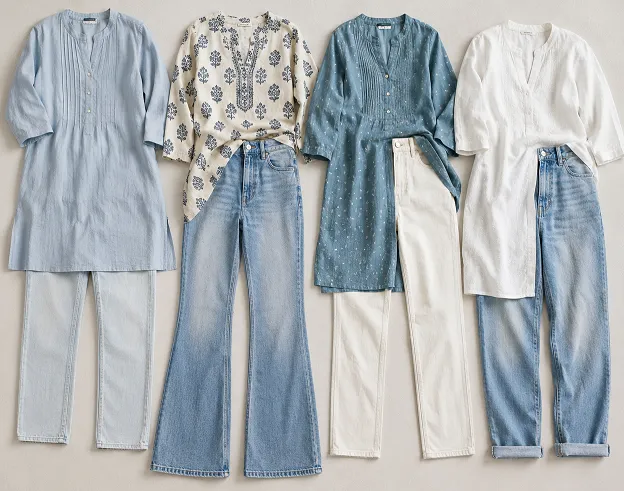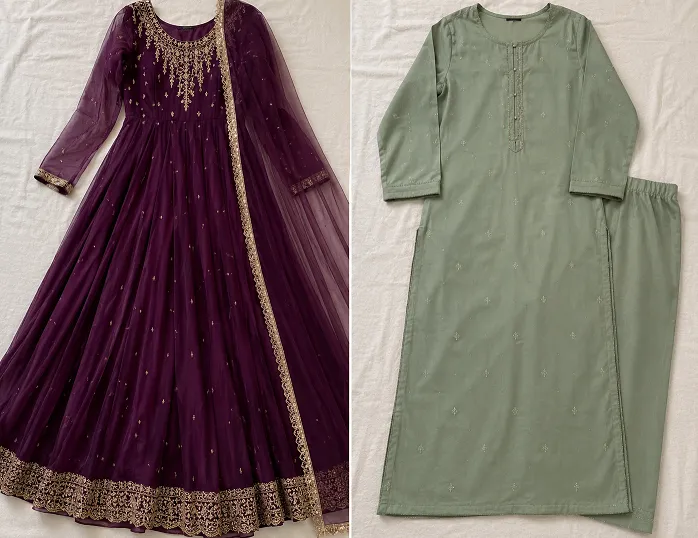
My cousin runs a small boutique near Ring Road, and last month a mother and her sixteen year old daughter walked in wanting the exact same georgette kurta set, just in different sizes. That request always makes her wince a little.
A teenager’s ethnic wear and a working woman’s ethnic wear are not the same purchase wearing two different sizes. One outfit gets worn to a school function twice a year. The other gets worn to office, then to a client meeting, then washed and worn again next week.
This is where most advice about ethnic wear for teenagers goes wrong. It treats every woman under thirty as one customer with one set of needs, when a teenager’s day and a working woman’s day genuinely don’t look the same.
Table of Contents
Ethnic Wear for Teenagers vs Working Women: Why the Shopping Logic Is Completely Different
A teenager’s kurta set is usually bought by a parent, worn occasionally, and needs to survive a growth spurt more than a hundred washes. That changes what actually matters when you shop.
Versatility and cost matter more here than anything else. A chaniya choli bought for Navratri this year should still work as separate pieces next year, even if her waist has changed by an inch or two.
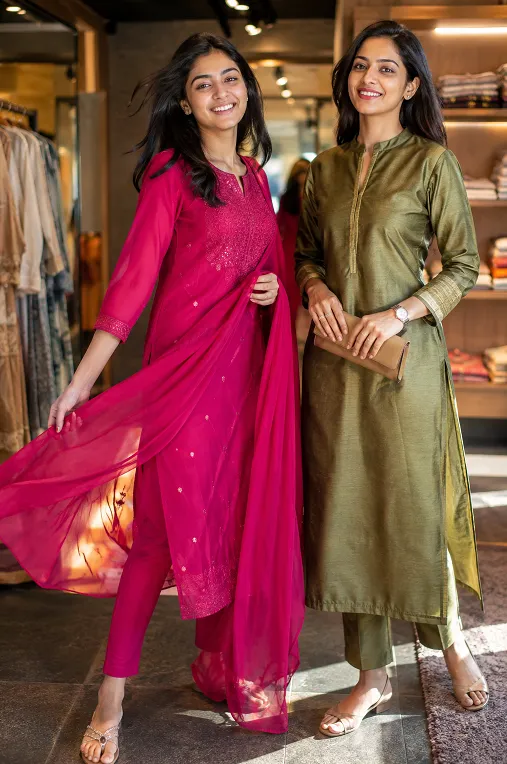
A working woman’s ethnic wear runs on a completely different logic. She might wear the same three or four kurtas on rotation every week, through Surat’s humid summers and the AC-cold of her office.
So durability and easy upkeep take priority over anything trendy. If a fabric creases the moment she sits at her desk, or bleeds colour after two washes, it doesn’t matter how good it looked in the trial room.
Most families still shop for both groups using identical logic, and it shows. A growing teenager ends up in a heavy, durable fabric meant for daily office wear, and a working woman ends up in a delicate net kurta that can’t survive a Monday to Friday routine. It never really was one purchase.
The Real Reason Their Days Ask for Different Fabrics
A teenager’s day rarely stays still. School, walking between classes, a rickshaw ride, maybe practice right after, her ethnic wear gets pulled, sat on, and moved in ways a working woman’s rarely is.
Georgette has more body than chiffon, so it holds a pleat and keeps its shape even when she’s climbing stairs or grabbing an auto in the last five minutes before the bell rings. A well-cut cotton kurta with a little give in the fabric handles a full day of movement better than anything stiff or heavily embellished.
A working woman’s day asks for something else entirely. She’s sitting through long meetings, commuting through Surat’s traffic, back at her desk again, and doing all of it in fabric that has to look unwrinkled by six in the evening.
This is where fabric weight becomes a real consideration and not just a styling detail. Banarasi silk is heavier than people expect, and if she’s wearing it through a full workday, the pull on her shoulder from the pallu starts to show by evening. A lighter cotton-silk blend or a well-woven georgette manages a desk job far better.

There’s a real difference in how these fabrics feel against the skin after eight hours too. Stiff, heavily starched cotton can feel scratchy by evening, while a softer modal blend keeps its ease all day, even in Surat’s humidity, since modal doesn’t cling to the body the way rayon tends to.
If you want to actually judge whether a fabric will hold up to that kind of daily wear before you buy it, checking the international care label symbols on the garment tells you more than the price tag ever will. For more on which specific cuts genuinely survive a desk job, our guide to kurta styles built for working women covers the silhouettes that hold up hour after hour.
Why Colour Boldness Isn’t a Personality Trait, It’s a Reflection of the Room
Everyone repeats the same line: teenagers wear bright colours, working women wear muted ones. Nobody usually explains why, so it sounds like a rule about age instead of what it actually is, a reflection of the room each of them walks into.
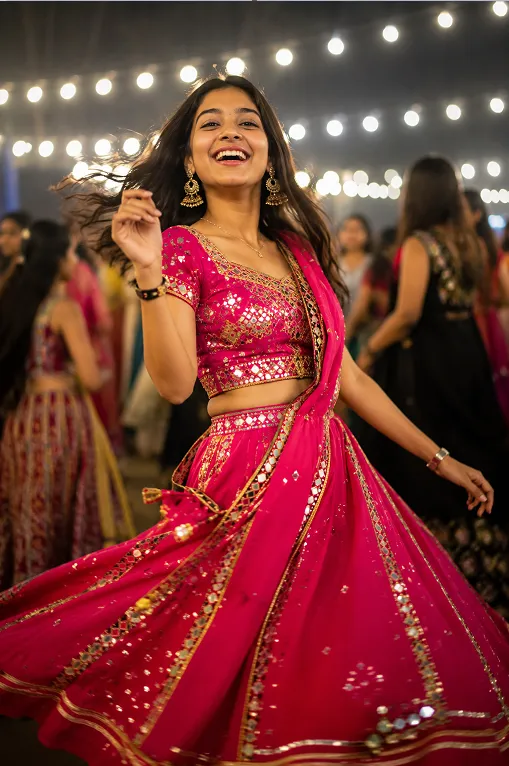
A teenager’s world, school, college fests, friend circles, rewards loud colour and bold prints. Nobody at a Navratri garba night is going to judge her for a mirror-work chaniya choli in fuchsia. That’s the entire point of the outfit.
Chiffon catches light in a way heavier cotton silk simply doesn’t, and there’s a certain drama in a chaniya choli glinting under garba lights that would look completely out of place under office tube lighting the next morning.
A workplace carries its own unspoken rules, and they usually aren’t written down anywhere. Studies on interview and workplace attire consistently show that muted, structured colour choices read as more competent in a professional context, while brighter or busier colours tend to read as more casual.
That doesn’t mean a working woman has to disappear into beige. A well-tailored kurta in a deep jewel tone, bottle green, wine, indigo, reads as polished in most Indian offices, and it does more for her confidence on a Monday morning than another safe, forgettable neutral ever will. That’s an unpopular opinion in most styling advice, but it holds up.
The same logic carries over to jewellery, not just colour. A teenager can wear large jhumkas and a stack of bangles to a college fest without a second thought, because bold accessories fit the room she’s walking into.
A working woman’s accessories usually need to disappear into the background instead. Small stud earrings and a single slim bangle won’t catch on a laptop bag strap, a phone call, or a stack of files the way bigger pieces will, and that quiet practicality reads as polish in an office the same way a muted colour does.

So the colour and accessory choices were never really about age. They’re about which room you’re standing in and what that room has quietly decided counts as appropriate.
Getting the Fit Right: A Real Fit Guide by Age, Not Just Size
Getting age appropriate ethnic wear right starts with fit, not colour. Most women choose a kurti length based on what looks good on the hanger. That’s the wrong way to do it, and it’s the single most common mistake I see repeated across both age groups.
For a teenager, kurti fit for teenagers vs adults comes down mostly to proportion and room to move. A slightly looser cut through the chest and shoulders that still narrows a little at the waist works better than anything fitted, since her body is still changing and comfort gets tested at school, not in a fitting room mirror.
A working woman needs a different kind of fit guide by age altogether. Structure matters more than looseness. A kurti that skims the body without clinging, with sleeves that don’t ride up when she’s typing or holding a coffee cup through a nine-to-five, actually does its job.
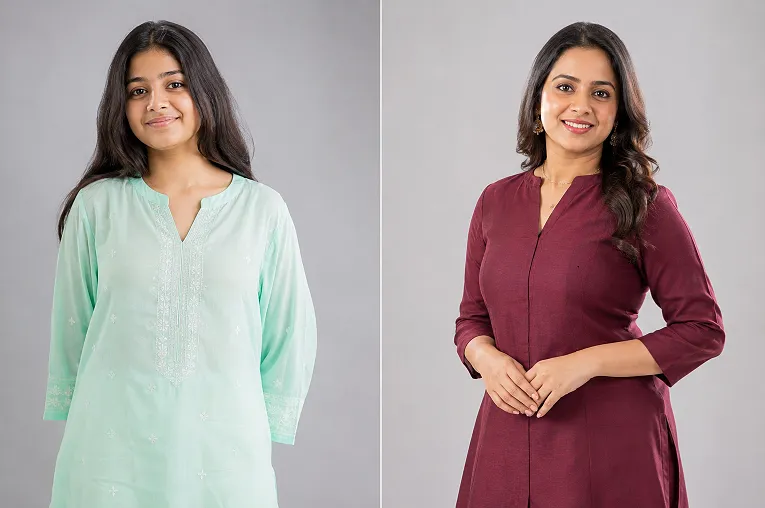
If you’re standing in front of two racks trying to decide which fit works for which of you, start with the day ahead of her, not the size on the tag. If you’re genuinely unsure which body type category either of you falls into, Ethora’s free body type calculator gives a result in under two minutes based on real measurements, not guesswork.
For the exact test on judging kurti looseness before you buy, our breakdown on how loose a kurti should actually be walks through it step by step.
These ethnic wear styling differences aren’t about one age group being more fashionable than the other. They come from two genuinely different relationships with clothing, one that’s still growing into itself, and one that needs to perform through a demanding, repetitive routine.
What Actually Matters Before You Buy
When you’re buying ethnic wear for teenagers, check for room to grow before you check for the print. Look at the seam allowance on the sides and the fabric of the lining. Kurtas and chaniya cholis often have enough hem and side seam to let out an inch or two later, which matters more than buying one size too big and hoping it works out.
For a working woman, check the fabric weight and how it holds up to weekly washing before anything else. A garment that needs dry cleaning every single time isn’t realistic for someone wearing ethnic wear several days a week.
This comes from making these fabrics ourselves. Ethora manufactures its sarees, salwar kameez, kurtas and lehenga choli directly at our Surat unit, and sources everything else from Surat’s own textile market, so this advice comes from people who actually handle these fabrics daily, not just style them.
One Wardrobe Truth Worth Remembering
Ethnic wear for teenagers and ethnic wear for working women are solving two different problems, not two versions of the same one. Buy for growth and versatility in one case, and for durability and daily performance in the other, and most of the sizing and styling confusion disappears on its own.
If this kind of practical, real-world comparison is useful, there’s more of it waiting on the Ethora blog, written by people who actually work with these fabrics every day. Our online store is launching soon, with pieces manufactured at our own Surat unit and sourced directly from Surat’s textile market, at prices without the usual middleman markup.
Frequently Asked Questions (FAQs)
What is the biggest difference between ethnic wear for teenagers and working women?
The biggest difference isn’t the print or the colour, it’s what the outfit needs to survive. A teenager’s outfit needs to survive growth and occasional wear, while a working woman’s needs to survive daily washing, sitting, and a full workday. Shop for that difference instead of just age, and the right fabric and fit choices become obvious.
Can a teenager and her mother wear the same ethnic wear style?
They can share a print or a colour family without wearing an identical fit. A shared georgette suit set styled with a fitted, structured cut for the mother and a slightly looser, relaxed cut for the daughter respects both their days without looking mismatched.
Which ethnic wear fabric is easiest to maintain for daily office wear?
Cotton-silk blends and good quality modal generally hold up best to frequent washing without losing shape or colour quickly. Pure chiffon looks beautiful but tends to snag and lose its finish faster with weekly wear, so it works better for occasion wear than for daily office rotation.
How do I know if ethnic wear fabric is good quality before buying it online?
Check whether the fabric has a slight natural texture and weight rather than feeling papery or overly stiff, and look closely at the finishing on the inside seams. Since Ethora manufactures directly at its own Surat unit and sources everything else straight from Surat’s textile manufacturers, you get factory-level fabric knowledge and quality without paying for several layers of middlemen in between.
Is it okay for a teenager to wear bold colours to a family function?
Yes, a family function is a far more forgiving space than an office, closer to the same social context as school or college. A teenager can wear far bolder colour and print than a working woman would choose for her Monday desk, and it isn’t inappropriate, it’s simply a different room with different unspoken rules.
Shopping for a teenager and a working woman under the same roof usually means two very different wardrobes, not one compromise. Ethora manufactures its sarees, salwar kameez, kurtas and lehenga choli at our own unit in Surat, and for everything else, we source directly from Surat’s local textile manufacturers. Our store is launching soon, so you’ll be able to shop pieces built for real, different days, at prices without the usual middleman markup.