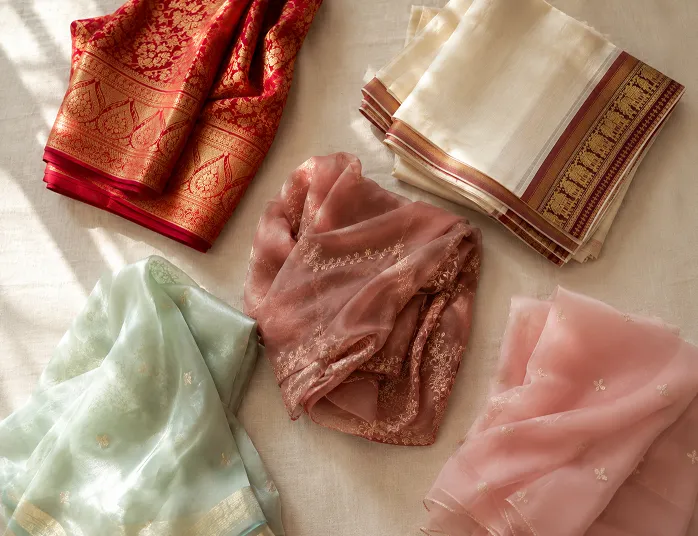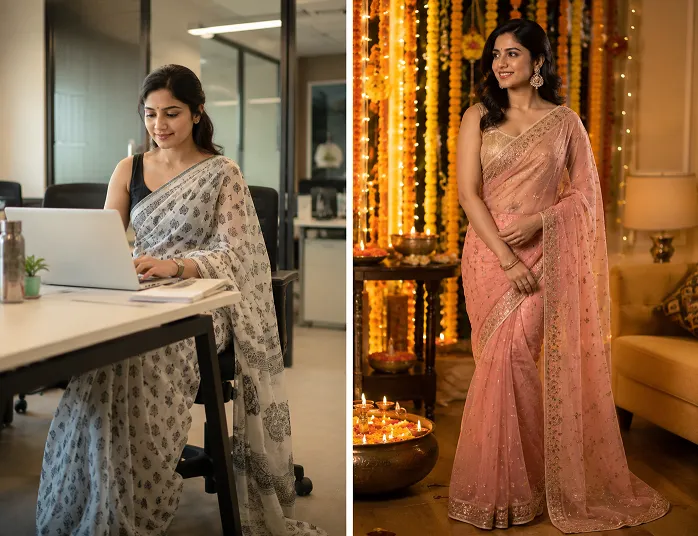
Three days before your cousin’s shaadi, your almirah is open and half your sarees are lying across the bed. The georgette from last Diwali suddenly looks tired. The silk one still has fold marks from the last function. You are standing there wondering how many sarees do you need to stop this exact scene from repeating every wedding season.
Most fashion articles answer this with one flat number. Own 6 to 10 sarees, they say, and move on. That number was written for nobody in particular, which means it was not really written for you either.
This article works differently. It walks through the real factors that decide your number, the cost per wear thinking that turns shopping into a decision instead of a guess, and the upkeep side of owning more sarees that almost nobody talks about honestly.
Table of Contents
How Many Sarees Do You Need? The 4 Factors That Actually Decide It
Here is the problem with 6 to 10 as a universal rule. A college student in Ahmedabad who attends two weddings a year and wears kurtis to class does not need the same wardrobe as a working woman in Mumbai juggling four shaadi season events, a joint family, and a saree-friendly office.
Most women build their saree count by how many they have already bought, not by how many their actual year of events needs. That is backwards. It is exactly why half the collection sits untouched while the same three sarees get repeated at every function.
Building a saree collection that actually works starts with four honest questions, not a shopping list.
- How many weddings and festive events you attend in a year. Someone with four shaadi season events plus Diwali and Navratri needs more variety than someone attending one wedding, since repeating the same saree in front of the same guest list twice in one season does get noticed.
- Your work dress code. If your office expects sarees on Fridays or client days, our guide to sarees for office wear is worth reading, since daily wear needs fabric that survives repeat use and quick ironing, not just occasion pieces.
- Your climate. Mumbai humidity behaves nothing like Rajasthan heat or Delhi winters, and your fabric choices should follow the weather, not just the calendar of events.
- How much storage space you realistically have. A small apartment almirah with limited hanging space changes the math completely, since sarees you cannot store properly get creased, forgotten, or damaged before you ever rewear them.
Add these four together and you get a number that fits your actual life, somewhere between four sarees for someone attending very few events and fifteen or more for a heavy shaadi season with a saree-first office. There is no universal answer. There is only your answer.
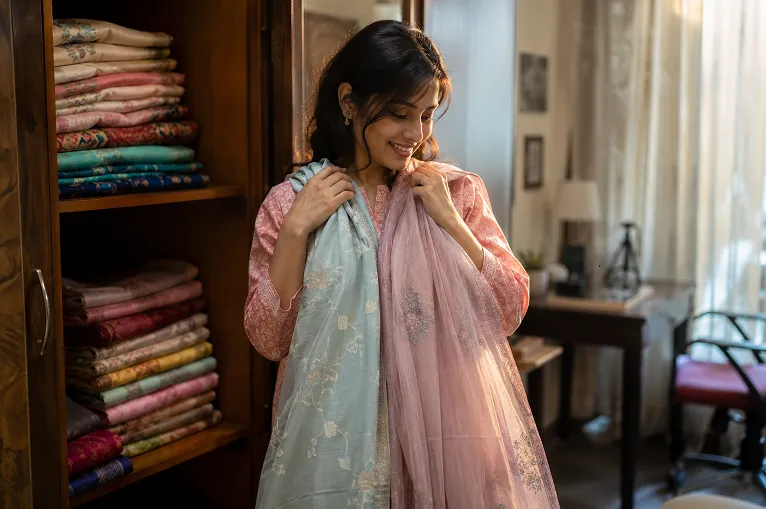
Think in Cost Per Wear, Not Just Occasion
Once you know roughly how many sarees you need, the next question is where to spend. Two sarees can cost the same amount and be completely different investments once you calculate what each rupee actually buys you in wear.
Take a heavily embroidered silk you wear twice a year against a georgette you reach for every second weekend. Divide the price by how many times you actually wear it, and the georgette usually wins even though it cost far less upfront.
Georgette has more body than chiffon, so it holds its pleats through a full day of walking, sitting, and climbing in and out of an auto rickshaw without going limp by evening. That is exactly why it earns its place as a frequent-wear fabric rather than an occasion-only one.
Everyone tells you to buy more affordable sarees to stay safe. Honestly, one very good silk saree that photographs beautifully and gets complimented every time beats five average ones that all blur together in photos from different weddings.
You already know the saree you reach for every single time. That is your highest cost-per-wear piece, and it deserves the better fabric budget next time around.
The Upkeep Nobody Warns You About
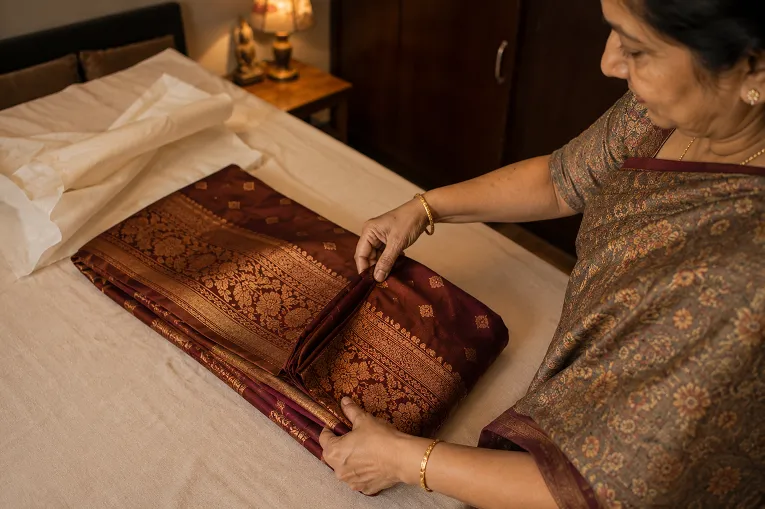
Nobody tells you this part when you are buying your fifth or sixth silk saree. Every silk saree needs periodic re-folding, roughly every two to three months, or the fabric develops a permanent crease exactly where it has been folded.
I have seen beautiful ten-year-old collections that were never re-folded, and by the time the saree comes out for a wedding, there is a visible line across the pallu that no amount of ironing removes completely.
Banarasi silk is heavier than most people expect before they actually wear one for a full day event. By evening, the weight sitting on your shoulder from the pallu genuinely starts to show, and that matters when you are choosing between a twelve hour wedding and a two hour puja.
The craftsmanship behind that weight is documented by the Central Silk Board, which tracks how India’s major silk weaving centres, including the ones close to home in Surat, produce fabric this dense and this detailed.
If you already own silk pieces, our guide on how to store silk sarees covers the re-folding schedule and the exact way to prevent this kind of permanent creasing.
This is the part the 6 to 10 rule conveniently skips. Ten silk sarees do not just mean ten times the storage. They mean ten times the re-folding, ten times the airing out before monsoon humidity sets in, and ten times the risk of one getting damaged in the back of the almirah.
What Your Saree Wardrobe Actually Needs to Cover
Once your number and your budget logic are sorted, the actual composition matters less than most articles make it sound. Think of this as a saree capsule wardrobe, a small set that covers every situation you actually face, rather than a pile that keeps growing.
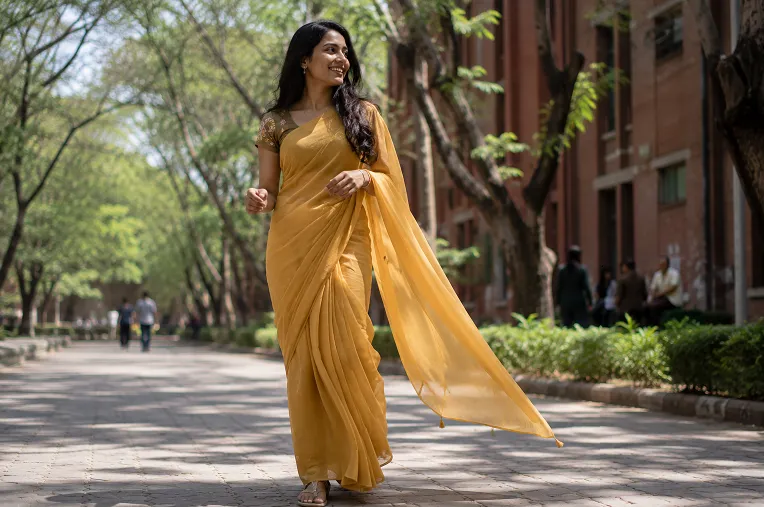
A college student in Ahmedabad, Surat, or Mumbai usually does well with two or three easy cotton or georgette sarees for college fests and small family functions, since anything more sits unused between semesters.
A working woman generally needs a couple of reliable office-appropriate pieces plus two or three festive options for Diwali and Navratri, so the workwear pile and the wedding pile do not overlap and wear out the same three sarees.
Someone deep in shaadi season is where the count climbs. Attending four or five weddings back to back genuinely needs more variety, particularly when the same guest list attends every single function.
For a fuller breakdown of which fabric suits which occasion, our guide to types of sarees in India goes into more depth than we have room for here.
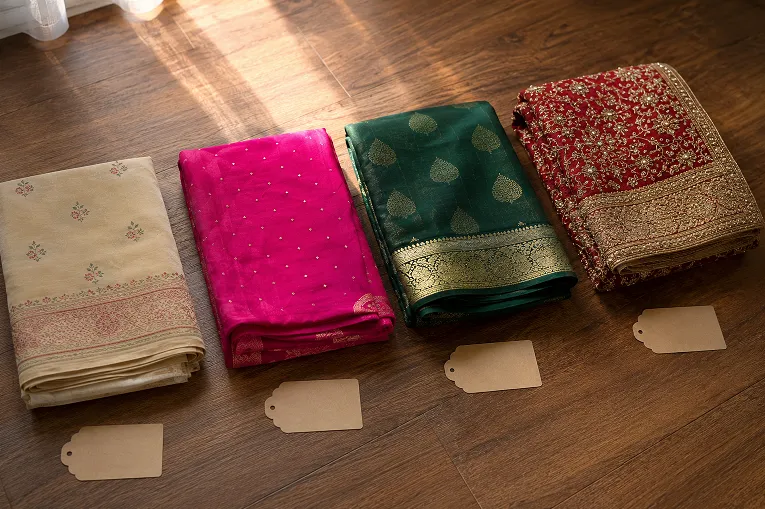
One everyday fabric, one versatile festive piece, one investment silk. That is the real list of saree wardrobe essentials, not a fixed number, but a mix that matches how you actually live.
What to Check Before You Invest in a Saree
Before you buy your next saree, run the cost per wear check first. Ask yourself honestly how many times you will realistically wear it this year, not how many times you hope to.
If the answer is twice or fewer, that is where spending more on a genuinely well made silk saree makes sense, since you want it to last decades, not seasons. If the answer is closer to twice a month, put your money into fabric that survives repeat wear and easy care instead of one that demands dry cleaning every time.
This is advice from people who actually handle these fabrics daily. Ethora manufactures its sarees, salwar kameez, kurtas, and lehenga choli directly at our unit in Surat, and for anything outside that range, we source directly from Surat’s local textile market, so what we tell you comes from the loom, not a showroom floor.
Your Real Number, Not Someone Else’s
Figuring out how many sarees do you need was never about landing on 6 or 10 as a magic number. It is whatever your weddings, your work life, your climate, and your storage space add up to, checked honestly against what you will actually rewear. That is the only math that holds up past the first year.
There is more on building a wardrobe that fits your actual life on the Ethora blog, and it is worth a look if this changed how you see your almirah. Our store is launching soon, with everything made at our own Surat unit or sourced directly from Surat’s manufacturers, so every future purchase comes with the same fabric knowledge.
Conclusion
Figuring out how many sarees do you need was never about landing on 6 or 10 as a magic number. It is whatever your weddings, your work life, your climate, and your storage space add up to, checked honestly against what you will actually rewear. That is the only math that holds up past the first year.
There is more on building a wardrobe that fits your actual life on the Ethora blog, and it is worth a look if this changed how you see your almirah. Our store is launching soon, with everything made at our own Surat unit or sourced directly from Surat’s manufacturers, so every future purchase comes with the same fabric knowledge.
FAQ
How many sarees should a beginner saree collection have?
Start with three: one easy cotton or linen for daily or college wear, one georgette or chiffon for festive events, and one silk for weddings. These three form the real saree must haves before you expand further, and you add more only after you know which one actually gets worn the most.
Is it better to buy more affordable sarees or fewer expensive ones?
It depends on cost per wear, not price alone. A saree you wear twice a month should be affordable and low maintenance, while a saree you wear once or twice a year is where spending more on silk genuinely pays off in how it looks and lasts.
Why does my silk saree develop a permanent line after storage?
That crease line comes from folding the saree the same way for months without changing the fold. Modal and rayon blends resist this better than pure silk, since pure silk fibres hold a crease more stubbornly once the fabric’s weight settles into a fold.
Where can I buy good quality saree blouses online?
Check whether the seller actually manufactures or just resells, since factory-direct sellers usually understand their fabric better than resellers do. Ethora manufactures directly at its own unit in Surat and sources everything else from Surat’s local manufacturers, which means genuine fabric knowledge and factory-level quality without the usual middleman pricing.
How many silk sarees are too many for one wardrobe?
There is no fixed cap, but if you are re-folding more sarees every few months than you can realistically manage, the collection has outgrown your ability to maintain it properly, and that is when quality quietly starts to slip.
Still not sure how many sarees actually make sense for your wardrobe, your closet, and your calendar of events this year? Ethora manufactures its sarees, salwar kameez, kurtas, and lehenga choli directly at its own unit in Surat, and everything else is sourced straight from Surat’s local textile manufacturers. Our store is launching soon, bringing that same factory-level fabric knowledge to every piece you buy.