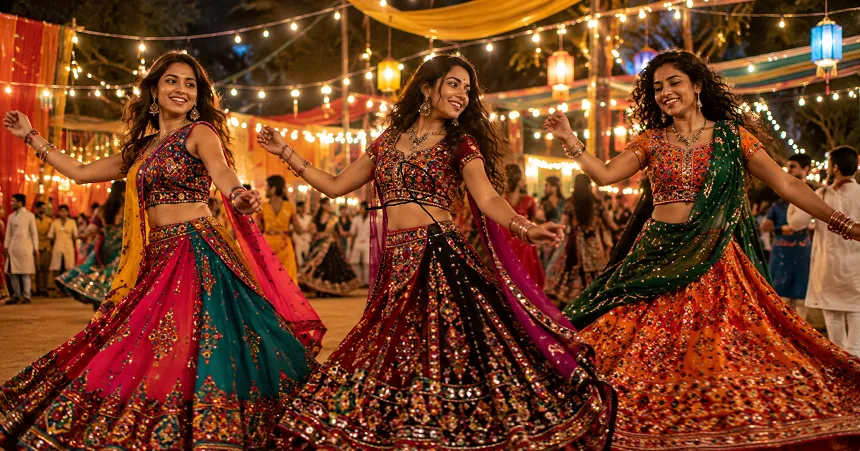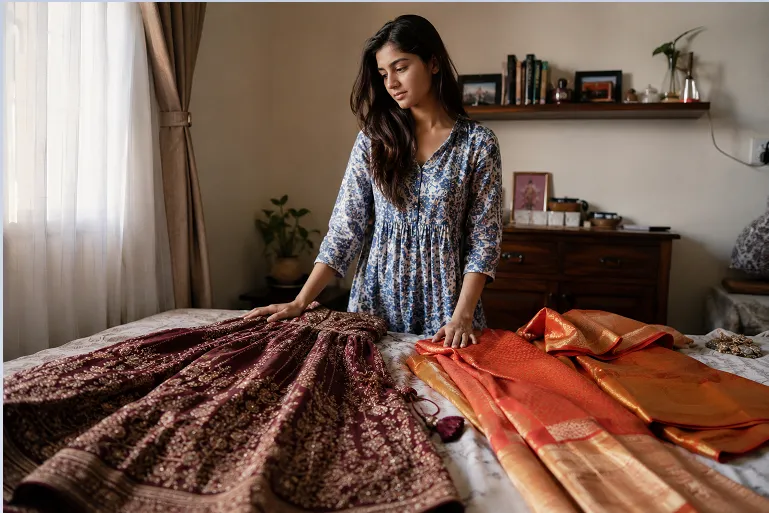
It is 9:40 pm at the sangeet, the DJ has just announced the family dance, and your cousin is dragging you to the stage by the dupatta. You smile, step forward, and realise your outfit has other plans.
Maybe the lehenga waistband is already biting. Maybe the Anarkali churidar will not let your knee rise past a polite angle. That is when lehenga vs anarkali for sangeet stops being a styling debate.
Most advice makes this worse. One blog crowns Anarkali the dancing champion, and the next says lehenga wins for the very same reason. Here is how to sort it out before you pay, from people who cut and stitch both in Surat every week.
Table of Contents
What Separates an Anarkali from a Lehenga
An Anarkali is a single long piece. The fitted bodice runs straight into a flared skirt, with a churidar or pant underneath and a dupatta over one or both shoulders. The flare comes from panels called kalis, and most of the weight hangs from your shoulders and bust.
A lehenga is three separate pieces: the skirt, the choli (the fitted blouse) and the dupatta. The skirt is tied or hooked at your waist, so its entire weight rests on that one join around your hips.
That is the textbook difference, and most sangeet outfit comparison pages stop right there.
But construction only tells you where the weight sits. It says almost nothing about which sangeet night dress options let you actually dance, and that is where the confusion starts. If you are still weighing sarees against stitched outfits, our guide to sangeet outfit ideas for dancing covers that wider question.
Mistake 1: Choosing by Category Instead of Flare Width
Here is the first mistake, and I see it constantly. Most women judge a sangeet outfit by how it looks on the hanger. That is the wrong way to choose it, because a skirt on a hanger never has to lift a knee.
The real variable is flare width, which tailors call the ghera: the full sweep of the hem. It varies enormously inside both categories.
A full umbrella-cut Anarkali with many kalis can open wider than a basic A-line lehenga. A fishtail lehenga that hugs the knee before it flares is far more restrictive than almost any Anarkali.
So in the lehenga vs anarkali for sangeet debate, the garment name tells you very little.
A wide-flare Anarkali can move more freely than a narrow-flare lehenga, and the reverse is just as true. Even Utsavpedia’s guide to the floor length Anarkali points out that abaya-inspired cuts carry less flare and fall straighter than the classic flared kind, which backs up the point that cut matters more than the name.
Fabric decides how that flare behaves once the music starts. Georgette has body, with a slight crinkle you can hear as a dry whisper, so the skirt opens on a turn and swings back into place. Under stage lights it catches the glow in small ripples as it moves.
Chiffon is lighter and softer, but it collapses against your legs mid-spin. In a dry Delhi December it clings with static too.
Net over a stiff can-can, the underskirt that gives a lehenga its stand-out shape, holds a dramatic silhouette. It also traps heat, which you will notice by the third song in a packed Mumbai hall.
Here is a test you can do in any trial room. Lift your knee to hip height, the way you would in a bhangra step or a garba turn. If the skirt grabs your other leg or you feel stitches pull, the flare is too narrow for dancing, whatever the label says.
As a loose working guide, not a rule, a hem sweep under about three metres starts to fight a full stride. Past five or six metres, you spend the evening managing the skirt instead of dancing in it.
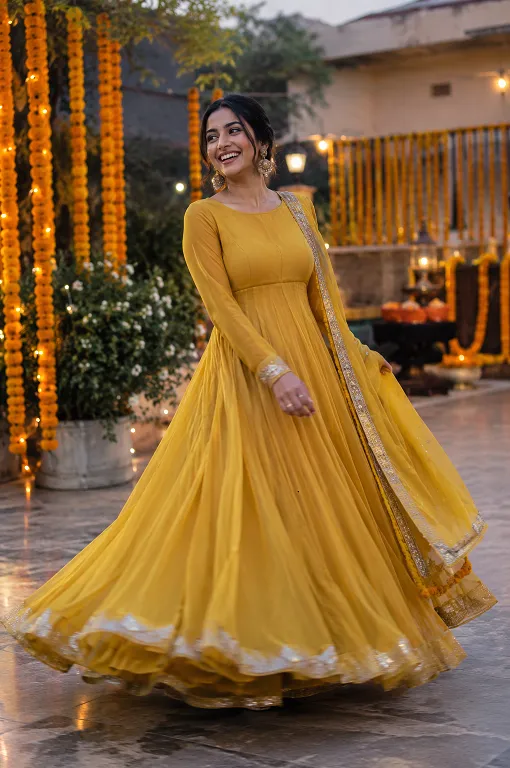
Mistake 2: Mixing Up Waist Comfort and Dancing
The second mistake is treating two separate questions as one. How freely does the skirt move, and how does the outfit feel after five hours? A lehenga can win the first and lose the second. Anyone weighing lehenga vs anarkali for sangeet should keep those two apart.
A lehenga skirt joins you at the waist with a drawstring or hooks. Every gram of embroidery and can-can hangs from that single line around your hips. A heavily embellished bridal-style lehenga is often quoted at anywhere from 3 to 8 kilograms, and a tight band becomes genuinely hard to ignore around hour five.
Sit down at the dinner table, bend to touch an elder’s feet, and the band folds into your stomach.
An Anarkali has no waist join to speak of. The weight travels through your shoulders and bodice instead, so it can feel easier at hour four even if it dances worse.
That is the honest trade. It is also why advice that only talks about dancing keeps contradicting advice that only talks about comfort.
Here is the habit that does the most damage. Women tie the lehenga nada tight to stop a heavy skirt from sliding, then blame the lehenga for the red line across their stomach by 11 pm. Anyone who has climbed into an auto rickshaw in a stiff can-can lehenga already knows how much that skirt resists being folded.
The better fix sits in the stitching. Ask for a soft cotton-lined waistband about two inches wide, which spreads the weight over more of your body, and keep the closure slightly looser than feels necessary in the trial room.
If the skirt still drags after that, it is simply too heavy to dance in, and no waistband will change it. Our guide on how to dance in a heavy lehenga goes deeper on weight and balance.
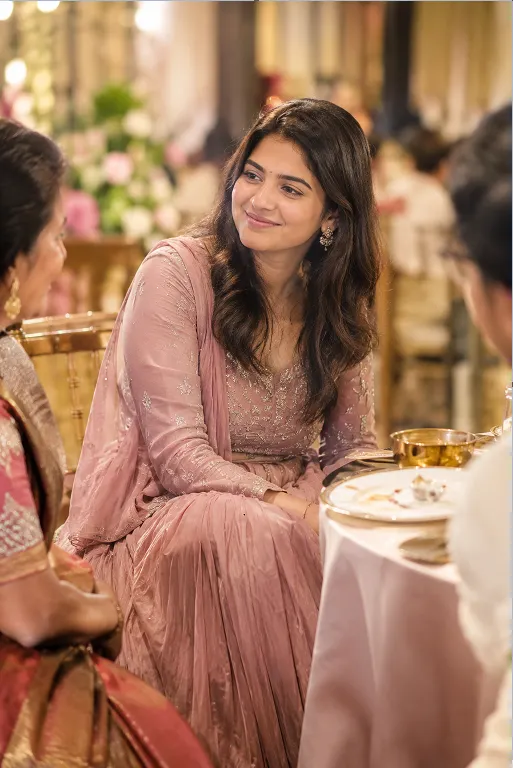
Mistake 3: Writing Off a Restrictive Anarkali Instead of Fixing It
Plenty of women try an Anarkali, feel their knees held back, and rule out the whole category. That is the third mistake, and it skews the whole lehenga vs anarkali for sangeet choice, because the restriction rarely comes from the flared skirt. It comes from what sits underneath it.
A churidar gathers tight around the calf and ankle, and the fitted hip seam above it leaves little room for a long step. The skirt opens up top, but your legs are still working inside a narrow tube.
How the High Slit and Palazzo Fix Works
A high side slit lets the Anarkali panels part as you stride, much like a lehenga skirt does. A palazzo, which is a wide-legged pant, replaces the churidar so your legs move freely underneath.
The pant also keeps the slit modest, since it shows in the opening instead of your leg. That is the whole trick.
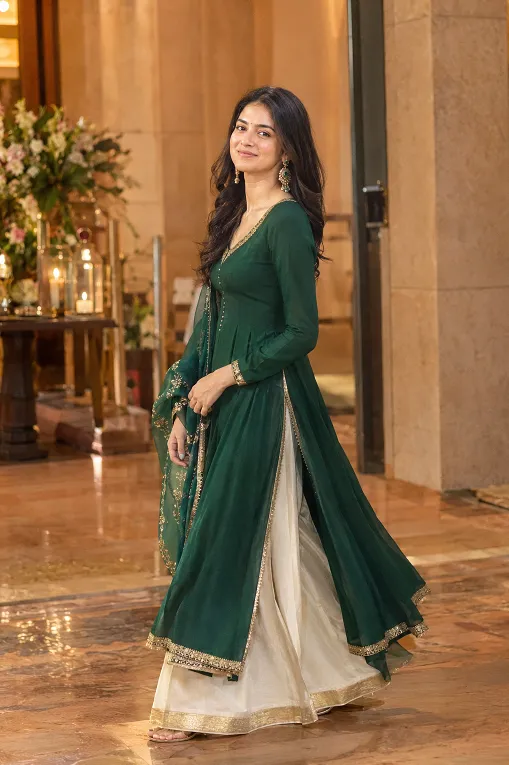
What to Ask Your Tailor or Boutique
Walk in with these five requests and you will not need to explain the idea twice:
- Side slits on both seams, starting around the hip bone and running down to the hem, so the panels open fully when you take a long step.
- A reinforced top on each slit, such as a small stitched bar tack, because that point takes the most stress and is where slits tear first.
- Palazzo in place of the churidar, in matching fabric or a contrast that suits the border, with a leg opening wide enough that you can step wide without the fabric pulling tight.
- A lining inside the palazzo if the Anarkali is georgette or net, so the pant does not turn see-through under bright stage lights.
- Palazzo hem cut in your sangeet heels, clearing the floor by about an inch, so you do not trip on it mid-step.
This fix does not suit everyone. If you want the classic churidar line for photographs, the slit and palazzo version gives that up, and a stiff, heavily embroidered bodice can still hold your shoulders back however the skirt is cut.
Lehenga vs Anarkali for Sangeet: Which One Should You Pick?
Anarkali or Lehenga for Sangeet: The Quick Rule
Once you separate flare, waist comfort and fixable restriction, the choice gets simple. Pick a lehenga if you are in a choreographed group dance with big turns, the fabric is light, and the waistband is soft and well lined.
Choose an Anarkali if you will move between the dance floor and the dinner table all night.
The split comes down to two priorities. An Anarkali usually wins on comfort across a long evening, since there is no waistband and the flow is continuous. A lightweight lehenga can win on a packed floor, because it gives your legs fuller movement while you are actively dancing.
When you are weighing anarkali or lehenga for sangeet, count the hours you will sit, not only the songs you will dance.
My honest pick for most women dancing more than two songs is a full-flare georgette Anarkali with side slits and palazzo. Popular advice treats the lehenga as the default sangeet choice. I disagree, because a heavy lehenga needs constant management, and a well-cut Anarkali lets you forget what you are wearing.
How Weather and Venue Change the Answer
A festive outfit choice for sangeet nights depends on the venue too. A velvet or heavy crepe Anarkali with slits keeps you warm at a Delhi winter sangeet, while georgette is far kinder in a humid November hall in Surat or Mumbai.
If you are unsure how a flared silhouette sits on your frame, Ethora’s free body type calculator gives you a result in under two minutes based on your actual measurements. Whichever outfit wins, get the hem checked against your actual heels, using our guide to lehenga length for your height.
What to Check Before You Buy or Get It Stitched
Before you settle lehenga vs anarkali for sangeet with your wallet, ask for the hem sweep in metres. Photos hide it completely.
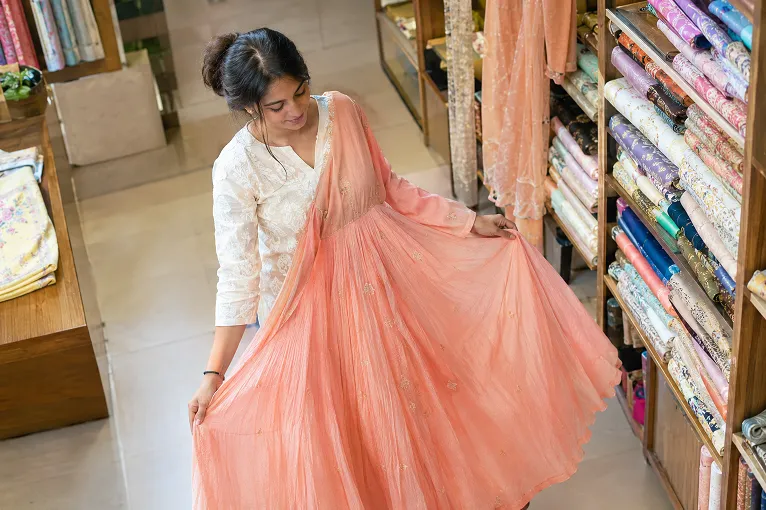
For a fitted Anarkali, request side slits starting near the hip and a lined palazzo instead of a churidar, then take one wide stride in the trial room. For a lehenga, check the waistband lining, since that is the part pressed against you for five hours.
We manufacture at our own unit in Surat and source everything else directly from the city’s textile market, so this advice comes from people who handle these fabrics every day.
Conclusion
Next time someone says the lehenga vs anarkali for sangeet question has one right answer, ask them two things: how wide is the hem sweep, and how does the waist feel after dinner? Those two answers will tell you more than any label.
Explore more honest, fabric-first guides like this on the Ethora blog.
Our store is launching soon, with everything coming directly from Surat’s manufacturing source.
Frequently Asked Questions (FAQs)
Lehenga vs anarkali for sangeet: which is easier to dance in?
Whichever has the wider hem sweep and the lighter fabric, not whichever carries the name. A georgette Anarkali with slits and palazzo usually beats a heavy lehenga, and a light lehenga with a generous ghera beats a narrow Anarkali. Try a knee lift in the trial room before you decide.
Will an Anarkali with palazzo look too casual for a sangeet?
Not if the pant fabric has some weight and shine. Satin or crepe palazzo has a smooth fall that reads festive, while thin cotton looks like daywear. Match the palazzo to a border colour from the Anarkali and it looks planned, not improvised.
Which fabric is best for an Anarkali in a humid venue?
Georgette over a cotton lining is a dependable choice, because the cotton lets sweat go somewhere. A synthetic lining sticks to the skin within an hour in Surat or Mumbai humidity. Skip multi-layer net if the hall will be packed.
What should I check when ordering a lehenga or Anarkali online for a sangeet?
Ask for the hem sweep in metres, the lining fabric, and the waistband details, because product photos hide all three. A good seller will also tell you the weight of the outfit. Ethora both manufactures at its own Surat unit and sources other products directly from Surat manufacturers, which gives you real fabric knowledge and factory-level quality without middleman pricing.
Choosing between a lehenga and an Anarkali gets easier once you know how each one is actually cut. At Ethora, we manufacture at our own unit in Surat and source everything else directly from Surat’s local textile manufacturers, and our store is launching soon.