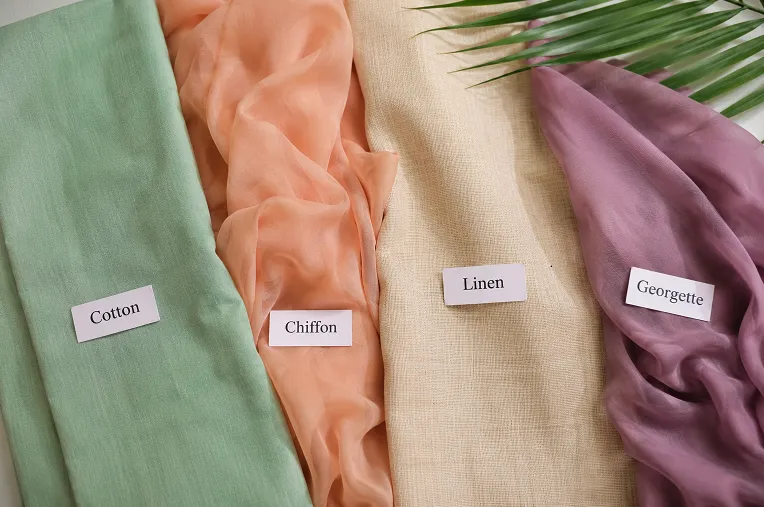
You are standing at a kurti rack during shaadi season, holding two pieces that look almost the same. One tag says rayon. The other says viscose. A little further down, a plain cotton one costs less and looks, honestly, a bit boring.
So which one do you carry to the trial room? Most women pick by touch and colour, then find out at 3 pm, in a packed auto or a stuffy office, what the tag was trying to tell them.
This cotton vs rayon vs viscose fabric guide is built around three things most guides skip: what the tags really mean, how each fibre behaves in Indian heat, and why natural is not automatically the greener choice.

Table of Contents
What Cotton, Rayon and Viscose Actually Are
Cotton is the simplest of the three. It grows in the boll of the cotton plant, gets spun into yarn and is woven into cloth, with no chemical rebuilding along the way.
Rayon and viscose take a different route. Wood pulp, or sometimes the short cotton fibres left over after ginning, is dissolved in chemicals and pushed through tiny holes into a bath that turns it back into solid cellulose thread. That is why they are called regenerated fibres, sitting somewhere between natural and synthetic.
You can feel the gap between cotton vs rayon vs viscose fabric before you read a single tag. Cotton has a dry, slightly crisp hand, and a new piece often rustles faintly when you shake it out. Viscose feels cool and slippery on the skin and falls in soft, heavy folds that cotton simply cannot copy.
On a cutting table the difference is even clearer. Cotton stays where you put it. Viscose slides, stretches on the bias and needs patient hands, which is why a carelessly cut viscose kurti starts twisting at the side seams after a few washes.
Viscose and Rayon Are Not Two Different Fabrics
This is the first truth in any honest cotton vs rayon vs viscose fabric comparison, and it changes how you read every label. Viscose is not a sibling of rayon. It is the original and most common type of rayon, made through what the industry calls the viscose process.
The gap between the two words is mostly geography. Textile Exchange, a global non-profit that works on fibre standards, treats them as one fibre in its glossary entry on rayon, with viscose being the name used across most of the world and rayon the name used in the US.
So when one kurti tag says rayon and another says viscose, do not assume one is the premium option. Usually you are looking at the same fibre. What actually separates the two pieces is the weave, the thickness of the yarn and the finish, whether that is a crepe, a slub, a challis or a satin weave.
Two labels deserve a bit of suspicion. Art silk can mean viscose, but it can just as easily mean polyester, so ask before you assume.
And modal, which sounds like a third name for the same fibre, is actually a related cousin made with a modified process. It holds its shape better and does not cling to the body in humidity quite the way ordinary viscose does.
Choosing fabric for ethnic wear gets much easier once you stop reading the tag as a ranking. It is a description of the fibre, and the weave tells you the rest.
Cotton vs Rayon vs Viscose Fabric in Indian Heat and Humidity
Most fabric comparison guides online were written with bedsheets in mind. A bedsheet never has to survive a packed Mumbai local, a stuffy auto or eight hours in a classroom with a slow fan. Your kurti does.
Here is the second truth, and it is about sweat, not fibre names. Viscose and rayon absorb sweat readily, often more than cotton does. But once they are damp, they go limp and cling to your back and thighs. Cotton absorbs and then lets moisture travel out through the weave, so it keeps some of its shape.
That is why cotton wins across a full day in humid cities like Mumbai, Surat or Chennai. By 4 pm a viscose kurti can look tired and clingy while the cotton one has simply softened.

Dry heat tells a different story. In Rajasthan or Delhi in May, sweat evaporates fast, so a lightweight viscose does not stick the way it does on the coast. In a Delhi winter, though, that cool, slippery feel is exactly wrong, and cotton under a jacket is the better base.
If you wear sarees through the rains, our guide to the best saree fabric for monsoon covers what copes with the wet.
Now the part that goes against popular advice. Everyone says cotton is always the safe answer, and I disagree. A stiff, coarse, badly finished cotton feels worse by evening than a well woven, lightweight viscose in an air conditioned office. The weave and finish matter as much as the fibre name.
Natural Does Not Automatically Mean Greener
Ask most people which is kinder to the planet, cotton or viscose, and they say cotton without thinking. It is natural, so it must be better. That is the third truth, and it deserves a closer look.
Conventional cotton is farmed with heavy inputs. As Textile Exchange explains on its cotton materials page, the pesticides and synthetic fertilisers used in conventional farming can pollute soil and water and add to emissions. It is also a thirsty crop, which matters where groundwater is already under strain.

Viscose has its own baggage. Made carelessly, the process relies on harsh chemicals such as carbon disulphide, and the wood pulp behind it is not always sourced responsibly. Cheap, unbranded viscose is not the good guy here either.
Closed-loop production changes the picture. The chemicals are captured and reused instead of released, and the pulp ideally comes from certified forests. Textile Exchange notes that Lenzing’s Ecovero, a viscose with the EU Ecolabel, has a much lower impact than generic viscose on the Higg MSI, an industry impact index.
So in the cotton vs rayon vs viscose fabric debate, the fair comparison is not natural against man-made. It is well made against carelessly made. Organic or regenerative cotton and certified closed-loop viscose both beat their conventional versions, and a vague eco tag on a very cheap kurti tells you almost nothing.
Dye is part of the story too, and our read on natural dye vs chemical dye explains what to look for.
How Long Each Fabric Lasts and How to Wash It
Now to viscose vs cotton durability, which depends far more on how often you wash a garment than on what the tag says.
Cotton actually gets stronger when it is wet. That is why a plain cotton kurti survives the washing machine, hard scrubbing and a bucket in the sun, twice a week, for years.
Viscose does the opposite. Wet viscose is at its weakest, so wringing it, twisting it on the line or beating it against a stone is how you end up with holes and a kurti that comes back a size smaller.
Here is the mistake I see most. Women choose a viscose kurti for how it falls on the hanger, then wash it like cotton. Fifteen washes later it has shrunk, twisted at the hem and lost its sheen. That is the wrong way to choose.
So decide by use, because the best fabric for a kurti depends on the week you are having. An everyday college or office kurti that meets the washing machine every third day should be cotton.
A festive piece you wear six times a year, for Diwali or a sangeet, can be viscose, because it looks richer under lights and you will wash it gently.
A few care habits make either fibre last longer:
- Wash viscose cold and inside out, by hand or on a delicate cycle, and press the water out between two towels instead of wringing it.
- Dry it in the shade on a hanger. A wet viscose kurti on a thin rope stretches under its own weight, and direct sun fades it.
- Iron viscose on low heat while it is slightly damp, from the inside, because a hot iron on dry viscose leaves shiny marks.
- Pre-wash new viscose fabric before stitching or hemming, since it can shrink and change the fit.
- Wash dark cotton separately for the first few washes, because new cotton dyes often bleed.

If cotton is your daily pick, our guide to styling a cotton kurti for summer shows how to keep it looking sharp through the heat. And once the fabric is settled, Ethora’s free kurti colour combination tool helps you test dupatta and bottom pairings before you buy anything.
What to Check Before You Buy
Before you buy, work out the cost per wear: price divided by the number of times you will actually wear it. A 700 rupee cotton kurti worn 70 times costs 10 rupees a wear. A 1,500 rupee viscose one that warps after 10 outings costs 150.
So ask two things at the counter: how often will I wear this, and how often will I wash it? Then check the tag and hold the cloth to the light, because thin, patchy weave ages fast in either fibre.
Ethora manufactures directly at its Surat unit and sources everything else from Surat’s local textile market, so this advice comes from people who make and handle these fabrics every day.
Conclusion
The cotton vs rayon vs viscose fabric decision comes down to the life the garment will live, not how it falls on the hanger. Cotton for the kurti you will wash every third day and wear through a humid commute. Viscose for the piece that comes out for Diwali and sangeet nights and goes back into a wardrobe afterwards.
Explore more fabric and styling guides on the Ethora blog whenever you are choosing your next outfit.
The Ethora store is launching soon, with every product coming directly from Surat’s manufacturing source.
Frequently Asked Questions (FAQs)
A kurti that still feels right at 4 pm in the heat starts with knowing what the tag really means. Ethora manufactures at its own unit in Surat, and everything else is sourced directly from Surat’s local textile manufacturers. The store is launching soon, and we would love to have you with us when it opens.