My mother still has a saree her mother bought from a weaver in Varanasi in the 1980s. The pallu has gone slightly uneven at one edge, the zari has dulled in patches, and it still gets pulled out every wedding season because nothing else drapes quite like it does.
Ask her if it is handloom or power loom and she will not check a certificate. She will run her thumb along the border first.
That instinct is exactly what most people searching handloom vs power loom are actually trying to build for themselves. Not a definition. A way to trust their own hands the next time they are standing in a shop in Surat or scrolling through a saree listing online, wondering if what they are paying for is real.
This article covers what genuinely happens on each type of loom, why one is not automatically better made than the other, and the actual signals worth checking before you buy either one.
What Actually Happens on a Handloom Versus a Power Loom
A handloom is operated entirely by a person. The weaver sits at the loom, passes the shuttle by hand or foot pedal, adjusts tension by feel, and controls every pick of the weft thread individually. Nothing about the process is automated. If the weaver is tired, distracted, or working past sunset with a dim bulb overhead, that shows up in the cloth.
A power loom does the same basic job of interlacing warp and weft, but a motor drives the shuttle at a fixed, programmed tension. One person can typically operate three or four power looms at once because the machine is doing the physical work the handloom weaver would otherwise do by hand.
If you want the fuller mechanics of warp, weft and thread density, our how a saree is actually woven guide walks through that process in more depth.
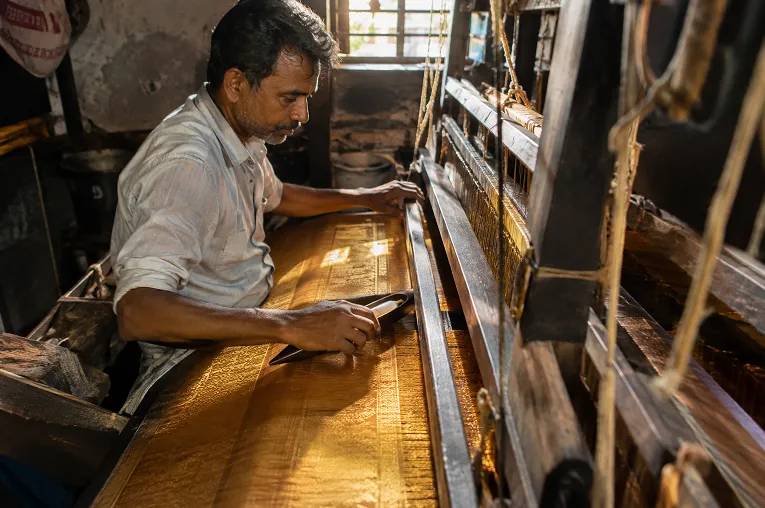
This is the actual difference that matters. Handloom is about human control over every thread. Power loom is about mechanical consistency at higher speed. Neither of those things is automatically the same as quality, and that distinction gets lost in almost every article written on this topic.
Why Handloom Isn’t Automatically the Better Quality Choice
Here is the part most saree guides skip. Handloom and power loom describe how a fabric was made, not how well it was made.
A handloom saree woven by a rushed weaver using thin, poorly twisted yarn can fray at the border within a few washes. A power loom saree made on a good machine, with properly finished yarn and a clean selvedge, can hold its shape and colour for years of regular wear.
What handloom genuinely gives you is uniqueness, craftsmanship, and heritage value. Every handloom piece carries small variations that make it one of a kind, and buying one supports a weaver’s livelihood directly. What it does not automatically give you is superior strength or longer life. Those depend on yarn quality and finishing, not on which loom made the cloth.
I will say this plainly because it needs saying. If you need a saree that survives a day at a reception, then a night train, then a wash and re-wear the following week, a well finished power loom silk can genuinely outlast a delicate, loosely woven handloom piece.
That is not a popular opinion in most fashion content, but it is a true one.
The Real Reason the Handloom vs Power Loom Checklist Works
Every article on handloom vs power loom saree gives you the same five-point checklist: irregularity, the border, the reverse side, the feel, the label. Almost none of them explain why those signals exist, which means the moment you meet a saree that does not perfectly match the list, the checklist stops helping you.
So here is the actual mechanism behind each of the five.
Signal one: irregularity in the weave. A human hand’s tension naturally shifts moment to moment, even for a skilled weaver. That is why handloom fabric has tiny, genuine variations in thread spacing, and why you can often feel a small, slightly irregular knot buried in the weave where a weaver tied in a fresh length of weft by hand.
A power loom holds a constant, programmed tension, so the weave comes out uniform every single time, with joins that are rare and mechanically neat when they do happen.
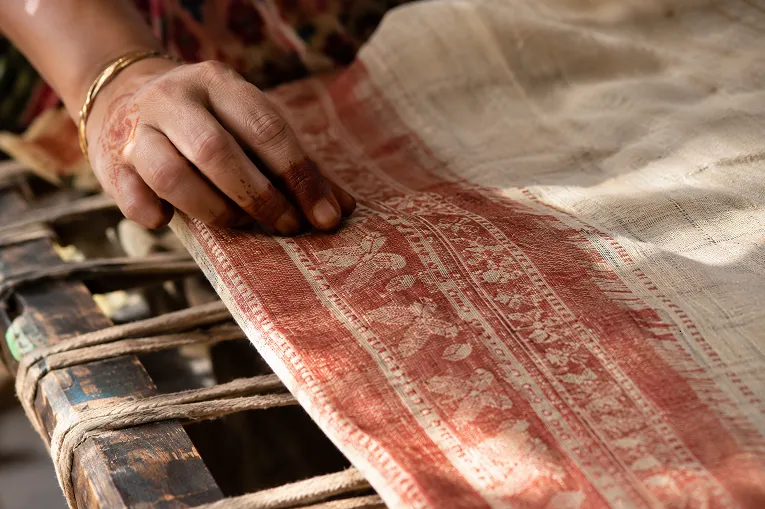
Signal two: pin marks near the border. Handloom fabric is physically pinned to the loom at intervals along the edges to keep the width even while the weaver works. Those small, evenly spaced pinholes near the selvedge are a direct physical trace of that process. Power loom fabric has no equivalent marking because the machine holds tension mechanically, not with pins.
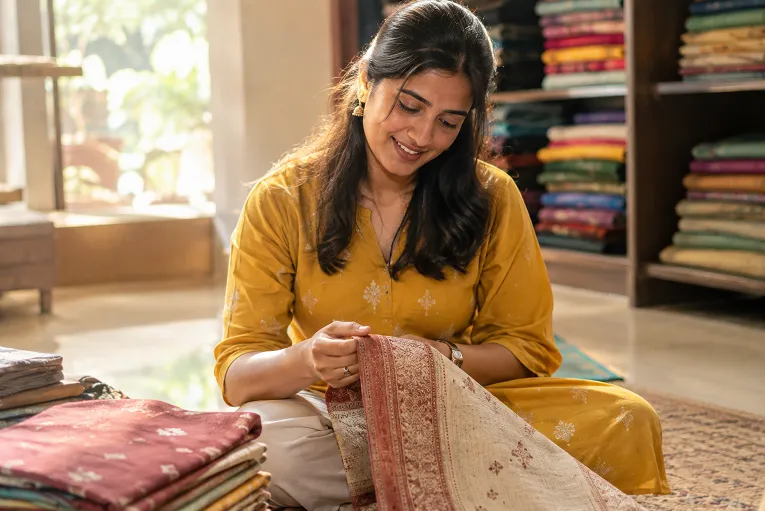
Signal three: the reverse side check. Turn the fabric over and look at the back. On a handloom piece, especially in silk with a woven motif, you can often see the pattern faintly bleeding through to the reverse side, because the weft floats are placed and packed by hand rather than by a fixed mechanical beat.
A power loom’s motif tends to sit more flatly finished on the back, with a cleaner separation between front and reverse, because the machine repeats the exact same float pattern every single row.
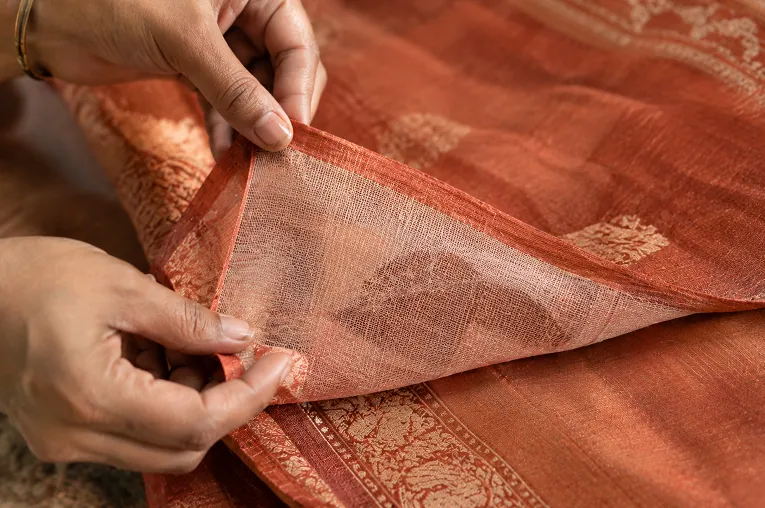
Signal four: the texture and drape feel test. Rub a small section between your fingers first. Handloom weaves, especially in cotton and tussar silk, tend to have slightly more texture and grip because of the uneven tension, where power loom fabric usually feels smoother and glides more easily.
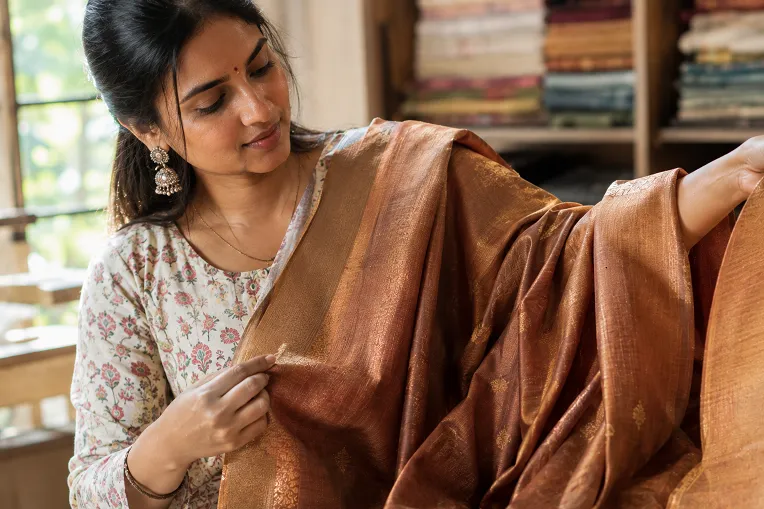
Then let a length fall over your forearm. Handloom silk tends to settle into softer, slightly less uniform folds, while power loom fabric often falls flatter and more evenly, a result of its finer, more consistent yarn.
Weight matters here too. Banarasi silk in particular is heavier than most people expect once you actually wear it, and by evening the pull of a handwoven pallu on your shoulder starts to show.
Power loom silk in the same design is often lighter, which changes how long it stays comfortable.
Signal five: the certification label. This is the only one of the five you cannot feel with your hands. A genuine Handloom Mark or Silk Mark, where the seller actually has one, is a real data point worth checking, best used alongside the physical checks above rather than trusted on its own.
Once you understand why each signal appears, you stop needing a perfect checklist match. You start reading the fabric itself.
If you already know your saree fabric preferences and want help narrowing down which colours and drapes work best on you, Ethora’s saree for body type guide is a useful next stop once you have sorted the loom question.
What Actually Matters Before You Buy
Look for the Handloom Mark or Silk Mark if the seller offers it. The Handloom Mark, a Government of India initiative implemented by the Textiles Committee, exists specifically to guarantee that a marked product is genuinely hand woven.
But treat it as one data point, not the final word. A hologram or label is easy to lose or misuse, and plenty of genuine handloom weavers sell without any certification at all.
Cross check the mark against the physical signals, the irregularity, the pin marks, the reverse side, and the feel, rather than trusting either one alone.
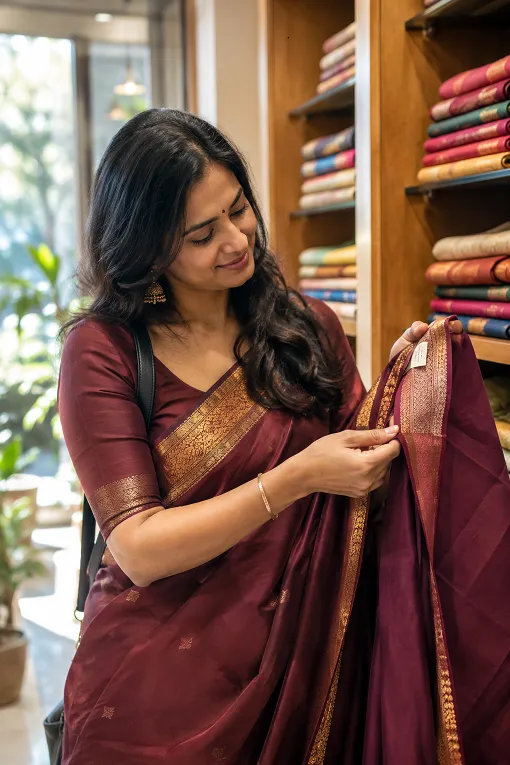
This is honestly the advice we give in our own showroom conversations at Pahal Silk Mills. We manufacture sarees, salwar kameez, kurtas and lehenga choli directly at our unit in Surat, and everything else we sell is sourced straight from Surat’s local textile market, so this comes from people who handle both handloom and power loom fabric every single day.
Conclusion
Loom type tells you how a saree was made, not automatically how well it was made or how long it will last you. The handloom vs power loom decision is really a question of what you value more for this particular purchase: uniqueness and heritage, or consistency and easier care.
Once you know how to read a fabric’s own signals instead of relying on a memorised checklist, you will never feel unsure standing in front of a saree shelf again.
If you want more honest, practical fabric guidance like this, our blog has more pieces exactly like it worth exploring. Our store is launching soon with sarees made directly at our Surat unit and sourced from Surat’s own textile manufacturers, so quality never passes through a middleman.
Frequently Asked Questions (FAQs)
Is handloom saree always better than power loom?
No. Handloom gives you uniqueness, craftsmanship and heritage value, but not automatically better durability. A well finished power loom saree with good yarn can genuinely last longer than a poorly finished handloom piece, so judge the specific saree, not just the loom type.
How can I tell if a saree is handloom or power loom?
Check for small irregularities in the weave, tiny pin marks near the border, and how the pattern looks on the reverse side. You can also hold the fabric up to natural light. Handloom weaves often let faint, uneven light through, while power loom fabric lets it through evenly.
What is the Handloom Mark and is it reliable?
The Handloom Mark is a government backed certification confirming a product is genuinely hand woven, and it is a useful signal. It should not be your only check, though, since labels can be lost, faked, or simply absent from small weaver stalls that are entirely legitimate. Cross check it against the fabric itself.
Where can I buy genuine handloom or good quality power loom sarees online in India?
Look for sellers who can tell you exactly where the fabric was made and by whom, not just a generic “handloom” label. Ethora manufactures at its own Surat unit and sources other pieces directly from Surat’s textile manufacturers, giving you factory-level quality without middleman pricing.
Once you know what to look for, the loom type stops feeling like a mystery and starts feeling like a choice you can make with confidence. Every saree we work with is either woven at our own Pahal Silk Mills unit in Surat or sourced directly from Surat’s local textile manufacturers.
Our store is launching soon, and every piece on it will carry that same traceable, factory-level honesty.