You order your usual size in a kurti, the one that has fit you across three different stores for two years, and it arrives too tight across the bust or hanging off your shoulders like you borrowed it from someone taller. You didn’t measure wrong. The kurti size chart you followed simply doesn’t match the one another brand used, and readymade kurti sizing in India has no single agreed standard behind it in the first place. This isn’t a personal failure or a one-off fluke order. It’s a documented, national-level gap in how Indian apparel brands size their clothes, one the government is actually working to close. That context alone should make the next mismatched parcel sting a little less.

Table of Contents
Standard Indian Kurti Size Chart
Before getting into how wildly this varies by brand, it helps to have one baseline reference point. Think of this kurti size chart in inches as a starting map, not a rulebook carved in stone.
Here’s the part almost nobody explains clearly. Different manufacturers add different amounts of ease, the extra room built into a garment beyond your actual body measurement, when they cut a kurti. Some brands add roughly 2 inches to your bust measurement to arrive at the finished garment size. Others add closer to 4 inches. That’s the real, verifiable reason a 36 inch bust can be a Small at one brand and a Medium at another. It isn’t random inconsistency. It’s a genuine difference in how generously each brand cuts.
This inconsistency is exactly why India’s upcoming national sizing standard is being built in the first place. The Ministry of Textiles sanctioned a project called INDIAsize, built from an actual anthropometric survey of Indian bodies across several cities, precisely because Indian brands mostly rely on US or UK-derived size logic that was never designed for Indian proportions to begin with. Until brands widely adopt something like it, cross-referencing charts is the only real workaround.
| Standard Tag Size | Indian Label Size | Body Bust (Inches) | Waist (Inches) | Hip (Inches) |
|---|---|---|---|---|
| XS | 32 | 32″ | 26″-28″ | 34″-36″ |
| S | 34 | 34″ | 28″-30″ | 36″-38″ |
| M | 36 | 36″ | 30″-32″ | 38″-40″ |
| L | 38 | 38″ | 32″-34″ | 40″-42″ |
| XL | 40 | 40″ | 34″-36″ | 42″-44″ |
| 2XL / XXL | 42 | 42″ | 36″-38″ | 44″-46″ |
| 3XL | 44 | 44″ | 38″-40″ | 46″-48″ |
Use this table as a starting orientation only. As you’re about to see, the exact same 36 inch bust lands in a completely different labelled size depending on which brand cut the garment, and a universal kurti size chart can only get you so far once you start comparing real brands against each other.
Brand-by-Brand Kurti Size Comparison
This is the section that actually matters, because a chart on a website means nothing until you know how a specific brand behaves in practice. This brand size comparison India shoppers can actually rely on comes from each brand’s own published chart, checked directly against live product listings as of September 2026, and, where a chart wasn’t the whole story, from detailed buyer reviews, not guesswork.
| Brand | If Your Bust Is 36″ (Actual) | Fits True to Size | Best Body Silhouette Match |
|---|---|---|---|
| Avaasa (Reliance Trends) | Size M | Yes, matches the generic baseline directly | Most frames, standard ease |
| Libas | Size S | Mostly, though sizing can vary within a collection | Straighter frames, smaller bust-to-waist difference |
| Biba | Size L | Runs true on the bust, but check festive pieces separately | Most frames, standard hourglass assumption |
| Anouk | Size M | Yes, matches the generic baseline directly | Most frames, moderate hourglass fit |
| W for Woman | No body-fit chart published | Can’t verify, only garment measurements are listed | Not confirmed, check product page |
Avaasa, the Reliance Trends in-house label, is the one brand here that actually matches the generic baseline chart above. Its own body measurement chart, checked across two separate product listings, lists a 36 inch bust as a Medium, the same answer the standard table gives. If you’ve been sizing yourself off that standard chart out of habit, Avaasa is one of the few places here that won’t catch you out.
Libas is the brand most likely to trip you up if you’re used to shopping elsewhere. A 36 inch bust is a Small at Libas, not a Medium, because Libas builds in less ease and cuts a straighter silhouette with a smaller bust-to-waist difference than brands built around an hourglass assumption. That actually makes it a better match for straighter frames than curvier ones. Worth flagging honestly: a specialised fit-comparison source notes Libas sizing can shift even within the same collection, so treat the brand chart as a starting point and check the specific product’s own measurements before you order.
Biba is the one that trips people up if they’re carrying a size from another brand. Biba’s own product listings number their sizes as 32/S, 34/M, 36/L and 38/XL, which means a 36 inch bust lands you in a Large, not a Medium the way it does at some other brands. If you’ve been buying Biba on autopilot in whatever letter fits you elsewhere, this is worth double-checking. Embellished and festive pieces also tend to sit tighter than the everyday collection because of the extra embroidery and lining, so size up for occasion wear if you’re between sizes.
Anouk, Myntra’s in-house ethnic label, is the other brand that lines up with the generic baseline. Its own chart lists a “to fit bust” of 36 inches for a Medium, taken straight off a live product listing. That makes two of the five brands here, Avaasa and Anouk, where the standard chart’s letter and the brand’s own letter happen to agree.
W for Woman is a different kind of problem. Their product pages publish garment measurements only, the finished chest width of the kurta itself, with no body-fit chart telling you what actual bust that’s designed for. Without a published ease figure to work backward from, there’s no honest way to hand you a size recommendation here. Measure a W for Woman kurta you already own and compare it directly, rather than guessing at a letter from a chart that isn’t there.
And here’s the honest caveat that applies to every brand on this list, not only Biba. Buyer reviews consistently show that different product lines within one brand, regular versus festive being the most common split, can fit differently even at an identical labelled size. Treat this whole comparison as a reliable starting orientation, never an absolute guarantee. The specific product’s own chart is always the final word, whether you’re shopping directly on the brand’s site or checking a myntra kurti size guide on a marketplace listing, since a seller-uploaded chart is only as accurate as whoever uploaded it.
How to Measure Your Kurti Size at Home
Skip the guesswork. Once you know how to measure kurti size at home properly, the whole process takes about five minutes and saves you a return label later.
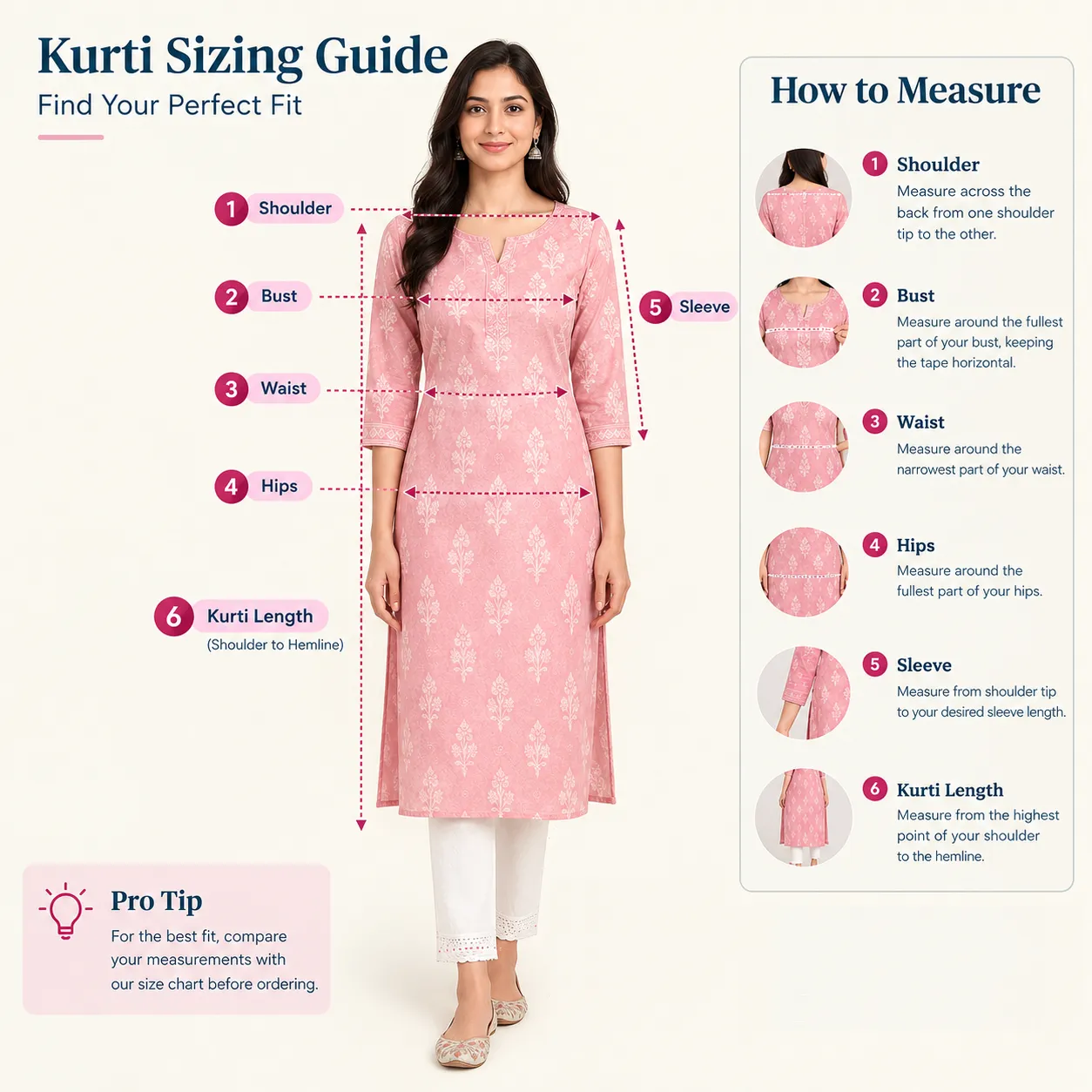
- Bust. Wrap the tape around the fullest part of your bust, keeping it parallel to the floor. Don’t pull it tight. The tape should sit against your body the way a well fitted kurti would, snug but never compressing.
- Waist. Measure at your natural waist, the narrowest point, roughly an inch above your navel. This one matters far more than people assume if you’re buying an Anarkali or anything with a fitted waist seam, since a loose reading here throws off the flare above and below it.
- Hips. Measure around the fullest part of your hips. Get this one right especially for straight-cut kurtis, because a straight cut with no flare will strain at the side slits if your hip number was off, and that strain shows up as a visible pull line the very first time you sit down.
Once you have these three numbers, add roughly 2 to 4 inches to your bust measurement to estimate a brand’s finished garment size, remembering that different manufacturers land at different points in that range depending on how much ease they build in, exactly as the brand comparison above shows. Which kurti size is M or L for you personally depends entirely on where in that range a specific brand sits, and that’s precisely why a single universal answer doesn’t exist.
Shoulder, sleeve and kurti length are worth knowing too, but they work differently. Those three are garment measurements, decided by the brand when the pattern was cut, so you compare them against the product page’s listed specs rather than using them to pick your size. Only bust, waist and hip actually decide which size you order. The rest tells you whether that size will look the way you want once it’s on.
Sizing Rules Based on Fabric and Kurti Silhouette
Fabric Physics: Cotton vs Rayon vs Georgette
Fabric changes the math, and this is the part most size charts skip entirely.
Pure cotton shrinks up to roughly 3% on its first wash. That doesn’t sound like much until it becomes the difference between a kurti that sits comfortably and one that suddenly feels a size too small after laundry day. If you’re between two sizes in a pure cotton kurti, size up rather than down.
Rayon and georgette behave differently. They don’t shrink the way cotton does, but they respond to humidity and body heat instead. Modal fabric looks similar to rayon on a hanger, but it doesn’t cling to the body the same way once real humidity sets in, on a Mumbai afternoon or through a Surat monsoon evening, which is worth remembering if you’re choosing between the two for something you’ll wear all day.
Georgette also has more body than chiffon, so it holds a flare or a pleat better when you’re actually walking in it, not just standing still for a photo. That’s a small detail, but it’s the difference between a kurti that still looks structured in motion by evening and one that goes limp after the first hour of a function.
Silhouette Rules: Straight Cut vs Anarkali Flares
The cut you’re buying changes which single measurement matters most.
A straight-cut kurti needs your hip measurement to be precise. There’s no flare below the waist to hide an error, so if your hip number is off, you’ll feel it pulling at the side slits the first time you climb into an auto rickshaw or sit cross-legged on the floor during Navratri.
An Anarkali or A-line kurti is more forgiving here, since the hem flares out freely below the bust or waist seam. What matters most for these silhouettes is getting your bust measurement right, because the rest of the garment is built to move independently of your hip line.
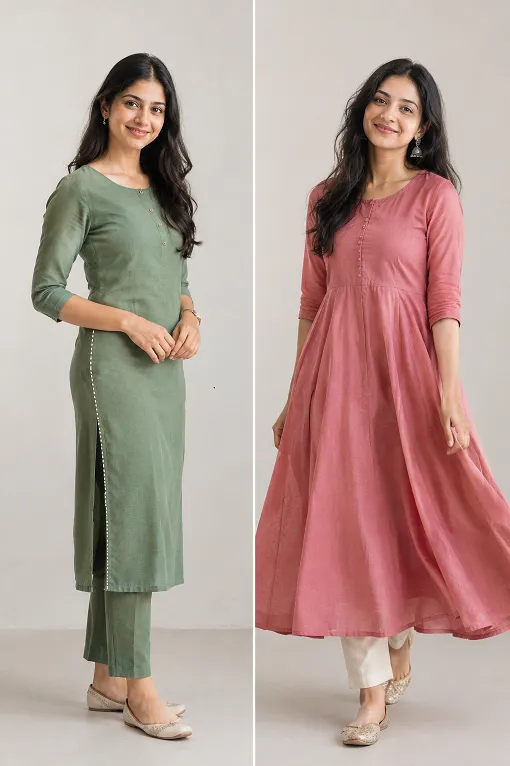
If you’re not sure which silhouette actually suits your body shape in the first place, not just which size, Ethora’s free ethnic wear body type calculator walks you through it using your own bust, waist and hip numbers, and it’s worth doing before you commit to a straight cut over a flared one. This matters even more if you’re working with a kurti for pear shaped body, where hip precision in a straight cut can work against you and a flared silhouette does the balancing instead.
Once you’ve settled on the right size and silhouette, the ease question comes right back around when you’re deciding whether to size up or down at checkout, and our piece on how loose a kurti should actually feel once it’s on goes deeper into that exact decision.
What to Check Before You Order Online
Before you click buy, check three things. Does the specific product page carry its own size chart that differs from the brand’s general one? Many do, especially for festive pieces. Does the fabric description mention stretch or shrinkage, since that changes whether you should size up? And in the product photos, look closely at the side seams and slits. A properly finished slit lies flat; a rushed one puckers.
We’re not guessing at any of this from a spreadsheet. Our own kurtas come off the line at Ethora’s manufacturing unit in Surat, and anything we don’t make ourselves is sourced from Surat’s textile market directly, so this advice comes from people who actually cut and handle these fabrics all day, not from a template. Once you’ve nailed the size, pairing a kurti with jeans is worth reading next for how the same fit works day to day beyond ethnic occasions.
Conclusion
The one thing worth carrying forward from all of this: match your measurements against the specific product’s own chart, not the brand’s general size guide, and lean on the ease range rather than chasing one fixed number. There’s more fit and fabric detail like this waiting across the Ethora blog if you want to keep building this kind of practical knowledge. Our store is launching soon, with every piece either manufactured at our own Surat unit or sourced directly from Surat’s textile market.
Frequently Asked Questions (FAQs)
What size is a 38-inch kurti?
A 38 inch kurti, or kurti size 38 in inches, typically corresponds to a Large on the standard Indian reference chart, meant for roughly a 38 inch bust and a 32 to 34 inch waist. Treat that as a starting point though. At Libas, for instance, a 38 inch bust only gets you a Medium, not a Large, since Libas numbers its sizes a step smaller than the standard reference throughout, so always check the specific brand’s own chart before assuming.
Which kurti size is M or L?
Going by standard reference charts, M corresponds to a 36 inch body bust and L to a 38 inch body bust. In practice, this label shifts depending on how a brand tags its clothes. For example, if you have an actual 36 inch body bust, you will get a Size M at both Avaasa and Anouk, since their own charts match the standard baseline, a Size S at Libas, since their tighter cuts run a step smaller, and a Size L at Biba, since their numbering runs a step bigger.
Should I buy a kurti size bigger or smaller if I’m between sizes?
Size up, especially in pure cotton, which can shrink close to 3% on its first wash and turn a snug fit into an uncomfortably tight one. A slightly loose kurti can also be tailored in at the seams later, while a too-tight one, particularly with embroidery, often can’t be let out without distorting the threadwork.
How do I know my kurti size using my Western dress size?
There’s no exact universal conversion, since Western sizing and Indian kurti sizing follow different body proportion assumptions, which is part of why India’s INDIAsize project exists in the first place. Different conversion charts don’t even agree with each other on where a US size lands in Indian numbering, so treating any single US-to-Indian equivalent as reliable would be misleading. Measure your actual bust, waist and hip and match those inches directly to the specific brand’s chart instead of leaning on a size-label conversion.