You order a kurti online, same size as always, and the moment it arrives something feels off. It pulls a little under the arm when you reach for a shelf, or worse, it swallows your frame completely and you look like you borrowed it from your mother’s cupboard.
Somewhere between too tight and too loose sits the fit you actually want. Most sizing guides throw an arbitrary inch figure at you and never explain why that number keeps changing from brand to brand.
So how loose should a kurti be? The honest answer depends on the cut, the fabric, and what you plan to do while wearing it. This piece works through the real reasoning, plus three physical checks that hold up no matter which size chart you used.
Table of Contents
How Loose Should a Kurti Be? Start With the Basic Measurements
Before anything else, you need two numbers. Your actual bust and waist, taken with the tape snug but not pulled tight, and the kurti’s finished measurement at the same points.
The gap between these two numbers is what patternmakers call ease, the extra room built into a garment beyond your body measurement. Woven fabric like cotton and most kurti silks doesn’t stretch, so this room isn’t optional.
It’s what lets you sit, raise your arms and breathe without a seam pulling. A short reference on garment ease explains this better than most sizing charts do, since it breaks ease into named categories instead of one fixed inch figure.
Most brands recommend somewhere between 1 and 2 inches of ease at the bust for a regular fit kurti, going up to 3 inches for a relaxed, flowy silhouette. That range is exactly why the numbers you see online never quite agree with each other.
Think of this as a kurti fitting guide built around your own body, not a generic chart borrowed from a size sheet that fits nobody in particular.
Why One Ease Number Never Works for Every Kurti
Here’s the part nobody explains properly. Ease isn’t one universal number, because different body zones need different amounts of room, and the cut of the kurti changes how much you actually need.
An A-line kurti already flares out from the waist. That flare creates visual and physical room at the hip without needing much extra circumference ease built in.
A straight-cut kurti has no flare to fall back on. It needs more actual ease at the waist and hip to move the same way an A-line does with less.
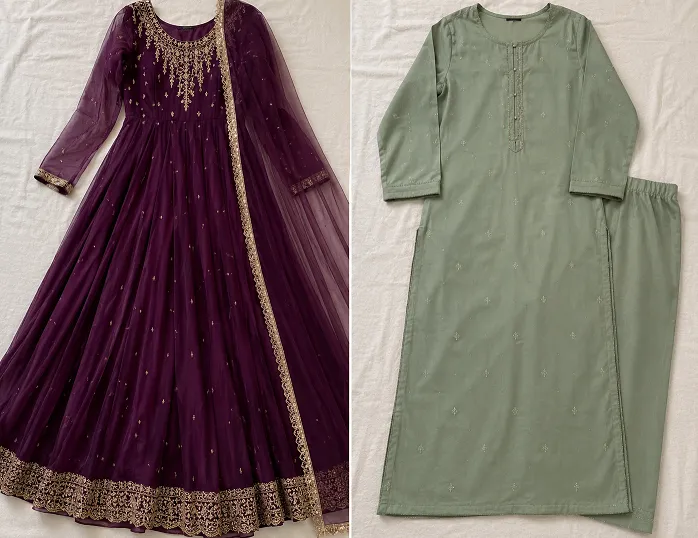
Georgette has more body than chiffon, so an A-line kurti cut in georgette holds its flare through a full day out instead of collapsing by evening. That’s a fabric detail worth knowing before you pick between the two for a wedding function that runs from afternoon into night.
Fabric stretch changes the equation too. A kurti in cotton lycra needs less structural ease than the same design cut in pure cotton or chanderi, because the fabric itself gives you part of that room.
I’ll say this plainly. Chasing one perfect ease number across every kurti you own is a waste of time. The cut and the fabric decide the number, not a chart.
If you’re unsure which cut and silhouette actually suit your frame before you even get to ease, Ethora’s free body type calculator gives you a result in under two minutes based on your own measurements.
Three Physical Tests That Tell You More Than Any Size Chart
So how loose should a kurti be in real life, not on a hanger? Numbers only take you so far, because every body distributes measurements differently. These three checks work regardless of your size or which brand’s chart you followed.
The pinch test. Pinch the fabric at your bust and waist. You should be able to comfortably hold about an inch of fabric between your fingers. Less than that, and the kurti is working against your movement instead of with it.
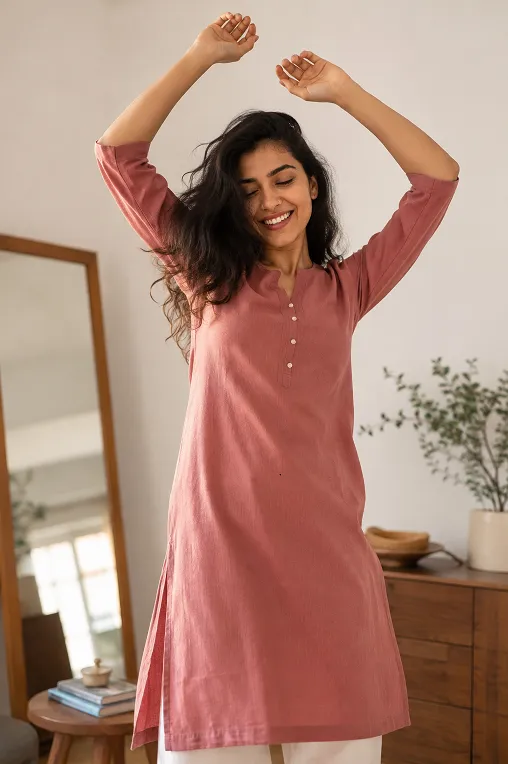
The arms-overhead test. Raise both arms fully overhead the way you would reaching for a top shelf or dancing at a sangeet. The hem shouldn’t ride up past your hips, and the shoulder seam shouldn’t strain toward your neck.
The sitting test. Sit down the way you actually would, at an office desk or cross-legged during a puja. The fabric across your lap shouldn’t pull tight or stretch across your thighs.
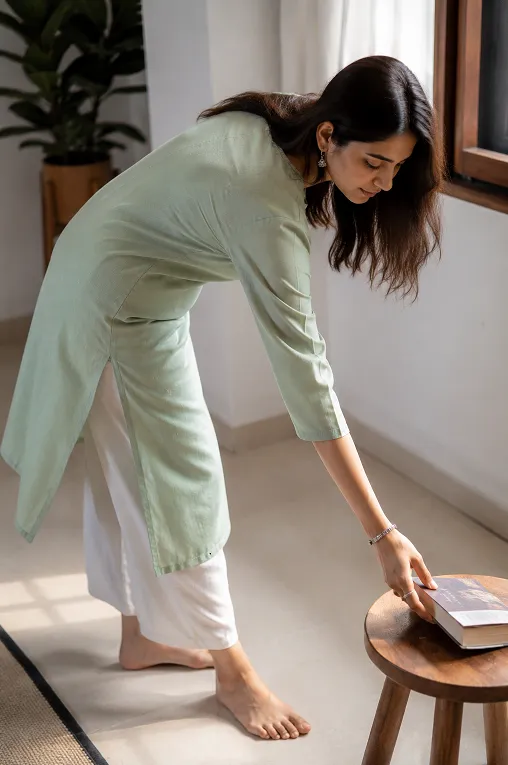
This is what a comfortable kurti fit actually feels like once you’re moving, not just standing still in front of a mirror for ten seconds. Choosing kurti size online is harder than in a store precisely because you can’t run any of these three checks before you buy, so lean on the brand’s finished measurements instead of the size label alone.
What a Too-Tight Fit Does to Embroidery and Drape
Most women judge a kurti’s fit by how it looks in the ten seconds they’re standing in front of a mirror. That’s the wrong way to judge it, and it’s an especially costly mistake on anything embroidered.
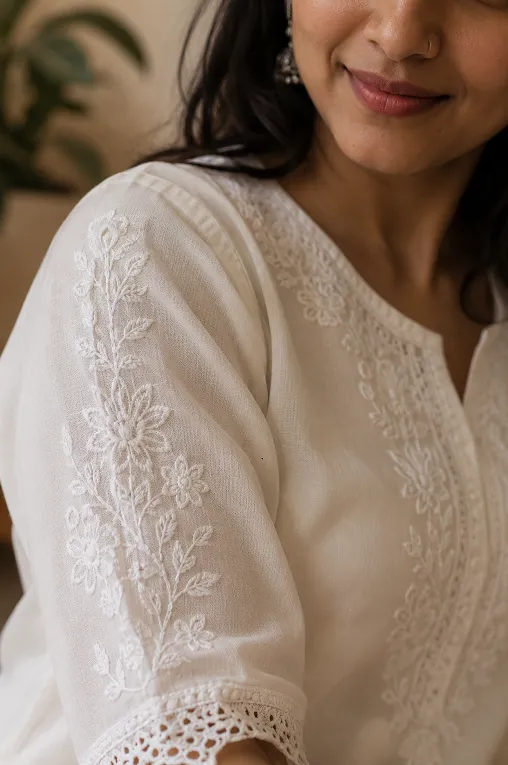
When a kurti is pulled taut against the body, the fabric under the embroidery stretches along with it. Threadwork like chikankari or gota patti is stitched to sit flat on fabric in its relaxed state.
Size it too small, and those motifs slowly distort out of their intended shape, stitch by stitch, wash by wash. This isn’t only a chikankari problem either. It applies to any embellished or delicately woven kurti, mirror work, zari, even a simple printed cotton with a raised thread border.
There’s a sensory side to this too. Fabric that hangs the way it was cut to hang moves and catches light differently as you walk, there’s a softness to it that looks effortless even when you’ve barely thought about how you’re standing.
Pull that same fabric tight and the movement disappears entirely. It goes stiff against your skin instead of settling into its natural fall, and no amount of ironing brings that back once the weave has been stressed for months.
Getting the Fit Right for College, Office and Festive Days
A slightly looser kurti works well for college days, moving between lectures, the canteen and an auto rickshaw ride home. You want enough room to sit on a hostel bed without adjusting your dupatta every five minutes.
Office wear asks for something different. You’re seated at a desk for hours, so waist ease matters more than hip flare, and a base layer that’s slightly loose feels far better under an AC vent all afternoon than something fitted from the start.
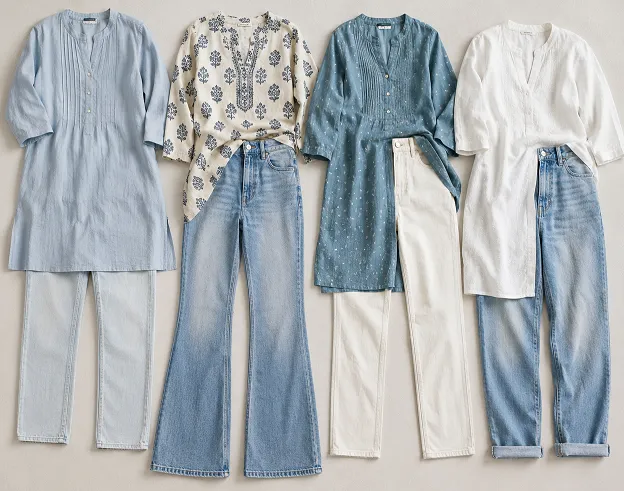
If you like keeping the top relaxed, our guide on kurti with straight fit jeans walks through eight ways to balance a looser kurti with a more fitted bottom.
Navratri and Diwali call for something else again. You’re dancing garba for hours or managing a dupatta through a dozen photos, and a too-tight festive kurti shows sweat marks and restricts your arms exactly when you need them free.
Modal fabric looks similar to rayon on a hanger, but it doesn’t cling to the body the same way once Ahmedabad or Mumbai humidity sets in, which is worth remembering if your festive kurti has any stretch in the blend.
Not every cut flatters every frame the same way at the same looseness. Our guide on kurti for pear shaped body goes further into which silhouettes actually balance different frames once fit and fabric are sorted.
What to Check Before You Buy or Keep a Kurti
Before you finalise an online order or decide to keep something you tried in-store, run it through the pinch test, the arms-overhead test and the sitting test. These are the kurti fit tips worth applying whether you’re standing in a fitting room or scrolling through a cart, because they work regardless of whose size chart you followed.
Check the fabric composition too. A kurti listed as cotton but woven with a synthetic blend behaves differently in Gujarat’s heat than one in pure cotton, even at the identical size on the label.
We manufacture our kurtas directly at our own unit in Surat, and for anything outside that range we source from Surat’s local textile market. That’s the kind of detail you start noticing once you’ve handled fabric at the factory level rather than only on a hanger.
Getting Comfortable With Your Own Fit
The right amount of looseness in a kurti isn’t a fixed number you can carry from one brand to the next. It’s a feeling you check with your own arms, your own waist and how the fabric moves when you finally sit down.
Trust the pinch test over the tag inside the collar.
There’s more on fit and fabric across the Ethora blog if this kind of detail helps you shop smarter. Our store is launching soon, and every piece will come either from our own Surat manufacturing unit or sourced directly from Surat’s textile market.
Frequently Asked Questions (FAQs)
How loose should a kurti be if I’m buying online?
Aim for 1 to 2 inches of ease at the bust and waist for a regular fit, and check the brand’s finished garment measurements rather than relying on the size label alone. Since you can’t run a pinch test through a screen, err slightly loose rather than slightly tight when you’re between two sizes.
Should I size up if I’m between two kurti sizes?
Generally yes, especially in a woven fabric with no stretch. A kurti that’s a touch loose can be tailored in at the side seams, but one that’s too tight often can’t be let out enough to matter, and that’s truer for embroidered pieces where the seam allowance is usually narrower.
Does kurti fabric affect how loose it should be?
Yes. Banarasi silk and other heavier weaves carry weight on the shoulder that pulls the whole garment down slightly by evening, so a size that felt right at 10am can feel tighter by 6pm. Lighter fabrics like georgette hold their fit through the day since there’s less weight dragging on the seams.
How do I know if a kurti fits well before I buy it online?
Check the brand’s finished garment measurements, not just the size label, and compare them to your own bust, waist and hip numbers. Ethora manufactures its kurtas directly at its own Surat unit and sources everything else from Surat’s local textile market, so the measurements and fabric details come from people who actually handle the cloth, not a marketing team guessing at it.
Can a too-tight kurti be altered later?
Sometimes, but only if there’s enough seam allowance left, which embroidered and printed kurtis often don’t have. It’s usually easier and cheaper to size up at the point of buying than to alter a too-tight piece later, especially around an embellished yoke or neckline.
That mirror check you just did in your head, pinching an inch of fabric at your waist, is exactly the kind of thing size charts never tell you. We build that knowledge into everything we make. Ethora manufactures its kurtas, sarees, salwar kameez and lehenga choli directly at our own unit in Surat, and for anything outside that range, we source it directly from Surat’s local textile manufacturers, so you get real fabric knowledge, not guesswork borrowed from a catalogue. Our store is launching soon.