You are standing in front of the mirror with three lehengas laid out on the bed, and none of them feel right. One makes your waist disappear. Another sits oddly at the hip. The third looked perfect on the mannequin at a shop in Surat’s textile market but somehow does not translate to your body at home.
This happens to almost every curvy woman shopping for a lehenga for curvy body type, and it is rarely about your body. It usually comes down to panel count, waist placement and fabric weight, three things nobody explains properly. This article covers what actually changes how a lehenga sits on a fuller frame, including a few things most styling guides get wrong or skip entirely.
Table of Contents
Why a Flattering Lehenga for Curvy Body Type Starts With Silhouette, Not Size
If you have searched for a lehenga for plus size sizing and found the same five silhouettes repeated on every site, structure is the reason they do not all look the same on you. Before colour or embroidery, the silhouette does most of the actual work.
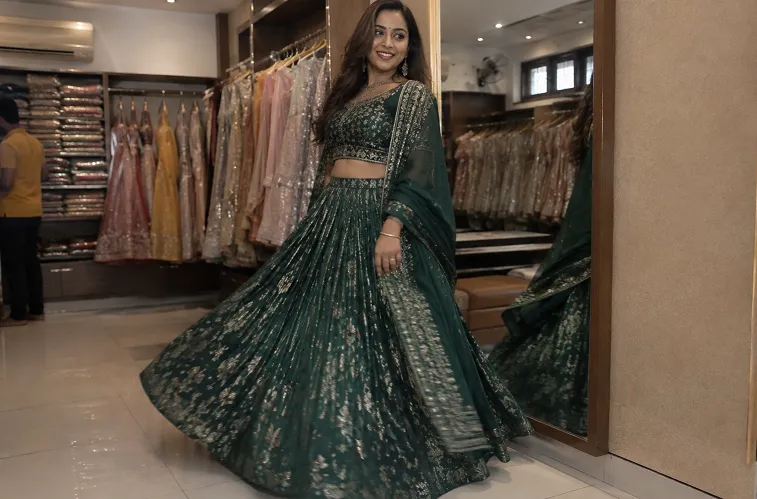
A lehenga skirt built with more panels, usually ten to twelve, creates fuller volume from the hip down without adding tightness anywhere. Fewer panels look sleek in a photo but often cling exactly where you do not want cling.
Waist placement matters just as much. A high, clearly defined waist seam gives your torso an obvious starting point. Set the waist too low and the eye loses track of where your body actually narrows, which makes the whole outfit read as shapeless instead of curvy.
Fabric choice changes this further. Georgette carries more body than chiffon, so it holds a fuller flare while you are walking or dancing at a sangeet. Chiffon moves beautifully but can go flat against wider hips within an hour of sitting through the ceremony.
Once you understand which panel counts and waist placements make flattering lehenga cuts for a fuller frame, everything else becomes a preference rather than a rule. That single shift is worth more than any colour advice you will read below.
If pear-shaped fit questions come up for you too, our guide to lehenga styling for a pear-shaped body covers the width-balance side of this in more detail.
The Choli Neckline and Sleeve Fix Most Guides Skip
Most advice on lehenga for curvy body type stops at the skirt. That is a mistake, because the choli neckline and sleeve do more visible work than any skirt panel, simply because they sit closest to the face.
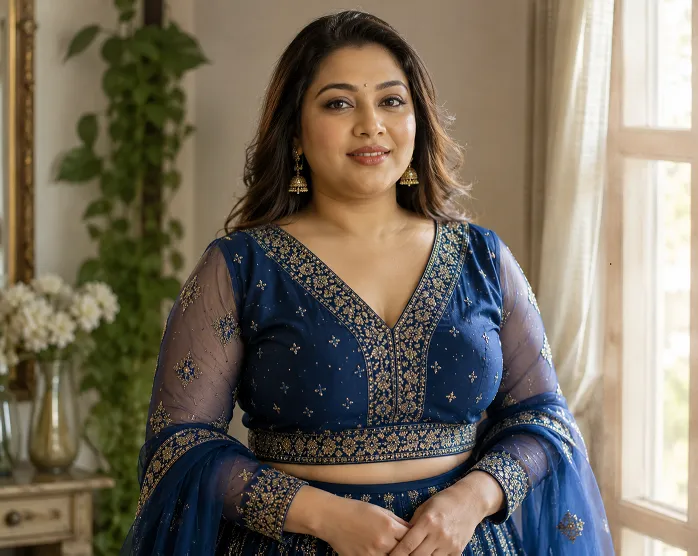
A deep V-neck draws the eye upward and elongates the neck and upper chest in one move. Pair it with full-length sleeves in a sheer net and the arms stay covered without the choli looking heavy or overly structured.
Keep the structure at the neckline only. A little embroidery or a defined border right at the collarbone holds shape and adds polish. Let the sleeve fabric stay soft and sheer below that, so the eye moves up instead of getting stuck at the shoulder.
This is the real reason two women can wear the same lehenga skirt and look completely different from the waist up. The choli is doing the heavier lifting, and it rarely gets credit for it.
The Colour Darkness Debate Is Solving the Wrong Problem
You have probably read two opposite pieces of advice already. One blog says dark colours slim you down. Another insists bright colours celebrate curves and dark tones just make you fade into the background at a wedding.
Both are half right and mostly beside the point. Colour darkness is a weak lever for how proportioned you look in a lehenga. It barely moves the needle compared to panel count, border thickness, and where the embellishment actually sits on the garment.
A dark lehenga with a heavy border stacked only at the very hem pulls the eye downward and can make hips look wider than they are. A bright lehenga with embroidery spread evenly across the full skirt, not bunched at the bottom, reads as balanced regardless of shade.
This tradition of even, considered embellishment is not new. The Ministry of Textiles’ own India Handloom Brand objectives specifically call out embellishment placement and weaving design as core quality markers, not colour, which tells you where the real craftsmanship attention has always gone.
This is good news for you. Pick the colour you genuinely love, whether that is a rani pink for Navratri or an ivory for a daytime mehndi in Surat’s April heat. Everyone will tell a curvy woman to avoid loud colours. Honestly, a bold marigold lehenga with well-placed embroidery does more for your confidence walking into a sangeet than a safe beige one ever will.
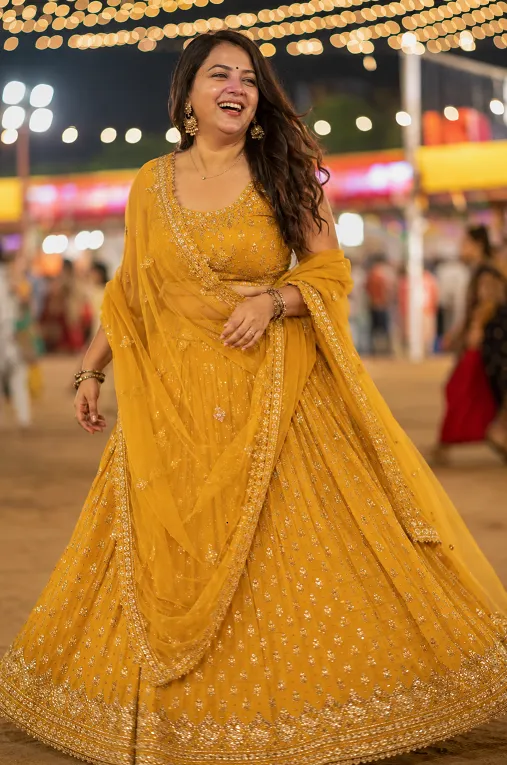
Can-Can Layering: Grace or Bulk Depends on One Thing
The can-can question splits every styling guide down the middle. Some swear by it for graceful movement. Others tell curvy women to skip it entirely and stick to fewer panels.
Both camps are describing different fabric situations without saying so. A can-can under a soft, flowing outer fabric, starting from a clearly defined high waist, adds movement without visible bulk. The outer layer holds its own shape, and the can-can just gives it lift.
Put that same can-can layer under a stiffer raw silk, or under a lehenga with a lower, less defined waist, and it adds real volume exactly where you do not need it. This is the real factor behind lehenga styling for curvy women, and it has nothing to do with a universal rule about net layers and curvy bodies.
Weight matters here too. Banarasi silk lehengas are heavier than most women expect. Wear one for a full wedding day and the pull on your shoulder from the dupatta starts to show by evening. Historic Varanasi weaves like this, woven with real gold-wrapped thread, have carried this exact weight for centuries, as the V&A’s coverage of its Fabric of India research shows in detail. So check how the outer fabric actually behaves before you decide on layering underneath it.
If you are still unsure which structural choices work for your specific shape, Ethora’s free body type calculator gives you a result in under two minutes based on your real measurements, not guesswork.
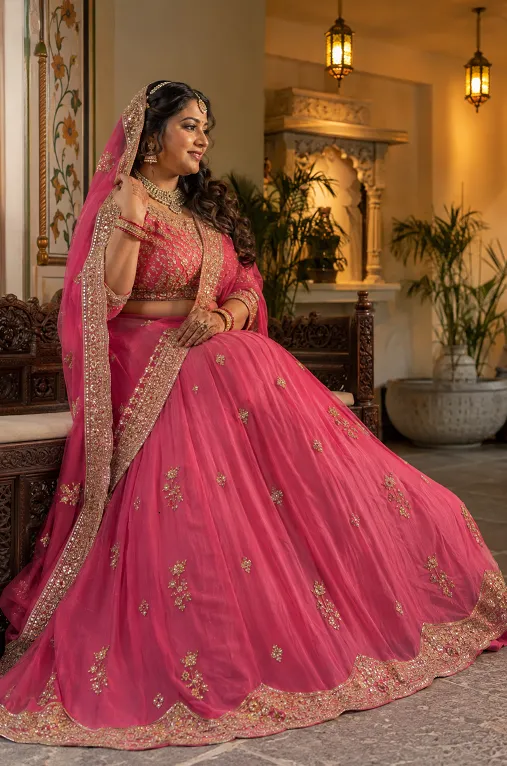
How to Actually Drape a Double Dupatta
You have probably seen the tip before: drape one dupatta around the lehenga and one over your head to camouflage the belly and waist. What nobody explains is how to place both pieces so the look reads as intentional instead of like you added fabric to hide something.
Start with the waist dupatta. Pin it at one hip, take it across the front at a slight diagonal instead of straight across, and pin the other end near the opposite hip bone. A diagonal line creates a waist illusion. A straight line just adds a flat panel of extra fabric.
The second dupatta goes over one shoulder and loosely over the head, pinned so it falls open rather than gathered tight. If both dupattas pull in the same direction, the whole look reads as one deliberate drape instead of two separate pieces trying to cover something up.
Most women pin the second dupatta too tight against the chest because they are worried about it slipping. That is the actual reason it ends up looking bulky, not the fabric itself.
I have watched women at Surat weddings safety-pin a second dupatta on in the car, five minutes before walking in, and it shows. Take the extra ten minutes at home in front of a full-length mirror instead. It changes everything about how the drape sits.
There is a softness to how a well-set dupatta catches the light at a mandap, and that only happens when the fabric is allowed to fall instead of being pinned flat.
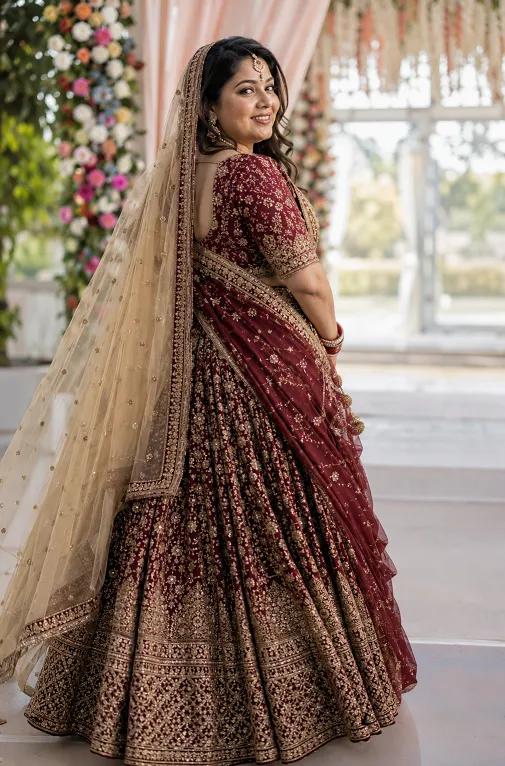
For more ways to work with this piece beyond the lehenga context, see our guide to easy dupatta draping styles for a confident look.
What Actually Matters Before You Buy
Before you buy, check how the outer fabric behaves on its own, without a dupatta or jewellery styled over it. Hold it up and let it fall. A stiff fabric paired with a lower waist will add bulk under any can-can layer, no matter how graceful the sample looked on the shop mannequin.
Ask where the waist seam actually sits when you try it on, not where the tag says it sits. This one detail decides whether layering adds grace or adds volume once you are actually wearing it, not while it is hanging on the rack.
We manufacture our lehenga choli directly at our own unit in Surat, and everything outside our production line is sourced straight from Surat’s local textile market. This kind of fabric-first advice comes from people who handle these weaves every day, not from a styling blog.
Conclusion
The real work in dressing a curvy body for a lehenga happens in the structure, not the colour chart. Panel count, waist placement, and fabric weight decide more about how the outfit sits than any shade ever will. Get those right first, and the drape and dupatta styling fall into place on their own.
If this kind of practical, fabric-first advice was useful, there is more of it across the Ethora blog. Our store is launching soon, with pieces made at our own Surat unit and sourced directly from Surat’s textile market, so the fabric knowledge reaches you without the usual markup.
Frequently Asked Questions (FAQs)
Is a lehenga good for a curvy body type?
Yes, a lehenga for curvy body type can look stunning once the silhouette, waist placement and fabric weight are chosen deliberately instead of by size chart. The skirt’s natural volume works with curves rather than against them, unlike snugly fitted western silhouettes.
Which lehenga fabric is best for curvy women?
Raw silk and silk chanderi are strong choices because they hold embroidery weight without sagging at the hem, something soft georgette can struggle with after a few hours of movement. Both fall with enough structure to keep panels looking full rather than limp by the end of an event.
Should curvy women avoid can-can lehengas entirely?
No, and this is one of the most repeated myths in styling advice. A can-can under a soft outer fabric with a high, defined waist adds graceful movement without bulk. It is the fabric and waist placement that decide the outcome, not your body shape.
What should I check when buying a lehenga online for a curvy body type?
Look closely at fabric weight in the product photos and ask for a video of the skirt in movement if it is not shown. Ethora manufactures at its own Surat unit and sources everything else directly from Surat’s manufacturers, which gives you factory-level fabric knowledge and quality without middleman pricing.
How many panels should a lehenga have for a fuller figure?
Ten to twelve panels generally give the fullest, most balanced flare for a curvy frame without adding visible weight at the hip. Fewer panels can look sleeker in photographs but tend to cling in exactly the areas most women want softened.
Still unsure which silhouette will actually work for your shape? A lehenga for curvy body type comes down to panel count, waist placement and fabric weight, not luck. We manufacture our lehenga choli at our own unit in Surat, and everything else is sourced directly from Surat’s local textile manufacturers, so you get real fabric knowledge behind every piece. Our store is launching soon.