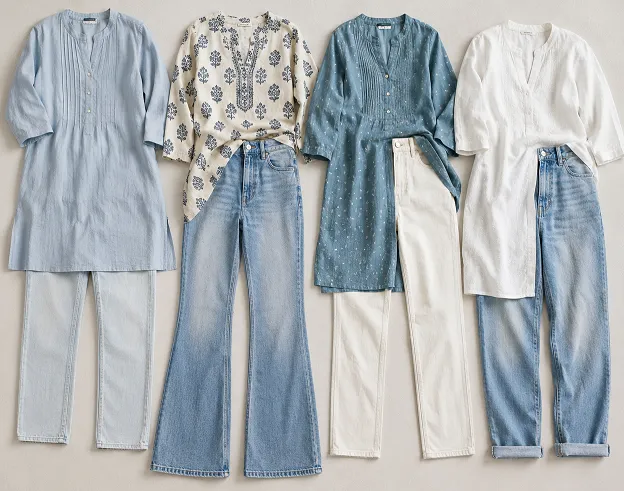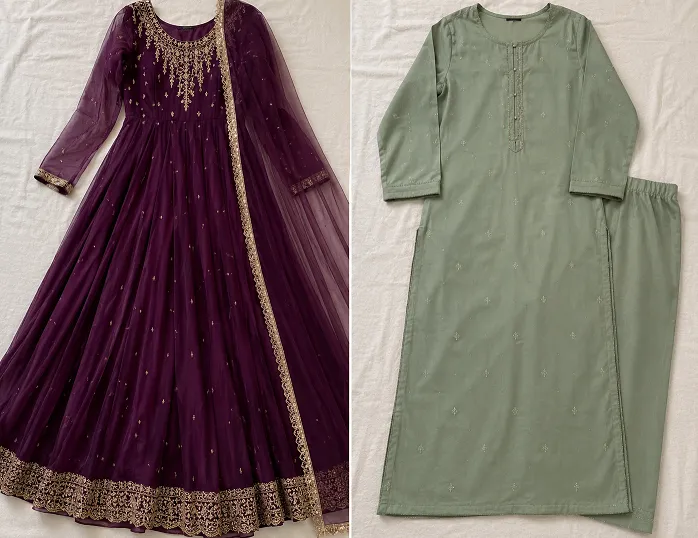
You are standing in a trial room on Ring Road in Surat, third salwar kameez of the afternoon, and it looks exactly like the last two. Straight down, no shape, like the fabric forgot you have a waist.
That flat feeling is the real reason most women search for salwar kameez for rectangle shaped body in the first place. A rectangle shape simply means your bust, waist and hips sit close in width with no strong indentation anywhere, which is not a flaw, it just means certain cuts do more work for you than others.
This article covers seven cuts that genuinely create shape, the one principle that explains why they work, and one belt mistake that quietly makes things worse instead of better.
Table of Contents
Understanding the Rectangle Body Shape Before You Shop
If you have not confirmed your shape yet, it helps to know for certain before you follow any of this advice. Ethora’s free ethnic wear body type calculator takes under two minutes and gives you saree, suit and lehenga suggestions together, based on your actual measurements rather than a guess in a trial room mirror.
A rectangle body type is one of five recognised shapes, alongside pear, apple, hourglass and inverted triangle. Bust and hip stay close in width here, with no strong waist definition either way.
The same logic that applies to a kameez applies to a saree blouse and pallu too, so if you drape sarees often, it is worth understanding how this plays out there as well.
The Real Principle Behind Every Waist Illusion Tip
Most articles on this topic just list tactics: add a peplum, wear a belt, try ruffles. Nobody explains why these work, so you end up guessing which combination is right for you.
Here is the actual mechanic. When you add visible volume above the waist through bust detail and below it through a flare or peplum, while keeping the point in between narrow, the eye reads narrow-then-wide as a curve. It does not matter that the body underneath does not actually taper there.
This is the one principle you can apply to any outfit, not just the seven below. Once you understand narrow-then-wide, you can look at any new kurta or dress and judge in two seconds whether it will work for you.
Salwar Kameez for Rectangle Shaped Body: 7 Cuts That Create the Illusion
These are the cuts that actually apply the narrow-then-wide principle, rather than just looking pretty on a hanger.
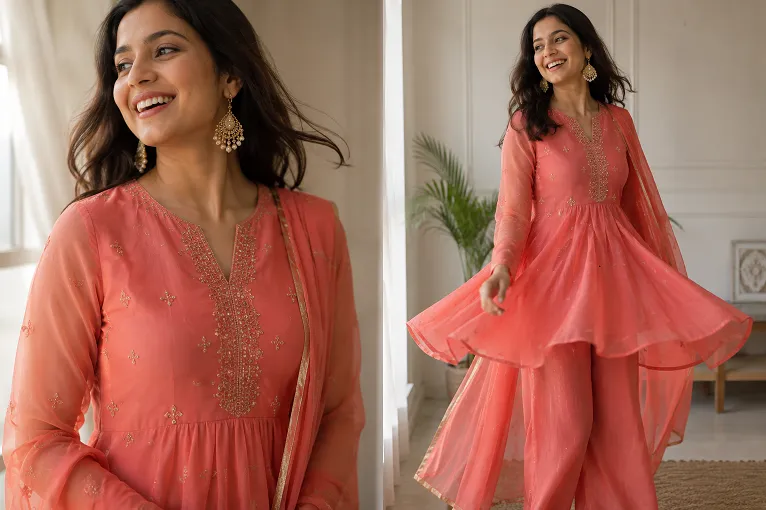
- Peplum kameez with a fitted waist panel adds a hard stop at the waist before the flare kicks in, which is the clearest version of the illusion.
- Anarkali with a fitted yoke narrows sharply at the bust before releasing into a full flare, so read the fit through the chest and shoulder carefully before you buy. Our anarkali versus straight salwar kameez comparison breaks down which fit suits which body type in more detail.
- Angrakha-style kameez with an overlapping front panel creates a diagonal line across the torso that naturally breaks the straight vertical line without needing a belt at all.
- High-low or asymmetric hem kameez draws the eye to the shorter front point, which functions as a visual waist marker even without any actual cinching.
- Cape sleeve or shrug-layered sets add width at the shoulder and bust, which is the “volume above” half of the illusion, especially useful if your shoulders are narrow.
- Straight-cut kameez with a contrast colour waist panel uses colour blocking instead of fabric volume to fake the narrow point, a good option if you find peplums fussy for daily wear.
- A short peplum jacket worn over a plain straight kurta gives you the belted look without an actual belt digging into a waist that has nothing to hold onto.
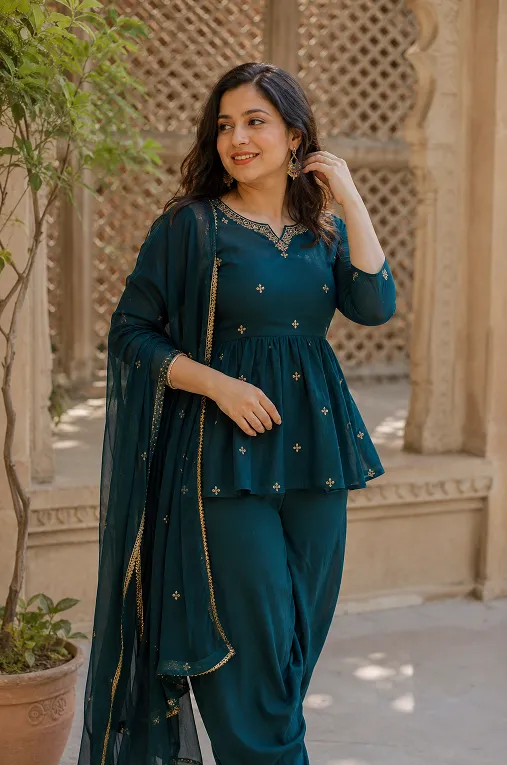
Why a Tight Belt Can Backfire on a Straight Waist
Every guide tells you to add a belt. Almost none of them tell you when that advice works against you, and honestly, this is the part most rectangle body shape kurti advice skips entirely.
A belt only reads as a waist when it sits at a point where the body actually pulls in slightly. Pull a belt tight on a torso with no indentation and it stops looking like a waistline. It starts looking like a rope tied around a straight column, which draws more attention to the lack of curve, not less.
You are better off choosing a kameez where the waist shaping is built into the seams, like a princess cut or a fitted yoke, rather than forcing a separate belt onto a plain straight kurta and hoping it settles into place. The seam does the work quietly. The belt asks the fabric to fake something it cannot hold.
Layering and Jackets: Why They Work Especially Well on This Shape
“Layering adds dimension” is the laziest line in fashion writing, because it never explains what dimension actually means or why it happens.
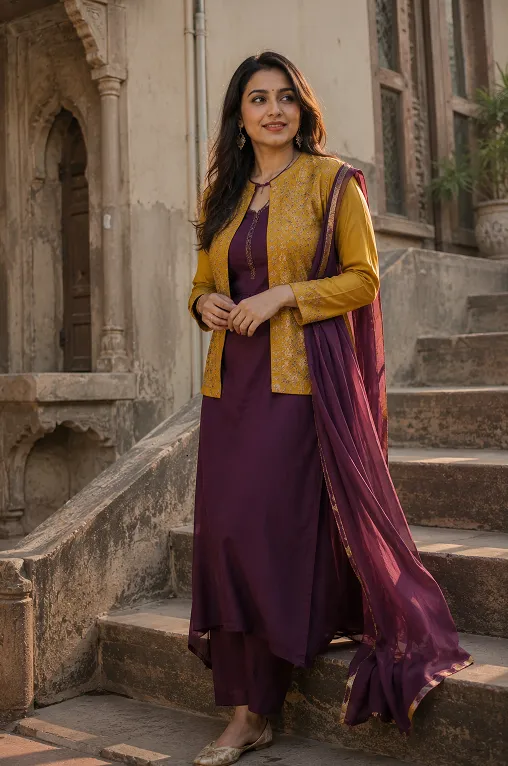
Here is the real reason it works. A jacket or overlay that ends at a different length than the kameez underneath breaks your torso into visual steps instead of one unbroken straight line. Each step gives the eye a place to pause, which reads as shape even though nothing about your body has changed.
This is exactly why layering helps a rectangle shape more than it helps a body that already has a defined waist. A curved body does not need the extra visual break. Yours can genuinely use it.
A structured jacket in a firmer fabric like dupion silk over a flowier georgette kameez works particularly well here, because the contrast in how the two fabrics fall adds a second visual break at the hem line, not just at the jacket length. If you want more specific combinations, our guide on layering a jacket over a kurta covers five picks that hold up through a full day, not just for photos.
Fabrics That Help, and the Ones That Work Against You
Fabric choice matters more here than most women realise, and this is where actually working with looms for years changes what you notice. Good fabric picks are half the reason any salwar kameez for rectangle shaped body actually holds its shape past the first hour of wear.
Georgette has more body than chiffon, so it holds a peplum’s flare shape while you are walking instead of collapsing flat against the leg within an hour. Chiffon looks lovely standing still but goes limp fast in Surat’s humidity, which quietly undoes the whole waist illusion by evening.
Banarasi silk is heavier than it looks in the store. If you are wearing a Banarasi kameez set for a full day event like an engagement or a Diwali gathering, the weight starts to pull the shoulder line down by evening, which flattens the very volume you were trying to create up top.
According to a detailed fabric guide on georgette from MasterClass, georgette’s tightly twisted weave gives it a distinctive body and drape compared to sheerer fabrics, which is exactly why it holds pleats and peplum flares better through movement.
Skip soft, clingy fabrics like plain rayon or thin viscose for peplum or angrakha cuts. They lie flat against the body instead of holding their own shape, and the whole illusion depends on that shape staying put while you move, not just while you stand for a photo.
What to Look For When You Buy
Before you buy a peplum or belted style, check where the waist seam or cinch actually sits on your own torso, not where it sits on the model in the photo. If it lands above your natural waist, the narrow-then-wide illusion breaks immediately, no matter how good the salwar kameez for rectangle shaped body looked in the product photo.
Run your hand along the inside seam too. A well-constructed waist panel has a slight structure to it, sometimes a thin lining or interfacing, so it holds its narrow point instead of folding with your movement.
This is advice that comes from actually handling these seams every day. Ethora manufactures its salwar kameez and kurta sets directly at its own Surat unit, and for anything outside that range, we source directly from Surat’s local textile market, so this comes from people who work with the fabric, not just people who style it.
Conclusion
Once you understand narrow-then-wide, the guesswork mostly disappears. You stop asking “will this suit me” for every single kurta and start checking one thing: where does this piece add volume, and where does it stay narrow.
There is more styling detail like this across the Ethora blog if you want to keep reading before your next shopping trip. Our store is launching soon, with pieces made at our own Surat unit and sourced directly from Surat’s textile manufacturers, so what you see is what actually comes off the loom
Frequently Asked Questions (FAQs)
Can a rectangle body shape wear a straight cut salwar kameez?
Yes, but pair it with a contrast dupatta drape or a jacket overlay, since a plain straight cut on its own has no built-in waist marker. Without one of those additions, it tends to read as one flat block of colour from shoulder to hem.
What kurti style suits a rectangle body shape the most?
A cropped kurti with a peplum hem or gathered waist works better than a long straight kurti, because the shorter length puts the flare closer to your actual waistline instead of somewhere near your hip. Look for kurtis with front panel piping too, since a vertical seam line down the centre adds a subtle waist marker without needing a belt.
How do I know if a peplum kameez is good quality before buying online?
Check the product description for lining or interfacing at the waist panel, since a peplum without any internal structure will not hold its flare shape after a few washes. Ethora manufactures at its own Surat unit and sources everything else directly from Surat’s textile manufacturers, which means genuine construction detail and factory-level quality without the usual middleman markup you find on marketplace listings.
Does a rectangle body shape need a specific dupatta style?
An asymmetric or one-shoulder dupatta drape works better than a straight centre drape, since the diagonal line it creates across your chest adds another break in the vertical line, similar to how a jacket overlay works.
Is a belt a must for rectangle body shape outfits?
No, and honestly a well-placed peplum or angrakha panel often looks more natural than a belt forced onto a waist with no indentation to hold it. A belt pulled tight on a straight torso can end up looking tied around a column rather than sitting at an actual waistline.
Trying to find the right cut for a straight silhouette is a lot easier once you know what to look for in a seam, not just a photo. Ethora manufactures its salwar kameez and kurta sets at its own unit in Surat, and for pieces outside that range, we source directly from Surat’s local textile manufacturers, so every recommendation here comes from people who actually handle the fabric. Our store is launching soon.