Your lehenga arrives, you try it on standing still in front of the mirror, and it looks perfect. Then you take one step at the sangeet and the hem catches under your heel.
That gap between the fitting room and the actual event is where most lehenga length for height advice falls apart. Every guide gives you a hemline number based on your height in inches.
Fewer of them tell you that the exact same number behaves differently once you factor in fabric weight, the kind of event you’re attending, and the ground you’ll be standing on. This piece covers the height chart, because you need it. But it also covers what happens once you actually start moving in the outfit, since that’s usually where the real trouble begins.
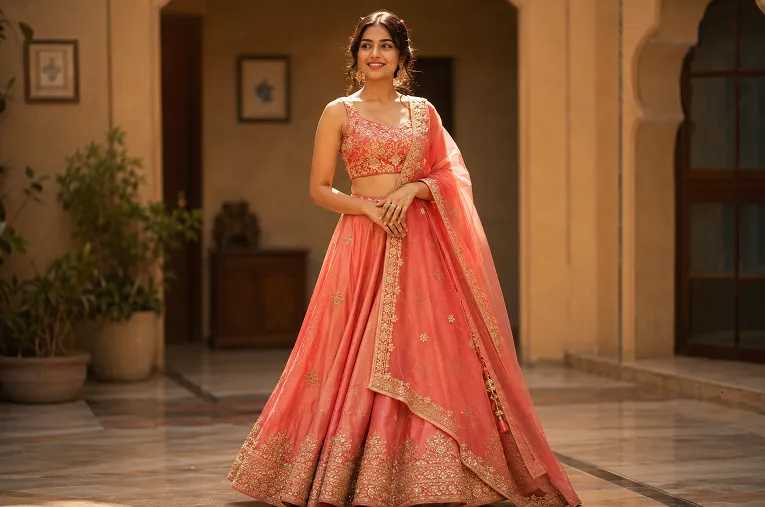
Table of Contents
Lehenga Length for Height: The Real Numbers to Start With
Choosing lehenga length starts with one measurement: your natural waist to the hem, taken while standing straight in the footwear you’ll actually wear that day.
- Under 5’0″ (below 152 cm): 38 to 40 inches works best, brushing just above the ankle bone so you’re not tripping on stairs or during the phera.
- 5’0″ to 5’3″ (152 to 160 cm): 40 to 42 inches sits right at the ankle, keeping your footwear visible instead of hidden under the fabric.
- 5’3″ to 5’6″ (160 to 168 cm): 42 to 44 inches grazes the floor while you’re standing still, which is the safest average length for most off-the-rack pieces.
- 5’6″ to 5’9″ (168 to 175 cm): 44 to 46 inches gives the fully floor-sweeping look most bridal shoots show, since taller frames carry the extra fabric without it pooling.
- Above 5’9″ (175 cm and up): 46 to 48 inches. This is the point where a lehenga for tall women stops being a standard-chart problem and turns into a tailoring one, since most ready sizes stop short of you.
Keep in mind these numbers assume you’re standing still for a photograph. That assumption is exactly where things start to go wrong, and it’s the part almost nobody talks about.
Quick Lookup: Lehenga Length by Exact Height Chart
Here’s the quick-reference version of lehenga length for height, if your exact number isn’t showing up in the bands above.
Use this exact height-to-lehenga-length chart to find your perfect fit in inches and centimeters.
| Height | In cm | Lehenga Length (Waist to Hem) |
|---|---|---|
| 4’10” | 147 cm | 39 to 40 inches |
| 5’0″ | 152 cm | 40 to 41 inches |
| 5’2″ | 157 cm | 41 to 42 inches |
| 5’4″ | 163 cm | 42 to 43 inches |
| 5’6″ | 168 cm | 44 inches |
| 5’8″ | 173 cm | 45 inches |
| 5’10” | 178 cm | 47 inches |
These sit inside the ranges above, just narrowed down to your exact height instead of a band. If you’re between two rows, split the difference.
Why the Same Hemline Number Behaves Differently by Fabric
Here’s something a tailor knows that a size chart never tells you. A 42 inch hem in silk and a 42 inch hem in georgette are not the same garment once you start moving.
Heavier fabrics like velvet or silk hold their shape. The weight pulls the hem down and keeps it steady, so a floor-grazing length stays exactly where you left it, even through a hug or a quick turn.
Georgette behaves completely differently. It’s light, and during a spin or a fast dance step, the exact same length can flip up and show more ankle than you planned.
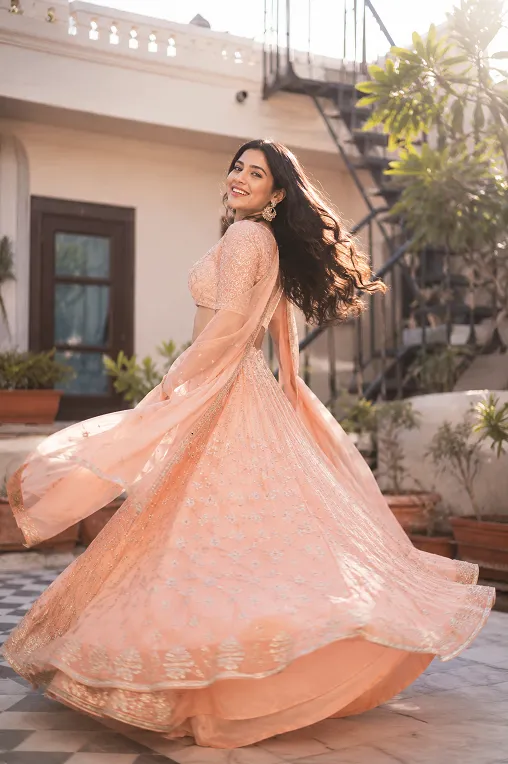
This isn’t a flaw in the fabric. Georgette gets its soft, bouncy fall from the way its yarns are tightly twisted in opposite directions before weaving, which is what creates that puckered, springy surface. That same construction is what makes it move so freely against your legs.
Banarasi silk brings its own consideration. It’s heavier than most women expect, and in a fully worked Banarasi lehenga worn through a full day event, the weight sitting at your waist and shoulders starts to feel noticeable by evening, especially once the dupatta is layered on top.
So the honest version of lehenga length for height advice is this: the number shifts slightly depending on what the outfit is made of, not just how tall you are.
The Length Should Also Match the Event, Not Just Your Height
Most guides treat height as the only variable, and that’s the part I’d push back on. A wedding ceremony is mostly static. You’re standing at the mandap, seated for the pheras, posing for photos. A precisely floor-length hem works beautifully here because you’re not moving fast enough to trip on it.
A sangeet or a garba night is a different story. You’re dancing, spinning, and stepping in ways the standing-still number never accounted for.
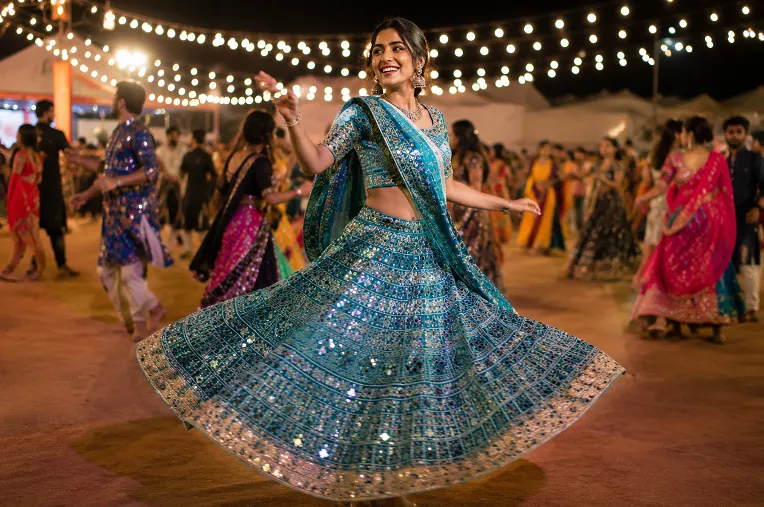
The same floor-grazing length that looked perfect at your fitting can get stepped on, by you or by the person next to you, within the first song. For dancing-heavy functions, go slightly shorter than your calculated length, even at the exact same height.
If you’re building a full garba wardrobe, our Navratri outfit guide breaks down what actually holds up through a full night of dancing, and it’s worth reading alongside this one. And if you’re still deciding between a lehenga and a chaniya choli for the occasion, the flare and length rules genuinely differ between the two, which we’ve covered in our lehenga versus chaniya choli comparison.
Everyone assumes one hemline should work for the entire wedding season. It shouldn’t. Treating your sangeet length the same as your reception length is one of the more common sizing regrets I hear about.
When the Venue Decides Before Your Height Does
There’s a third factor almost no guide mentions, and it has nothing to do with your body or the fabric. It’s the ground you’ll actually be standing on.
An outdoor destination wedding on grass, a monsoon-season function, or a venue with an uneven stone floor all make a precisely floor-grazing hem impractical, no matter how flattering it looks on paper.
Wet grass stains a trailing hem within minutes. Uneven flooring catches fabric that’s sitting exactly at floor level. If your event is outdoors or the forecast looks unreliable, go half an inch to an inch shorter than your calculated length. You’ll thank yourself later, and nobody at the function is measuring your hemline against a chart.
Silhouette and Blouse Length Play Their Part Too
Length isn’t only about the skirt. A high-waisted lehenga with a cropped blouse visually adds height, which matters if you’re on the shorter side and want the outfit to look longer than the fabric actually is.
If you’re searching for the right lehenga for short height and worried about looking swamped in fabric, the fix is usually proportion, not just a shorter hem.
Another trick works even before you touch the hemline. A vertical embroidery panel running from waist to hem, or a dupatta draped front-to-floor instead of across the body, creates one continuous visual line from shoulder to floor. That single line does more for the illusion of height than adjusting the length ever will.
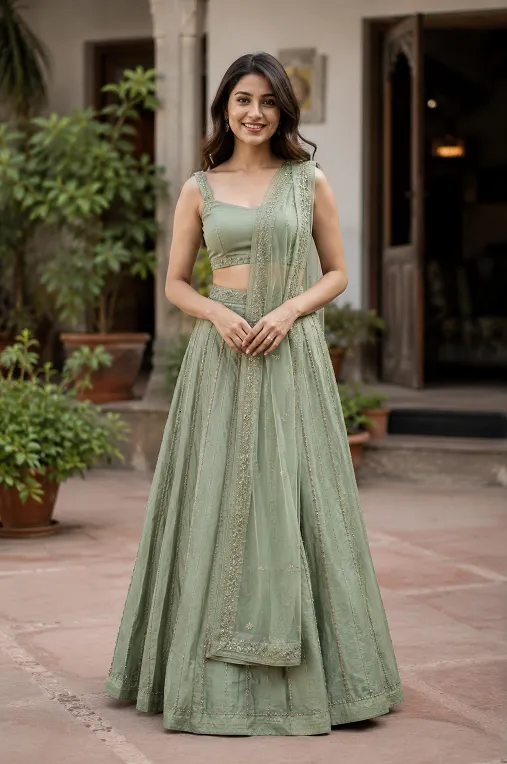
A-line and flared silhouettes tend to be more forgiving across body types than a fully circular ghagra, which needs more fabric and can overwhelm a petite frame. If you’re unsure what cut actually suits your proportions rather than just your height, Ethora’s body type calculator is a genuinely useful starting point before you commit to a length or flare.
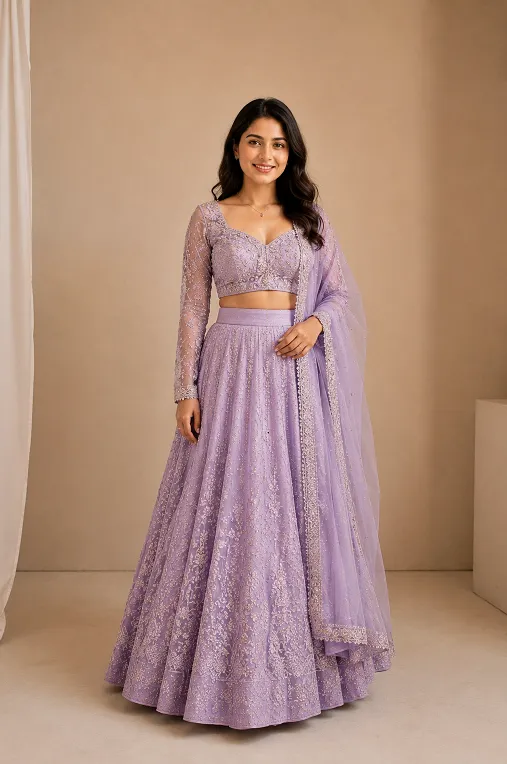
One mistake I see constantly: women pick their blouse length based on what looks good on a hanger, without checking how it sits once the lehenga skirt is tied at the actual waistline. That’s the wrong way to judge it, because where the skirt sits changes where the blouse needs to end.
What to Check Before You Buy
Before you order or book a fitting, check what the lehenga is made of, not just the printed length. Fabric weight decides whether a precisely hemmed length actually holds its shape once you’re moving, not just standing for a photo.
Ask whether the skirt is lined, since lining adds a little weight and helps a lightweight fabric like georgette hang steadier through the day.
We manufacture our sarees, salwar kameez, kurtas, and lehenga choli directly at our own unit in Surat, and for everything else, we source directly from Surat’s local textile market. That fabric-first habit is where this checklist actually comes from.
Conclusion
The number on a lehenga length for height chart is only the starting point. What actually determines whether your outfit behaves the way you imagined is the fabric weight, the event you’re wearing it to, and the ground you’ll be standing on that day.
Get those three right alongside your height, and the length stops being a guessing game.
If this kind of practical, experience-based styling helps, there’s more of it on the Ethora blog worth exploring. Our store is launching soon, with pieces made directly at our Surat manufacturing unit and sourced from Surat’s local textile market.
FAQ
How much longer should a lehenga be for a tall woman?
If you’re above 5’9″, add roughly 2 inches to the standard chart length, landing around 46 to 48 inches from the waist. At this height, custom tailoring almost always works better than a standard size, since most ready-made pieces are cut for average heights.
What is the ideal lehenga length for a short height bride?
For a height under 5’3″, staying closer to 38 to 42 inches keeps the proportions balanced and avoids excess fabric pooling. Pairing this with a slightly higher waistline and a cropped blouse helps elongate the frame further.
Should a lehenga always touch the floor?
Not always. A floor-touching hem works well for static, photo-heavy functions like the wedding ceremony, but a slightly shorter length works better for sangeet or garba nights where you’re dancing. Net and organza also behave differently here, since their natural stiffness holds a shorter length away from the ankles instead of dragging the way a soft, flowy fabric would.
How do I know if a lehenga fabric is good quality before buying online?
Check whether the fabric shows consistent weight and drape in photos or videos, since good georgette or silk falls smoothly rather than looking stiff or paper-like. Ethora manufactures directly at its own unit in Surat and also sources other pieces straight from Surat’s textile manufacturers, which means you’re getting factory-level fabric knowledge and quality without middleman markups.
Can a lehenga’s length be altered after I’ve already bought it?
Yes, most lehenga skirts can be shortened or let down slightly by a tailor, as long as there’s enough seam allowance at the hem. Heavily embroidered borders are harder to alter without disturbing the design, so check the hem work before assuming it’s an easy fix.
What is the ideal lehenga length for a 5 feet girl?
At 5’0″ (152 cm), aim for 40 to 41 inches from the waist to the hem. This sits close to the ankle rather than the floor, which keeps the proportion balanced without needing extra tailoring.
What is the ideal lehenga length for a 5’4 feet girl?
At 5’4″ (163 cm), 42 to 43 inches from the waist usually grazes the floor while standing. If the lehenga is in a lightweight fabric like georgette, keep it closer to 42 inches so it doesn’t drag while you’re dancing.
Getting the length right is only half the job when the fabric and the event both change how it actually wears. Ethora manufactures lehenga choli, sarees, salwar kameez, and kurtas directly at our own unit in Surat, and for everything else, we source directly from Surat’s local textile manufacturers. Our store is launching soon, bringing that same factory-level fabric knowledge straight to you.