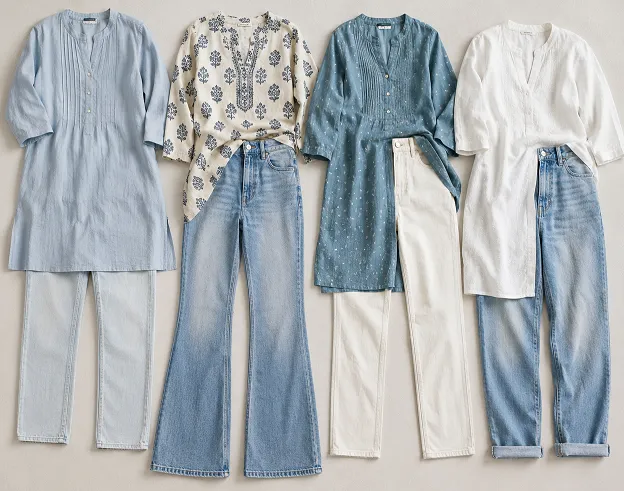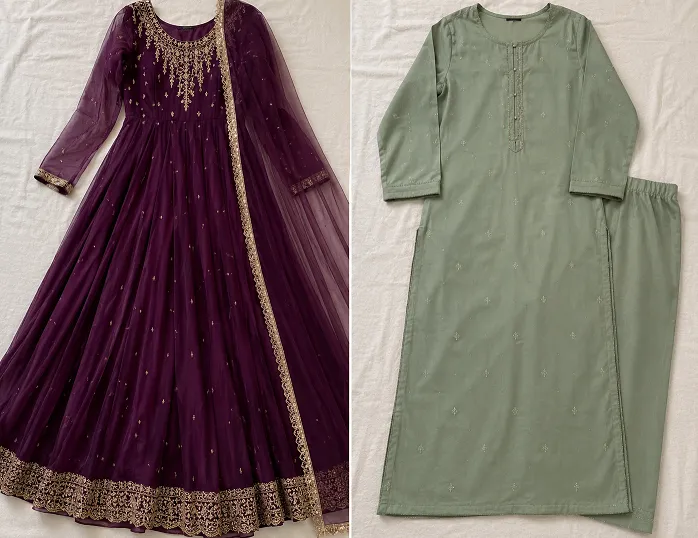
You ordered the kurti because the photo looked perfect. Then it arrived, and the neckline sits nearly two inches lower than it did on the model. Now you’re standing in front of the mirror before the function, safety pin in hand, wondering if a scarf pinned across your chest is really the only option left.
This is one of the most common complaints Indian women have about buying kurtis online, and almost nobody talks about it honestly. Learning how to fix deep front neck of readymade kurti at home is not complicated once you understand what you’re working with.
Depending on the fix, it takes anywhere from ten minutes with no needle at all to about forty minutes with one.

Table of Contents
Why Readymade Kurtis Run Deeper Than the Photo Shows
Most readymade kurtis are cut on a curve that photographs beautifully but sits differently once the fabric settles against a real body. Mannequins and models are usually smaller through the shoulder than an average Indian woman’s frame, so a neckline that looked modest in the listing photo drops lower once you actually put it on.
Most women choose a kurti based on how it looks folded on a shelf or lit up in a product photo. That’s the wrong way to judge a neckline, and it’s a big part of why this complaint repeats every season, from Navratri shopping hauls to last-minute college fest orders.
And once the kurti is home and the tags are off, returning it usually isn’t worth the hassle.
How to Fix Deep Front Neck of Readymade Kurti: Match the Fix to How You Wear It
Before you pick up a needle, decide how this kurti actually lives in your wardrobe, and whether you want to sew at all. That decision changes which of the three fixes makes sense for it.
If you’re short on time, unsure whether you’re keeping this kurti long-term, or you simply don’t sew, layering a plain camisole or fitted tank underneath the neckline is the fastest option here. It’s the only one of the three that’s completely reversible, since it changes nothing about the garment itself.
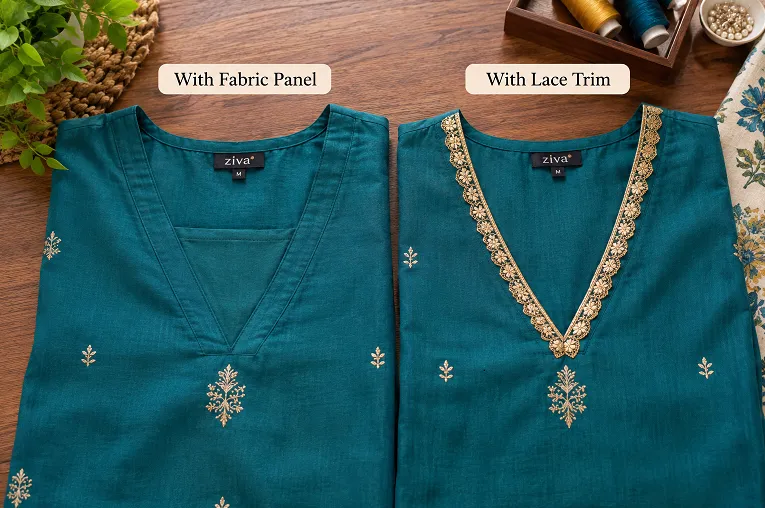
If this is a kurti you’ll wear to work through an Ahmedabad summer or on a regular Tuesday, though, you want something more permanent and invisible. A sewn-in modesty panel, a small piece of matching fabric stitched behind the opening, holds up to daily wear and repeated washing without coming loose at the edges.
A modesty panel is really just a way to reduce kurti neck width without touching the rest of the garment, and it does the job quietly enough that nobody will ever clock it as a fix.
If it’s a festive kurti you’ll wear once or twice a year, for Diwali or a friend’s sangeet, you have more room to play. A decorative lace insert across the neckline can become part of the design instead of just hiding a problem.
It reads as a style choice, not a repair, and it usually photographs better than the original neckline did.
If you’re not sure this particular kurti earns a place in your regular rotation to begin with, it’s worth running through how loose a kurti should actually fit before you commit an evening to altering it.
Check the Kurti’s Own Fabric Before You Buy Anything Else
Before you go hunting for contrast fabric or lace, turn the kurti inside out and check what it’s already giving you. Most readymade kurtis are hemmed with more fabric than they strictly need, sometimes an extra inch and a half folded up and stitched out of sight.
Unpick that hem allowance carefully with a seam ripper, press it flat, and you have a strip of fabric that matches your kurti exactly. No dye lot mismatch, no hunting through the local market for the right shade of georgette.
This same strip covers more than the neckline. If you’re also short on sleeve length, the same kurti sleeve extension design ideas apply here. Use the leftover hem fabric to add a cuff at the sleeve edge, so the neck patch and the sleeve extension read as one design decision instead of two separate repairs.
Surat’s textile district has a long, GI-registered history of embellishment work like zari craftsmanship, which is part of why the local market carries such a deep stock of coordinating lace and trims if your own kurti simply doesn’t have enough fabric to spare.
Which Kurti Fabrics Are Actually Easy to Fix Yourself
Most tutorials promise this technique works on any kurti. It doesn’t, and pretending otherwise sets a beginner up to fail on her first attempt.
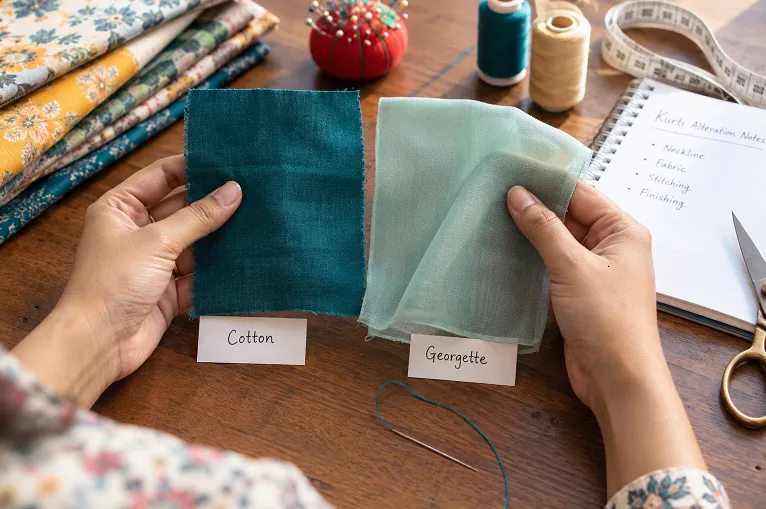
Cotton and cotton-blend kurtis are genuinely beginner-friendly. The fabric holds its shape under the needle, the weave doesn’t shift while you’re pinning, and small stitching mistakes are easy to unpick and redo without leaving a mark behind. If you’re deciding what to practice on first, a cotton kurti built for everyday summer wear is the right place to start.
Georgette and chiffon are a different story. Both have very little body of their own, so they slide under the needle instead of staying put, and any uneven stitch shows through the sheer, light weave.
Georgette does have slightly more body than chiffon, which is why it holds a stitch a little better. Neither one, though, is a true beginner fabric next to cotton.
If you own both types, start on the cotton one. Save the georgette or chiffon kurti for after you’ve done this once and know how steady your hands actually are with a needle.
How to Cover Deep Neck Designs in Kurti, Step by Step
Once you’ve decided which path fits your kurti, here’s how to fix deep front neck of readymade kurti step by step, no boutique required.
Camisole or Tank Layering, the No-Sew Fix
If you’re leaving in ten minutes and don’t own a needle, this is the one. Slip on a plain camisole or fitted tank close to your skin tone or the kurti’s base colour, and let it show a little at the neckline instead of trying to hide it.
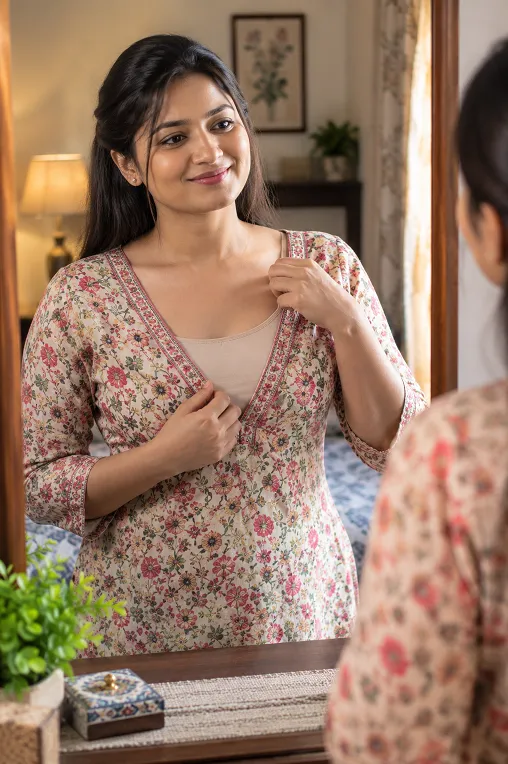
This works best on a kurti you’re not sure you’re keeping, or a borrowed outfit you don’t want to permanently alter.
The trade-off is how it reads, not durability. A camisole peeking out looks like a deliberate styling choice on a boat neck or a wide U-neck, but on a sharp, narrow V it can look more like an obvious patch job.
The Modesty Panel Method, for Kurtis You Wear Often
- Measure the gap first. Turn the kurti inside out and check how much extra coverage you need at the lowest point of the opening. One to two inches is usually enough for most necklines.
- Cut a curved panel. Use your reused hem fabric, or matching cotton if you’re buying fresh, and cut a piece that mirrors the shape of the neckline with a small seam allowance on the outer edge.
- Pin it from the inside. Place the panel against the inside of the neckline, right side facing your body, so it stays completely invisible once you’re wearing the kurti.
- Slip stitch it in place. Use small, even stitches close to the existing neckline seam with thread that matches your kurti exactly. Uneven stitches are the one thing that gives a home fix away.
- Try it on before trimming. Put the kurti on before you cut away any excess panel fabric, then trim and fold the raw edge under so it won’t fray after a few washes.
The Lace Insert Method, for Festive Kurtis
Pick a lace trim that echoes any embroidery or motif already on the kurti, rather than something that fights with it. Pin the lace as a visible band along the neckline edge instead of tucking it inside, since the whole point here is to let it show.
A running stitch along both edges of the lace secures it without flattening the texture. Chiffon and georgette catch the light differently than cotton does, and a lace band against either fabric has a softness to it that photographs well under festival lighting.
If you’re unsure which lace shade will actually work with your kurti’s colour, Ethora’s free kurti colour matching tool gives you pairing suggestions in under two minutes based on the shade you already own.

What You’ll Need Before You Start
The camisole fix needs nothing beyond the camisole itself. For the two sewn fixes, you don’t need a sewing machine either, just a hand sewing needle, thread that matches your kurti’s colour exactly, sharp fabric scissors, a measuring tape, and a handful of pins.
If you’re not reusing the kurti’s own fabric, pick up about a metre of narrow lace trim close to your kurti’s shade. Thread colour and a sharp pair of scissors matter the most here. A slightly blunt pin won’t ruin the result, but mismatched thread or a ragged cut edge will show on every wear.
This is the kind of practical, hands-on fabric knowledge that comes from actually manufacturing garments, not just styling them, which is exactly the experience Ethora brings from making sarees, kurtas and salwar kameez at its own unit in Surat, and from sourcing everything else directly from Surat’s local textile market.
Getting the Fit Right Without a Tailor
The neckline on a readymade kurti is fixable in an evening, not a project that needs a boutique visit or a fresh purchase. Once you know which of the three fixes suits how you actually wear the piece, the rest is just careful execution, whether that’s a needle or just a camisole.
These are exactly the kind of ready made kurti alteration tips a boutique tailor would charge you for.
If today’s fix went well, our blog has more practical fixes worth browsing before your next wardrobe dilemma. Ethora’s own store is launching soon, with pieces made at our Surat unit and others sourced directly from Surat’s textile manufacturers.
Frequently Asked Questions (FAQs)
Can I fix a deep neck kurti without any sewing at all?
Yes. Layering a plain camisole or fitted tank underneath the neckline needs no needle at all, and it’s the fastest of the three fixes in this guide.
It won’t hold up as a permanent solution the way stitching does, but if you’re wondering how to fix deep front neck of readymade kurti for a single wear tonight, this is genuinely enough.
How much extra fabric do I actually need for a neck patch?
Most necklines only need one to two inches of extra coverage at the lowest point, so a strip roughly three inches wide and long enough to curve across the opening is usually plenty, even after seam allowance.
Will a modesty panel be visible from outside the kurti?
Not if the thread colour matches and the stitches sit close to the existing seam. A panel cut from the kurti’s own hem fabric blends in almost perfectly, since there’s no dye lot difference to give it away.
Can this same method work on a salwar kameez neckline?
Yes, the same modesty panel and lace insert approach works on a salwar kameez kurta, since the neckline construction is nearly identical to a kurti’s. Just check the fabric weight first, since heavier salwar kameez fabric may need a slightly wider seam allowance.
How do I know if a kurti’s fabric is good quality before buying online?
Check whether the listing names the actual fabric rather than a vague term like “premium fabric,” and look at how it falls in the product photos. Stiff, glossy fabric in every shot is often a sign of a lower thread count.
Ethora manufactures directly at its own unit in Surat and also sources other pieces from Surat’s textile manufacturers. That means the fabric knowledge behind every listing comes from people who handle these materials daily, without the usual middleman markup.
A neckline you fixed yourself is proof that a kurti doesn’t need to fit perfectly out of the box to earn a place in your wardrobe. Ethora makes its sarees, kurtas and salwar kameez directly at its own manufacturing unit in Surat, and everything outside that range is sourced straight from Surat’s local textile manufacturers, so what you’d eventually buy comes from people who understand fabric the way you just learned to. Our store is launching soon.