You already know the moment. You are standing in a trial room somewhere between Ring Road and Athwa Gate, the zip stuck three inches from the top, and the shopkeeper tells you to size up. So you do. The next size skims your waist just fine but hangs off your shoulders instead, the sleeve seam sitting somewhere near your elbow.
Nothing about this makes sense until you realise nobody explained the one measurement that actually decides your size. Think of this as your plus size ethnic wear guide for the one decision most sizing charts get wrong. This guide on ethnic wear for plus size women starts where most sizing charts stop, at the shoulder seam, and works backward from there, along with a few plus size styling tips you can actually use this festive season.
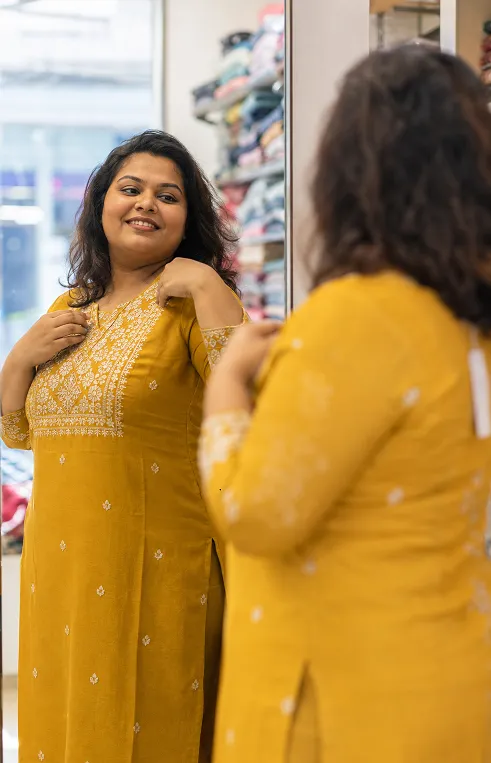
Table of Contents
Why Shoulder Fit Should Decide Your Size First, Not Bust or Waist
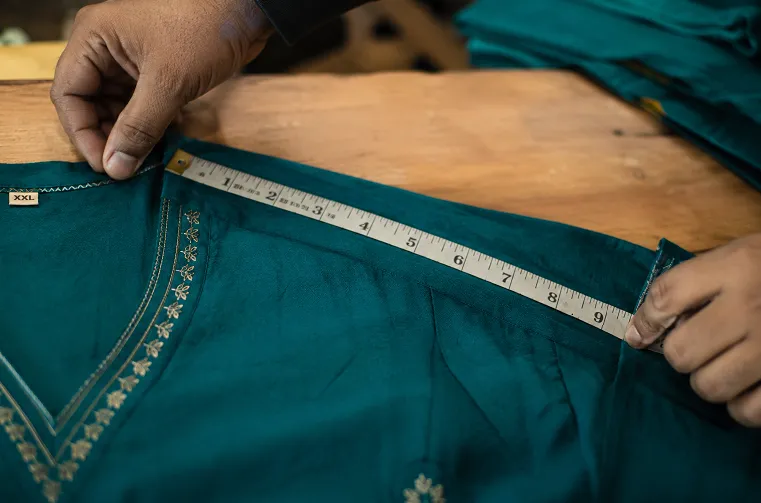
Most women pick their blouse or kurti size based on the bust measurement. That is the wrong starting point. Bust and waist have room to move through darts, side seams and simple tailoring, but the shoulder does not.
The shoulder seam sits exactly where the yoke is cut. Move that seam even half an inch and the entire sleeve shifts with it, changing how the fabric falls across your upper arm and back. A tailor can take in a waist in twenty minutes.
Resetting a shoulder seam means unpicking the sleeve, the yoke and often the collar too, and even then the drape rarely looks the same again once it has been redone.
Here is the part nobody tells you in the trial room. If your blouse or kurta fits at the shoulder and feels loose everywhere else, that is actually the easier problem to fix. A blouse that fits your bust but pulls at the shoulder seam is the one that bothers you the whole day, because every arm movement tugs at a seam that cannot stretch.
So the real order is shoulder first, then bust, then waist, then length. Size up for the shoulder even if the rest of the garment looks slightly loose in the trial room mirror. A good tailor in Surat’s market can nip in a waist for less than the price of your chai break. Nobody can rebuild a shoulder seam without it showing.
Getting the Basic Measurements Right for Ethnic Wear for Plus Size Women
Once the shoulder is sorted, the rest becomes simple maths instead of guesswork. Measure your bust at the fullest point, your waist at the natural crease above the navel, and your hip at the widest point below it. Write these down, not what you remember from six months ago.
Most women choose a kurti or kurta length based on what looks good on the hanger. That is the wrong way to decide length. A kurta that hits mid thigh on a five foot two frame will land above the knee on someone taller, and that changes the entire silhouette.
Length should be decided against your own height and where your body actually carries weight, not against a photo of a model wearing the same piece. If you are not sure which body shape you fall into within the plus size range, pear, apple, hourglass or rectangle, Ethora’s free body type calculator gives you a result in under two minutes using your actual measurements.
In Surat’s humid stretch from June to September, cotton and modal fabrics measure differently once you have been wearing them for three hours. Modal looks similar to rayon on the hanger, but it does not cling to the body the same way once humidity sets in, which matters if you are measuring against a fabric sample sitting in an air conditioned store.
Why Co-Ord Sets Solve a Proportion Problem Most Charts Ignore
Fused ethnic sets, a kurta stitched to assume one fixed waist to hip ratio, work on the idea that everyone’s upper body and lower body grow in the same proportion. They do not.
A lot of plus size bodies carry weight differently above and below the waist than the standard chart assumes. One woman needs a size 44 kurta on top and a size 40 palazzo on the bottom. A fused set forces her to pick one number and compromise on the other half.
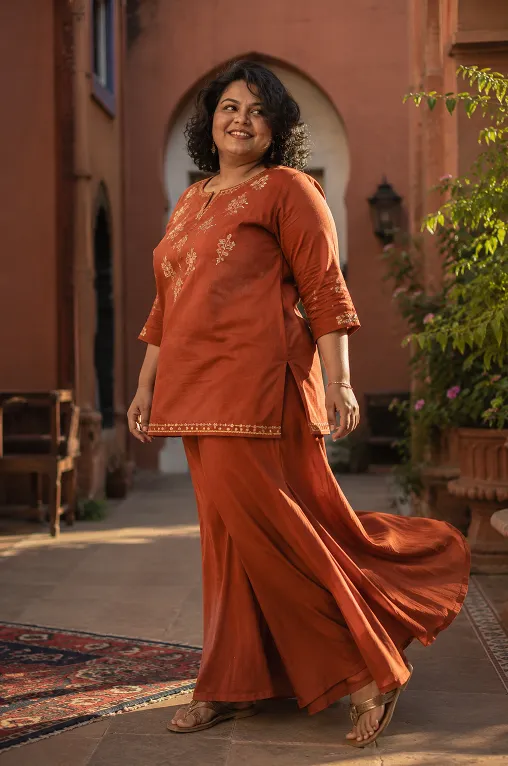
Co-ord sets solve this because each piece is sized on its own measurement instead of a fixed ratio. You buy the kurta that fits your shoulder and bust, and the bottom that fits your waist and hip, without either half apologising for the other. This is not a styling trend. It is a sizing fix that happens to look good too.
The Fabric Detail That Changes How Two “Same Size” Pieces Fit
Here is something almost nobody mentions when they talk about ethnic wear sizing. Heavy embellishment does not just add weight, it removes stretch.
Stitching behind zari work, sequins or dense embroidery locks the base fabric in place. A georgette blouse with a plain back gives a little at the seams when you raise your arms. The same georgette blouse with embroidery covering the back panel will not give at all, even though the fabric itself has not changed.
This is why two blouses labelled the same size from the same store can fit completely differently. Run your hand across a heavily embroidered panel and you can feel it, the fabric underneath sits stiffer and thicker than the plain georgette right next to it. Georgette on its own has more body than chiffon, which is why it holds a pleat better when you are walking, but embroidery changes that behaviour entirely.
Banarasi silk brings its own honesty to this conversation. It is heavier than most women expect, and if you are wearing it through a full day wedding function, the weight of the pallu on your shoulder starts to show by evening. Add embellishment to a silk this heavy and the reduced stretch becomes even more noticeable by the time you are dancing at the sangeet.
Cuts and Silhouettes That Actually Flatter Curves
This section is about flattering ethnic wear cuts, not about hiding your body. A-line kurtas and anarkalis work well for plus size bodies because the flare starts below the fullest part of the body instead of clinging to it. Straight cut kurtas can work too, but only if the shoulder and bust fit properly first, otherwise the straight line simply outlines every place it does not fit.
Neckline does more work here than most women give it credit for. A V-neck or sweetheart neckline draws the eye upward and slightly lengthens the neck, which balances out a fuller upper body far better than a round neck sitting flat against the collarbone.
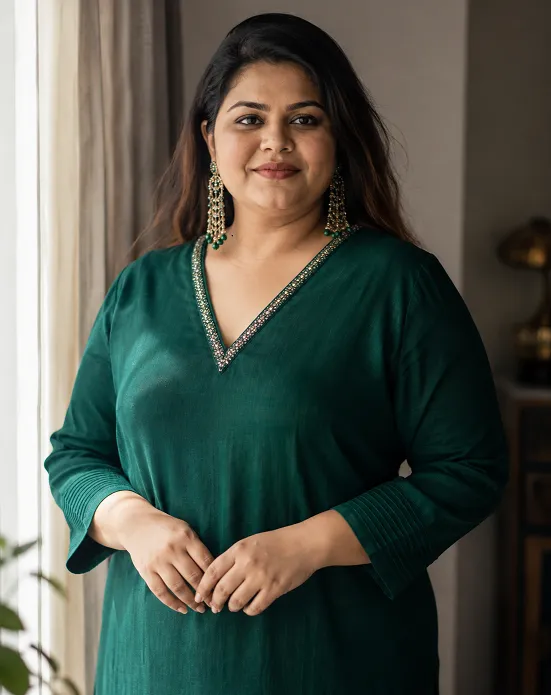
Plus size is not one body shape. A pear shaped plus size body needs different cuts than an apple or hourglass shaped one, so a blanket tip like avoid empire waists does not work for everyone.
If you are pear shaped and carry more weight below the waist, a straight or A-line kurti in a slightly longer length balances the proportion better than a fitted one that stops at the hip. For a curvier, more hourglass plus size frame, structured lehengas built for a curvy body type do the opposite job, they hold the shape instead of hiding it.
Everyone says darker colours slim you down. Honestly, a well fitted bright kurta in a colour you actually love does more for how you carry yourself through a Navratri night than another safe black one ever will.
Indian design is slowly catching up to this. Designer Wendell Rodricks built an entire plus size label around this exact idea, using drapes and bright colour to work with curves instead of against them. That shift, fabric and cut working with the body rather than disguising it, is exactly the direction ethnic wear for plus size women needs to keep moving in.
What to Check Before You Buy
Before you buy, run your hand over the embellished areas and gently stretch the fabric next to a plain section of the same piece. If the embroidered part barely moves while the plain part gives easily, size up in anything with heavy work, even if the plain version in the same size fits you perfectly.
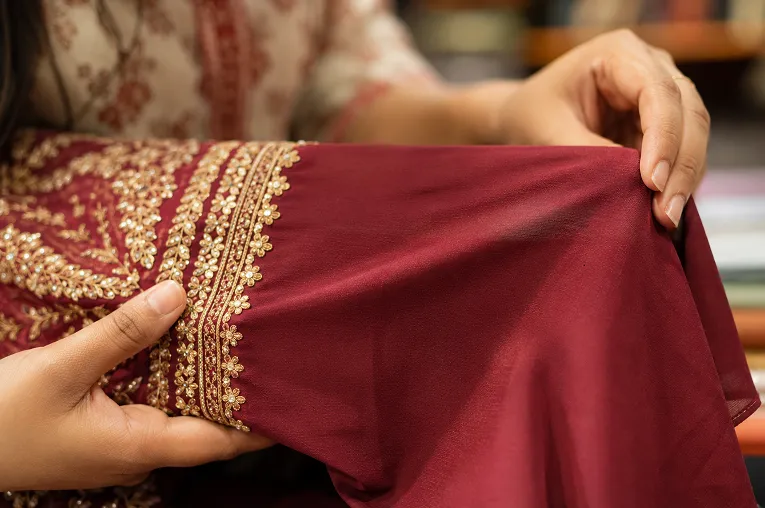
Two pieces tagged the same size can behave completely differently once zari or sequins are stitched in. This advice comes from actually making these clothes. Ethora manufactures sarees, salwar kameez, kurtas and lehenga choli directly at our unit in Surat, and we source everything else from Surat’s local textile market, so this comes from handling the fabric, not guessing from a size chart.
Getting the Fit Right, Every Time
Fit is not about finding the perfect number on a tag. It is about working through the order that actually matters, shoulder first, then bust, waist and length, and paying attention to how embellishment quietly changes what that number means once you actually try the piece on.
There is more on the Ethora blog on ethnic wear for plus size women and body specific styling, if you want to go deeper. Our store is launching soon, with pieces made directly at our Surat unit and sourced from Surat’s own textile market, so what you buy comes from people who handle this fabric every day.
Frequently Asked Questions (FAQs)
How do I know my correct size when shopping for ethnic wear for plus size women?
Start with your shoulder measurement, not your bust. Take it across the back from one shoulder point to the other, then match that number to the brand’s size chart before you look at anything else. Bust, waist and length can be adjusted by a tailor. Shoulder width mostly cannot.
Are co-ord sets better than one piece suits for plus size bodies?
Co-ord sets often fit better because you are sizing two separate pieces to two separate measurements instead of one number trying to cover your whole body. This helps most if your upper body and lower body do not follow the exact ratio most size charts assume.
Why do two kurtis in the same size fit differently?
The most common reason is embellishment. Embroidery, sequins and zari work are stitched through the base fabric, which restricts how much it can stretch or give. A plain cotton kurti in size XL will almost always feel roomier than an embroidered one in the same labelled size.
Where can I buy good quality ethnic wear online without guessing on fit?
Look for sellers who can actually tell you how a fabric behaves, not just its name on a label. Ethora manufactures sarees, salwar kameez, kurtas and lehenga choli at our own unit in Surat and sources everything else directly from Surat’s textile market, so the fabric knowledge behind each size chart comes from people who handle the cloth themselves, not just resell it.
Does chiffon or georgette work better for plus size ethnic wear?
Georgette generally works better for plus size bodies because it has more weight and holds its shape without clinging. Chiffon is lighter and softer against the skin, but it can cling in humidity and show every line underneath unless it is lined properly. Georgette holds pleats and structure through a long function in a way chiffon usually cannot.
Finding your correct fit should not mean settling for whatever a size chart says comes closest. Ethora makes its sarees, salwar kameez, kurtas and lehenga choli at its own manufacturing unit in Surat, and sources everything else directly from Surat’s textile market, so every size recommendation here comes from people who actually handle the fabric. Our store is launching soon, built around exactly this kind of fit-first thinking.